
[AI DAILY RUNDOWN] OpenAI Drops GPT-5.6 and GPT-Live, Grok 4.5 Launches at Half-Price, and Bezos Raises $10B for Blue Origin (July 9, 2026)
🎧 Listen ADS-FREE: https://podcasts.apple.com/us/channel/djamgamind/id6760446113
Visit our Research Hub at https://djamgamind.com/pdfs
Summary: In today’s briefing, we analyze “The Symmetric Escalation and the Architecture of Full-Duplex Intelligence.” We deconstruct OpenAI’s double rollout of the GPT-5.6 model family and the full-duplex GPT-Live-1 conversational system. We examine SpaceXAI’s aggressive market move, launching the Cursor-optimized Grok 4.5 model to undercut frontier token pricing. We break down Meta’s entry into the public developer ecosystem with Muse Spark 1.1, Jeff Bezos’s historic $10 billion outside capital raise for Blue Origin, and Mistral AI’s first vision-only robotics navigation model.
Important Topics:
-
OpenAI Launches GPT-5.6 Series: OpenAI releases its next-generation model tiers: the flagship Sol ranks second on global intelligence indices; Terra delivers near-Opus level reasoning at half the token cost; and Luna ties with open-source options. The update unifies the desktop interface and deprecates the legacy agentic browser.
-
ChatGPT Upgrades to Full-Duplex Voice: OpenAI drops GPT-Live-1 and GPT-Live-1 mini, replacing Advanced Voice Mode with an architecture capable of processing inputs and outputs continuously, enabling natural interruptions and real-time translation card synchronization.
-
SpaceXAI and Cursor Release Grok 4.5: Built jointly after a $60B merger, Grok 4.5 enters the market at $2 per million input tokens and $6 per million output tokens-claiming a 4x token efficiency gain over Claude Opus 4.8 while streaming at 80 tokens per second.
-
Meta Enters AI Coding Market: Meta Superintelligence Labs head Alexandr Wang launches Muse Spark 1.1 in public preview, pricing the code-generation model at an aggressive $1.25 input and $4.25 output per million tokens.
-
Blue Origin Seeks $10B Outside Funding: Jeff Bezos opens his rocket company’s cap table to outside capital for the first time, planning a $10 billion Series A raise at a $130 billion valuation managed by Coatue Management.
-
Mistral AI Debuts Robostral Navigate: Mistral launches an 8-billion parameter robotics model that guides legged, wheeled, and aerial hardware through unmapped environments using a single RGB camera and text prompts, hitting a 76.6% success rate on spatial benchmarks.
-
ByteDance Drops Seedream 5.0 Pro: The new image foundation model introduces native multilingual processing across 10 languages and “precision layers” allowing designers to isolate, edit, and reconstruct generated graphics.
-
Paradigm Pivots $1.2B Fund to AI and Robotics: Moving away from its historical crypto-only focus, venture capital firm Paradigm announces its latest $1.2 billion fund will actively target physical AI, robotics, and defense sectors.
-
NHTSA Issues Autonomous Vehicle Warning: US road safety regulators issue an administrative warning ordering autonomous driving firms to fix software deficiencies after self-driving vehicles repeatedly obstructed emergency first responders.
-
Academic Exam Scandal Exposes Mass AI Cheating: A Brown University economics professor documents systemic AI cheating after a take-home exam average hit 96 out of 100, but plummeted to 48 once an in-person proctored final was enforced.
-
Cognition Deploys Devin SWE-1.7 Harness: Built on top of China’s open-source Kimi K2.7 architecture, the new software development engine matches frontier proprietary benchmarks at a fraction of closed-source costs.
🔗 RESOURCES
-
AI Learning App Recommendation: AI & ML Tutor PRO https://apps.apple.com/ca/app/ai-ml-tutor-pro/id1610947211
-
DJAMGATECH: Carrer Booster - Master AWS, Azure, AI & GCP Certifications | https://apps.apple.com/ca/app/djamgatech-ai-cert-exams-prep/id1560083470
-
DJAMGAMIND Bedtime Adventures:
https://wonderland-bedtime-stories.web.app/
⚗️ PRODUCTION NOTE: We Practice What We Preach.
AI Unraveled is produced using a hybrid “Human-in-the-Loop” workflow.
OpenAI releases GPT-5.6:
As expected, OpenAI’s new family of general AI models was released today. The largest, GPT-5.6 Sol, ranks second on the Artificial Analysis ‘intelligence index,’ after Anthropic’s Fable 5 model. GPT-5.6 Terra (the middle child of the new group) ranks right behind Claude Opus 4.8 but ahead of GPT-5.5. Finally, GPT-5.6 Luna (the smallest of the new models) ties with the popular GLM-5.2 model. OpenAI also killed off its agentic browser, unified its desktop experience, and said that its new models are more token-efficient than their predecessors.
SpaceX releases Grok 4.5:
Not content to sit back and rent out compute, SpaceX’s AI arm and Cursor, which the space launch company is buying, dropped Grok 4.5 yesterday. The new release pushed SpaceX up from the basement in model intelligence rankings close to the top, nearly matching GPT-5.5 on AA’s leaderboard and offering an attractive price-to-intelligence mix. Early usage data implies strong market demand for the new Grok offering.
Meta releases Muse Spark 1.1:
Meta released a new version of its Muse Spark line of AI models and began offering Muse models via a newly released developer API (still in beta). Meta also put out a new image AI model this week (Muse Image). Muse Spark 1.1 only costs $1.25 per million input tokens and $4.25 per million output tokens. For its ~Opus-level intelligence, that’s cheap, and less than what Grok 4.5 costs. Clearly, after a brief period of stasis, the world’s major AI labs are back to fighting one another for AI model dominance and prominence. Great news for startups, who have never had so many strong AI models to choose from, each built and released with an eye towards affordability.
SpaceXAI launches Grok 4.5 LINK
-
SpaceXAI has released Grok 4.5, its first model since going public, and set its price at half that of rival models by charging $2 per million input tokens and $6 per million output tokens.
-
The company says Grok 4.5 has “twice greater token efficiency” than other leading models, and can handle coding, app-building, office work, research, and writing, though its benchmarks fell just short of best-in-class.
-
Elon Musk called Grok 4.5 “roughly comparable to Opus 4.7, but much faster,” noting that Anthropic’s Opus 4.7 costs $5 per million input tokens and $25 per million output tokens.
SpaceXAI and Cursor release the strongest Grok yet
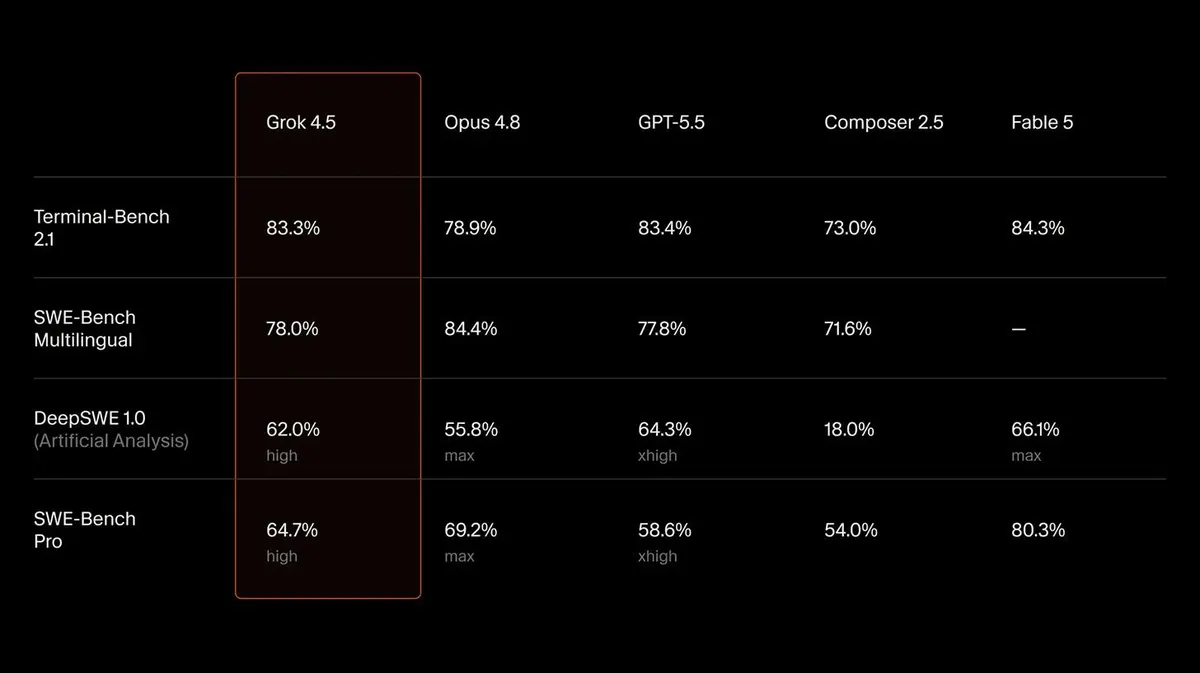
Image source: Cursor
The Rundown: SpaceXAI just launched Grok 4.5, the first model it built jointly with Cursor after its $60B acquisition, featuring strong benchmarks, speed, and efficiency gains that undercut frontier pricing and vault Grok back into the AI conversation.
The details:
-
4.5 features strong performance on coding, agentic, and knowledge work tasks, with benchmarks in similar ranges to Claude Opus 4.8 and GPT 5.5.
-
The model runs at 80 tokens per second, a speed that rivals flash models, while claiming a 4x efficiency gain over models like Opus 4.8.
-
Pricing lands at $2/$6 per million input/output tokens, versus $5/$25 for Opus 4.8, with usage temporarily free inside Cursor and Grok Build.
-
Elon Musk pitched the release on X as “an Opus-class model, but faster, more token-efficient and lower cost”, with an even bigger model coming next month.
Why it matters: Grok has historically been somewhat of a punchline compared to the frontier, but 4.5 came to play - with very impressive performance at this speed, price, and efficiency. With Cursor’s Composer models also continuing to move up the coding ladder, the gains from the $60B acquisition look to be flowing in both directions.
Meta enters the AI coding race LINK
-
Meta is challenging OpenAI and Anthropic in the AI coding market with Muse Spark 1.1, which AI chief Alexandr Wang called the company’s strongest model yet for agentic and coding work.
-
The new model’s API opens through a developer portal as a public preview, where users can join a waitlist, though Meta is limiting access to its own properties rather than third-party platforms like OpenRouter.
-
Every new API account starts with $20 in free credits, after which Meta charges $1.25 per million tokens of input and $4.25 per million tokens of output, pricing Wang described as aggressive.
ChatGPT can now listen and talk at the same time LINK
-
OpenAI has released two conversational models, GPT-Live-1 and GPT-Live-1 mini, that can speak and listen at the same time, letting users interrupt naturally and enabling features like live translation.
-
ChatGPT’s current Advanced Voice Mode is being replaced by GPT-Live-1 mini by default, while paid users get the larger GPT-Live-1 model, and both send queries to text models like GPT-5.5 for search and reasoning.
-
The new voice mode is built for longer conversations, can stay silent to absorb context until called upon, and includes safeguards giving age-appropriate responses to teens and resources for topics like self-harm.
ChatGPT’s voice gets a major upgrade with GPT-Live

Image source: OpenAI
The Rundown: OpenAI just rolled out GPT-Live, its next-gen voice model that makes talking to AI “feel much more like having a real conversation”, featuring an architecture that removes the clunky nature of previous experiences.
The details:
-
Live is a “full-duplex” architecture, processing inputs continuously instead of old systems that strung together models and used turn-based conversation.
-
When a question needs more reasoning, Live can delegate to a stronger model for the background work, and also surface visual cards alongside answers.
-
The ability to listen, process, and output simultaneously leads to less clunky, awkward pauses, while enabling abilities like real-time translation.
-
In OAI’s tests, users picked GPT-Live over the old Advanced Voice Mode in around 3 of 4 head-to-head chats, with expert science scores nearly doubling.
Why it matters: Sam Altman has often talked about his voice vision from the movie ‘Her’, but previous models hit snags that removed the natural feel. Live’s ability to talk, reason, and listen at the same time gives Voice the futuristic feel it deserves, especially at a time when more users than ever are leaning towards speaking over typing.
Brown professor’s chart exposes mass AI cheating in exams LINK
-
A Brown University economics professor, Roberto Serrano, believes most of his class cheated with AI after his take-home midterm averaged 96 out of 100, then dropped to 48 on an in-person final.
-
Serrano offered take-home exams after a campus shooting left students anxious, but 40 of the 86 students scored a perfect 100 on a midterm whose historical average sits between 65 and 80.
-
When he announced the in-person final, 18 students dropped the course and nine skipped the exam, and 22 of those 27 had earned perfect midterm scores, leaving Serrano to count at least 50 cheaters.
US warns self-driving cars are a danger to the public LINK
-
America’s top road safety regulator, the NHTSA, has told self-driving car companies to quickly fix what it calls a “clear pattern” of autonomous vehicles interfering with police, firefighters, and other first responders at emergency scenes.
-
In a letter to the industry, NHTSA chief Jonathan Morrison described autonomous vehicles blocking ambulances and firefighters and failing to respond to flashing lights, flares, smoke, fire, and traffic cones, calling this a “functional insufficiency.”
-
The agency plans to meet with vehicle developers by month’s end, and pointed to a late-May Dallas incident where a Waymo reportedly obstructed a fire truck heading to an apartment blaze.
Mistral’s first robotics model steers robots with one camera LINK
-
Mistral AI has launched Robostral Navigate, its first robotics navigation model, which can guide robots through complex, changing environments using only a single RGB camera and simple language instructions.
-
The 8bn parameter model reaches a 76.6% success rate on the R2R-CE benchmark, which measures how well an agent follows instructions in environments not seen during training, beating models that use extra sensors like LiDAR.
-
Built in-house and trained on simulated data, the model uses a pointing-based method that predicts targets as image coordinates, and has been tested on wheeled, legged, and aerial robot platforms.
ByteDance targets design work with Seedream 5.0
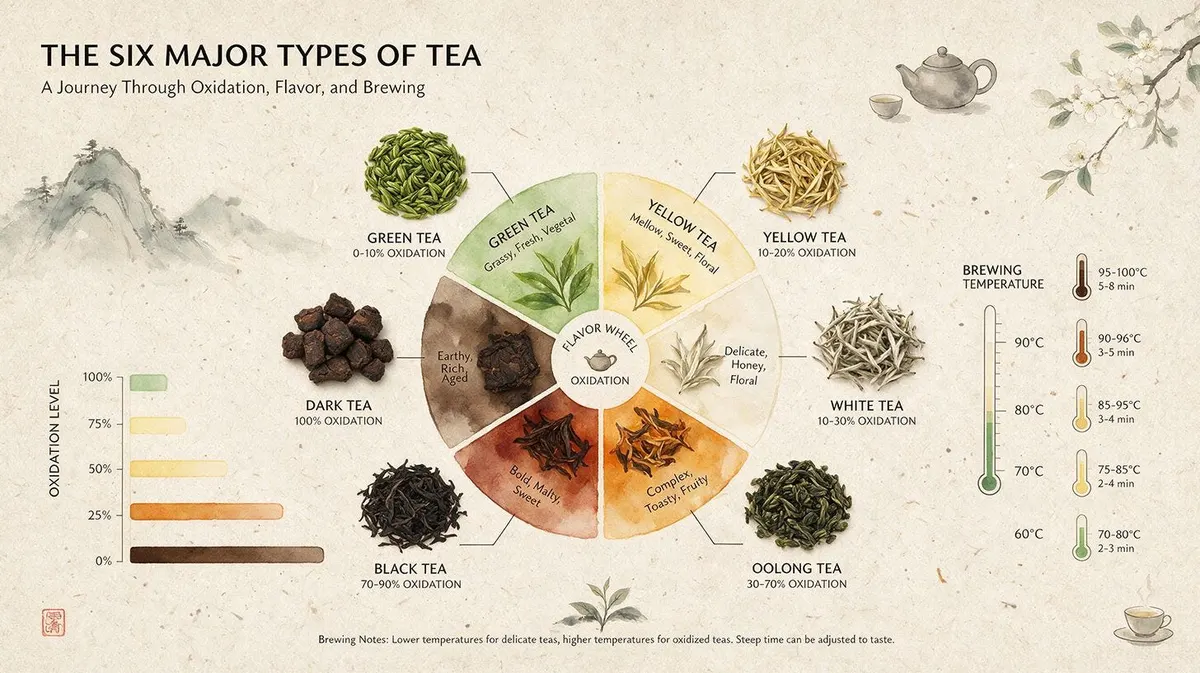
Image source: ByteDance
The Rundown: ByteDance rolled out Seedream 5.0 Pro, a new image model that claims to go beyond generation to “understand design” with powerful editing features, and the first release that looks to near the frontier level held by OpenAI’s Images 2.0.
The details:
-
5.0 Pro features improvements in text rendering, structure, alignment, and other design areas, resulting in strong infographics and professional work.
-
The model includes ‘precision editing’ with layer separation for editable designs, plus the option to draw, replace, or combine images.
-
Seedream 5.0 Pro can also handle multilingual inputs and outputs, able to work natively across over 10 languages.
-
The release comes ahead of ByteDance’s anticipated Seedance 2.5 video model expected this month, with 2.0 still near the top of leaderboards.
Why it matters: The biggest upgrade in next-gen image models has been the tool layer getting eaten, with more agentic, proactive systems absorbing the back-and-forth process that happens after a first generation. Models like 5.0 are now providing the type of control and creative partnership that really starts to change user workflows.
Blue Origin taking first outside funding:
The rocket maker from Amazon icon Jeff Bezos plans to raise a fresh $10 billion in funds at a $130 billion valuation. This is the very first outside fundraising in the company’s history, though Bezos still plans to contribute $2 billion of his own money, raised by selling Amazon stock. Hedge fund Coatue Management is putting up an additional $4 billion. Blue Origin, of course, competes directly with Elon Musk’s newly-public SpaceX (now SpaceXAI) in not just making rockets and lunar landers but also hawking satellite internet service.
Paradigm pivots to AI and robots:
Just over 3 years after JCal famously urged crypto companies to “pivot to AI,” venture firm Paradigm has finally taken his advice to heart. While Paradigm has historically (with some exceptions) focused on crypto companies, their third and latest $1.2 billion fund will feature bets outside that sector, particularly in the venture-friendly fields of AI and robotics. The firm has about $11.9 billion in AUM as of the end of 2025, not including investments from its most recent fund (which include delivery startup Zipline and space defense concern True Anomaly). Their biggest crypto-based success story to date has been breakout prediction market Kalshi, which is now valued at a hefty $22 billion.
What Else Happened in AI on July 09th 2026?
OpenAI’s chief futurist Joshua Achiam announced he is leaving the company after a nine-year stretch, calling it “a decade where centuries happened.”
Cognition released SWE-1.7, an in-house model for its Devin agent built on China’s open-source Kimi K2.7, nearing GPT-5.5 and Opus-level scores while costing far less.
MiniMax is reportedly targeting a Q3 release for a 2.7T-parameter model, which would land 6x bigger than the lab’s flagship and larger than any current open model.
Prime Intellect secured $130M in Series A funding, with the open-source training startup crossing $100M in annualized sales in its first year.
Udemy co-founder Eren Bali’s Monogram emerged from stealth with a $40M seed round, pitching an iOS app that swaps text walls for instantly generated interfaces.