
[AI DAILY NEWS RUNDOWN] White House Delays GPT-5.6, OpenAI Unveils Custom AI Chip, Meta Launches New Smart Glasses, and the AI Infrastructure Race Accelerates | June 26, 2026

🎧 Listen ADS-FREE: https://podcasts.apple.com/us/channel/djamgamind/id6760446113
Visit our Research Hub at https://djamgamind.com/pdfs
Artificial intelligence entered another defining chapter on June 26, 2026, as the U.S. government expanded its oversight of frontier AI models by requesting OpenAI to limit the initial release of GPT-5.6 to government-approved partners. The move follows similar restrictions placed on Anthropic’s Fable 5 and Mythos models, reinforcing a new era in which frontier AI deployment is increasingly shaped by national security policy.
Meanwhile, OpenAI unveiled Jalapeño, its first custom AI inference chip developed with Broadcom in just nine months. Designed to power ChatGPT, Codex, and future AI agents, the chip promises industry-leading performance per watt and represents OpenAI’s first major step toward controlling its own AI hardware stack.
Anthropic showed signs of progress in negotiations with the White House over restoring public access to Fable 5, while Meta introduced its first self-branded AI smart glasses, broadening the consumer AI wearables market. IBM announced the world’s first sub-1 nanometer chip architecture, Tesla partnered on what could become America’s largest virtual power plant for AI data centers, and OpenAI’s IPO ambitions were reportedly delayed as Sam Altman holds firm on a $1 trillion valuation target.
Today’s developments confirm that the AI race is expanding beyond models into semiconductors, energy, infrastructure, regulation, and consumer hardware.
📌 Topics Covered
AI Policy & Regulation
-
White House limits GPT-5.6 rollout
-
Government approval for frontier AI releases
-
Proposed AI Incident Reporting Act
-
Anthropic’s negotiations with the White House
-
Lawsuit challenging the Fable 5 restrictions
AI Hardware
-
OpenAI unveils Jalapeño custom AI chip
-
IBM introduces sub-1nm chip technology
-
Apple raises MacBook and iPad prices due to AI memory demand
-
Nvidia alternatives and custom silicon
AI Infrastructure
-
Tesla, Sunrun, and Renew Home build a 16 GW virtual power plant
-
SpaceX plans Starlink Mobile
-
OpenAI targets 10 GW of compute by 2029
AI Business
-
OpenAI IPO delayed over $1 trillion valuation goal
-
Anthropic accuses Alibaba of large-scale model distillation
-
Google talent continues moving to Anthropic
Consumer AI
-
Meta launches self-branded AI smart glasses
-
Claude Tag brings AI teammates to Slack
-
Meta develops Arena prediction markets
AI for Science
-
Proto programming language for AI-driven biology
-
AI pipelines for DNA, RNA, and protein research
🔗 RESOURCES
-
AI Learning App Recommendation: AI & ML Tutor PRO https://apps.apple.com/ca/app/ai-ml-tutor-pro/id1610947211
-
DJAMGATECH: Carrer Booster - Master AWS, Azure, AI & GCP Certifications | https://apps.apple.com/ca/app/djamgatech-ai-cert-exams-prep/id1560083470
-
Read Aloud wonderland bedtime Adventures:
https://wonderland-bedtime-stories.web.app/
⚗️ PRODUCTION NOTE: We Practice What We Preach.
AI Unraveled is produced using a hybrid “Human-in-the-Loop” workflow.
The White House limits GPT-5.6 release

Image source: Getty / Images 2.0
The Rundown: The Trump administration just asked OpenAI to limit the release of GPT-5.6 to select government-approved partners before any wider launch - citing security concerns stemming from the model’s capabilities, The Information reports.
The details:
-
Under the staggered rollout, OpenAI will preview the model to a small group of partners, with the government approving access “customer by customer.”
-
The intervention came as 5.6 is considered to have the same capability threshold as Mythos, with the government wanting to test it for safeguards.
-
In a memo, CEO Sam Altman told employees that this was the best path to getting 5.6 released, with a general release likely “a couple of weeks later.”
-
He also said that OAI has made it clear to the WH that this is not the preferred long-term model, and it will work toward a more sustainable release approach.
Why it matters: First, it was Fable 5 and Mythos 5. Now, it’s GPT-5.6. The pattern is clear: the U.S. is actively deciding when and how frontier AI reaches the public. The framing is security, not restriction, but the precedent is set. As models approach Mythos-level, government sign-off may become a new step before wider release.
OpenAI designs its first custom AI chip

Image source: OpenAI
The Rundown: OpenAI just shared new details on Jalapeño, the company’s first custom chip co-built with Broadcom in just nine months to run ChatGPT, Codex, and future agents more efficiently while reducing reliance on Nvidia.
The details:
-
OAI says Jalapeño went from design to factory-ready in nine months, with its own models helping in design and optimization.
-
Jalapeño is an ASIC chip that handles inference for running finished models for users, different from the chips used in training.
-
OpenAI also revealed that Jalapeño has delivered “performance per watt substantially better than current state-of-the-art” in testing.
-
OpenAI is pushing to power 10 GW of compute with custom chips by 2029, with Nvidia still anchoring model training.
Why it matters: OAI believes the buildout is “the fastest ASIC development cycle ever achieved”, and that’s only going to accelerate as its models become a bigger part of the process. Owning the silicon, models, and products at once lets OAI tune each layer for the other, unlocking cost and speed efficiency gains across the board.
The Fable 5 comeback starts taking shape

Image source: Images 2.0 / The Rundown
The Rundown: Anthropic’s Fable and Mythos remain offline in compliance with the U.S. order, but there’s smoke surrounding their path back - with Claude Code strings, White House talks, and a lawsuit hinting that the freeze may be starting to thaw.
The details:
-
A new Claude Code update log includes references to Fable usage and the removal of ‘purchased separately’, pointing to potential usage changes.
-
WIRED reported that the Trump admin is “happier” in talks with Anthropic, now dealing with co-founder Tom Brown instead of Dario Amodei in meetings.
-
Legal-tech firm Legion filed the first lawsuit against the order, calling it “unlawful” and arguing “the government’s real motive was unlawful retaliation.”
-
Reps. Sam Liccardo, Jay Obernolte, and Ted Lieu gave Commerce until June 26 to lay out how and when the public could get the model back.
Why it matters: Where there is smoke, there is fire, and hopefully that means Fable’s return to the frontier is coming soon after nearly a month on ice. It sounds like removing Anthropic’s outspoken CEO from talks is working, given this quote from WIRED: “Tom Brown is not being a weirdo like Dario and can actually engage”.
Altman won’t go public for less than $1 trillion LINK
-
OpenAI is leaning toward pushing its IPO to 2027 because CEO Sam Altman insists on a $1 trillion valuation, up from the company’s last private figure of $730 billion, which advisors say is the main reason for the delay.
-
Advisors gave Altman two choices: go public in 2027 at the trillion-dollar price, or move faster at a lower valuation, but he rejected anything below a trillion as a “nonstarter,” even as choppy tech markets worry investors.
-
The delay hit SoftBank hard, sending its stock down 13 percent, its steepest drop since August 2024, since the Japanese investor’s stake in OpenAI is set to reach about $65 billion by October.
SpaceX reportedly plans a Starlink mobile service LINK
-
SpaceX is reportedly planning a Starlink-branded retail mobile service for US consumers, a move that would put the company in direct competition with AT&T, Verizon, and T-Mobile.
-
SpaceX President Gwynne Shotwell told investors during an IPO roadshow that the company is considering the service, and could even build its own wireless network on the ground to support it.
-
The plan follows the FCC’s approval last month of SpaceX’s $17 billion purchase of 65 MHz of wireless spectrum from EchoStar, plus earlier trademark filings for “Starlink Mobile” and “Powered by Starlink.”
White House asks OpenAI to delay GPT-5.6 LINK
-
OpenAI plans to release its new model, GPT 5.6, only to a small group of close partners rather than the public, after the Trump administration told the company to limit access, according to The Information.
-
CEO Sam Altman reportedly told staff the government would be “approving access customer by customer” during a preview period, and OpenAI hopes to follow with a broader release a “couple of weeks later” if it goes well.
-
The Office of the National Cyber Director and the Office of Science and Technology Policy reportedly asked for the limited release, and OpenAI staffers worked closely with the government on the upcoming launch.
New US bill would force AI risk reporting LINK
-
A new US bill called the AI Incident Reporting Act would require developers of high-risk “covered models” to report major safety and security incidents to the Commerce Department, creating a federal oversight system for advanced AI.
-
Developers would have to file an initial report within seven days of learning of an incident, and for imminent threats, the Commerce Department must alert congressional leaders within 48 hours of getting it.
-
Reportable incidents include models that evade human oversight, resist shutdown, or enable cyberattacks and chemical weapons, while violators face civil penalties of up to $2 million, with each day counted as a separate violation.
Apple hikes MacBook and iPad prices, warns of more LINK
-
Apple raised prices on multiple MacBook and iPad models after saying surging memory and storage costs have made it impossible to keep prices unchanged.
-
The company blamed the AI boom for creating unprecedented demand for memory chips, causing component prices to soar and forcing Apple to pass some of those higher costs on to consumers.
-
Apple’s stock fell about 5% following the announcement, and the company warned that additional price increases across other products could happen if component costs remain elevated.
Anthropic accuses Alibaba of biggest-ever Claude theft LINK
-
Anthropic accused Alibaba of carrying out its largest known AI “distillation” attack, alleging the company used around 25,000 fraudulent accounts to generate 28.8 million interactions with its AI models.
-
The AI startup says the campaign was an attempt to illegally extract its technology and has urged the U.S. government and the AI industry to work together to better protect American AI capabilities.
-
The allegations come as AI security and export controls become a bigger focus, with Anthropic also facing recent U.S. government restrictions on access to some of its latest AI models.
IBM claims world’s first sub-1 nanometer chip LINK
-
IBM unveiled the world’s first sub-1 nanometer chip technology, featuring a new 0.7 nm “nanostack” architecture that nearly doubles transistor density compared to its previous 2 nm chip.
-
The new design is expected to deliver up to 50% better performance or 70% greater energy efficiency, making it well suited for AI, cloud computing, and next-generation electronic devices.
-
IBM believes the breakthrough can extend chip scaling for at least another decade, with commercial production of the technology potentially beginning within the next five years.
Tesla teams up to build largest US power plant LINK
-
Sunrun, Renew Home, and Tesla announced a partnership to combine millions of home batteries, smart thermostats, and EV systems into a virtual power plant capable of delivering more than 16 gigawatts of flexible electricity.
-
The companies say the system can help power AI data centers and other large electricity users within months, reducing strain on the grid without requiring major new infrastructure.
-
By using existing home energy devices more efficiently, the partnership aims to lower electricity costs for households, improve grid reliability, and accelerate the rollout of new AI and data center capacity.
AI researchers continue to leave Google for its rivals LINK
-
Two more researchers who helped build Google’s Gemini model, Jonas Adler and Alexander Pritzel, are leaving the company for Anthropic, according to a Bloomberg report on their departures.
-
These exits add to a worrying pattern at Google, which last week saw researcher Noam Shazeer leave for OpenAI and DeepMind Director John Jumper announce his own move to Anthropic.
-
The article suggests the trend may keep going as OpenAI and Anthropic prepare to go public, giving both companies a strong chance to recruit top AI talent by offering equity.
Anthropic puts Claude inside your Slack channels LINK
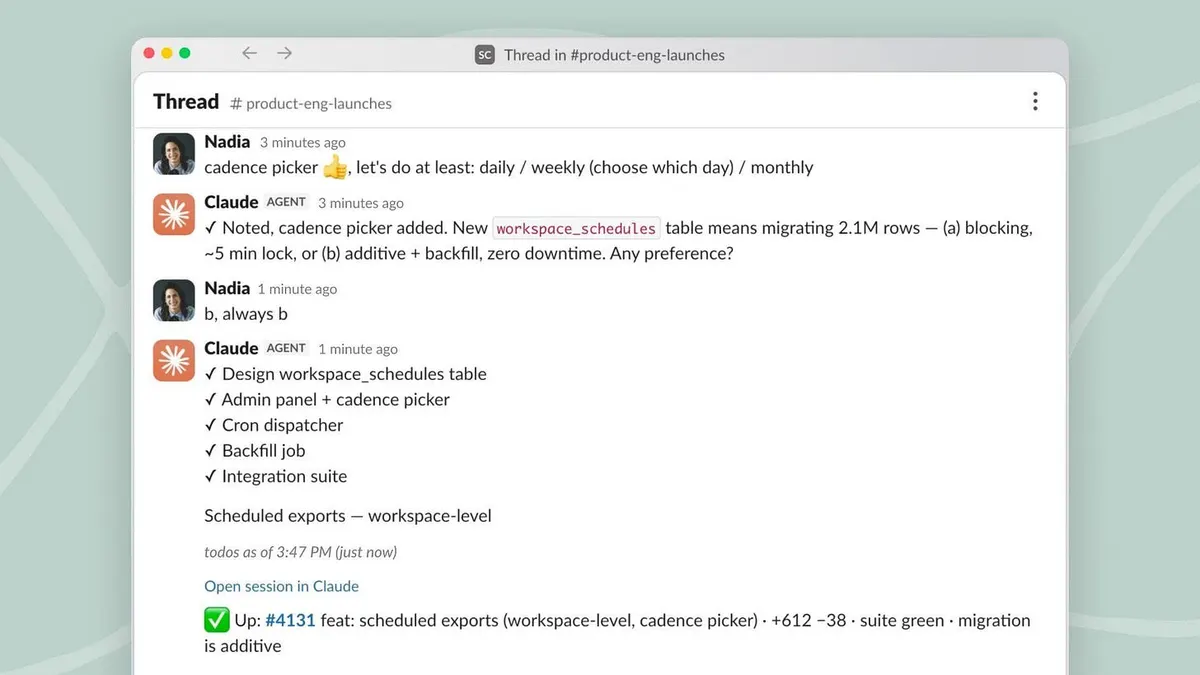
-
Anthropic has launched Claude Tag, a product that puts Claude directly inside Slack channels as a permanent team member that gathers knowledge over time, works on its own schedule, and can act without being tagged first.
-
Available in beta for Enterprise and Team plans, Claude Tag gives each channel one shared Claude with its own identity and accounts, so any team member can steer, correct, and build on a task in real time.
-
Administrators define what Claude can access at the workspace level through “agent identity,” set token spending ceilings per channel, and keep shared channels from becoming a backdoor into anyone’s private documents since Claude uses its own accounts.
Meta is building a prediction markets app LINK
-
Mark Zuckerberg has told a small Meta team to build a smartphone app called Arena that would compete with prediction market platforms Polymarket and Kalshi, operating separately from Facebook and Instagram, the New York Times reported Tuesday.
-
Arena would start with a video-game-style points system instead of real-money wagers, which sidesteps oversight from the Commodity Futures Trading Commission, though Meta has not ruled out adding real-money betting later.
-
Meta could steer its roughly 3 billion monthly active users toward Arena, a scale that dwarfs existing platforms, and the news sent DraftKings down more than 2 percent while Flutter Entertainment and Robinhood also fell.
SpaceX secretly launches its new Starfall capsule LINK
-
SpaceX quietly flew its new Starfall return capsule for the first time on June 23, launching aboard a Falcon 9 from Space Launch Complex 40 at Cape Canaveral and cutting the webcast about 10 minutes after liftoff.
-
According to an FAA assessment, the disk-shaped, uncrewed Starfall stands 2.5 feet tall, weighs roughly 4,600 pounds, carries 2,200 pounds of payload, and uses a detachable carbon-fiber heat shield filled with compressed nitrogen gas.
-
The capsule carries no propulsion and cannot deorbit itself, and SpaceX is targeting a Pacific Ocean splashdown about 700 nautical miles off the West Coast, though it has not said how long the vehicle will stay in orbit.
Alibaba sues Pentagon to escape military blacklist LINK
-
Alibaba has filed a lawsuit against the US Department of Defense to be taken off the Pentagon’s 1260H list, which names companies allegedly tied to the Chinese People’s Liberation Army.
-
The Defense Department labeled Alibaba a “military-civil fusion contributor to the Chinese defense industrial base” over its ties to Beijing regulators, while the updated list also includes internet services provider Baidu.
-
Being on the list bars the Defense Department from doing business with Alibaba through third parties, and the company says it presented evidence it does not back the Chinese military but got no response.
Meta doubles down on AI smart glasses

Image source: Meta
The Rundown: Meta is doubling down on the AI wearable space with the launch of “Meta Glasses,” a new $299 line of smart glasses built in partnership with EssilorLuxottica and powered by its Muse Spark AI out of the box.
The details:
-
Meta Glasses come in three designs - Meta Adventurer, Meta Fury, and Meta Glasses by Kylie - spanning 26 styles across colors, lenses, and frames.
-
The Kylie variant, at $399, is designed to be a fan-favorite with an embedded gem, a custom chime, and the option to use Kylie Jenner’s voice for Meta AI.
-
The glasses use Meta’s Muse Spark AI, promising smarter answers, better visual understanding, turn-by-turn navigation, and live translation.
-
While the hardware remains the same as previous models, the price is the highlight, with Meta ditching the Ray-Ban/Oakley branding for affordability.
Why it matters: Meta’s AI glasses play has been far from perfect, but the company still holds ~80% of the market. With this release, it is implementing a two-tier strategy - Ray-Ban for fashion credibility, Meta Glasses for price accessibility - that aims to close all remaining gaps and further increase the lead over rivals, especially Google.
Programming language for AI-driven biology
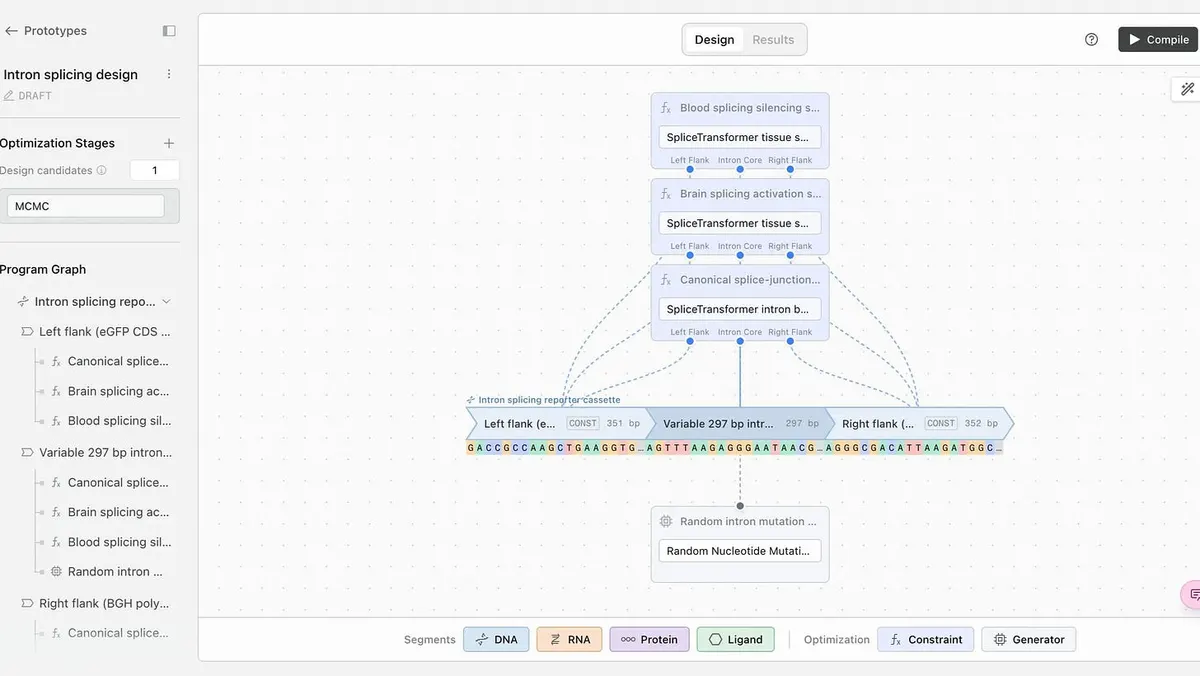
Image Source: Laboratory of Evolutionary Design
The Rundown: Brian Hie - the Stanford professor behind Evo genomic language models - just released Proto, an open framework that lets researchers compose AI biology models and tools into unified pipelines, rather than running them in isolation.
The details:
-
Over 120 AI biology models exist, but combining them has been impossible due to incompatible software, conflicting dependencies, and different input formats.
-
Proto brings a shared language, taking a research goal, composing relevant models, scoring, and steering work across DNA, RNA, proteins, and ligands.
-
In tests, it designed cell-line-specific splicing patterns with 32% success, testing only 65 candidates, vs. 7% with previous methods testing ~1,000.
-
AI agents can also write Proto programs, with the team using Claude to diversify 249 human protein complexes and specify a lung cancer therapy.
Why it matters: AI biology models and tools have never been more capable, but most researchers still can’t combine them for maximum benefit. Proto is the integration layer that changes that. If it becomes the standard interface for biological AI, every new model plugs straight in. It won’t cure diseases on its own, but it will pave the way for it.
What Else Happened in AI on June 25th 2026?
Meta Superintelligence Labs reportedly hired the founders and team behind AI security startup Virtue AI to strengthen its AI safety and agent security efforts.
Apple raised prices mid-cycle across several product categories, with Macs and iPads hit hardest, as memory and storage prices continue to surge in the age of AI.
Microsoft introduced AI Skills for Copilot in Excel, enabling reusable AI workflows, including pre-built skills for financial modeling, forecasting, and variance analysis.
U.S. giants, including OpenAI, Anthropic, Microsoft, and Amazon, backed the launch of RAISE US, a $500M initiative to help Americans prepare for AI job disruption.
Google is reportedly reorganizing its AI coding strike team into a dedicated “midtraining” group to catch up with Anthropic as key researchers leave for the rival lab.
Google AI researchers Jonas Adler, Alexander Prtizel, and Arthur Conmy are leaving the company and joining Anthropic, the latest in a wave of departures.
Former Anthropic, OpenAI, Google, and xAI employees launched Mirendil, a new lab building AI that runs its own R&D for self-improving science research.
Google DeepMind added new computer-use functionality directly into Gemini 3.5 Flash, allowing the model to power agents that navigate browsers, apps, and desktops.
xAI’s Grok is heavily driven by NSFW generations, The Information reported, with xAI employees saying that “well over half” of its traffic comes from explicit content.
Anthropic’s Mythos found flaws in classified US systems during a government test LINK
Password manager maker LastPass says hackers stole customer support case data during Klue breach LINK
US government reportedly urging Meta to share its AI models LINK
EU Digital Euro Plan Takes Aim at Visa, Mastercard, and Apple Pay LINK
China black market Nvidia prices rocket in wake of smuggling crackdown and customs freeze LINK
Why corporate AI super PACs spent $27 million on a local election LINK
UN chief calls on AI firms to reveal environmental costs LINK
White House drastically shortens deadline for dropping quantum-vulnerable crypto LINK
Apple and Disney had conversations about merging, says Bob Iger LINK
Frustrated Microsoft Researcher Uses Goats in ‘Age of Empires II’ to Demo the Absurdity of LLMs LINK
Mistral’s new OCR model beats competitors in 72 percent of blind test cases, company says LINK
ByteDance unveils Seedance 2.5, a 30-second native 4K AI video model that accepts 50 reference inputs LINK