
[AI DAILY NEWS RUNDOWN] OpenAI Offers U.S. a $42.6B Stake, Anthropic Restores Fable 5, Meta Enters AI Cloud, and Japan Bets on 10 Million AI Robots | July 2, 2026

🎧 Listen ADS-FREE: https://podcasts.apple.com/us/channel/djamgamind/id6760446113
Visit our Research Hub at https://djamgamind.com/pdfs
#DJAMGAMIND
Important Topics:
-
OpenAI Offers 5% Sovereign Equity Stake: Sam Altman offers the Trump administration a 5% stake in OpenAI (worth $42.6B) to ease regulatory pressure, while lobbying Google, Anthropic, and Meta to match the concession.
-
Anthropic Restores Fable 5 Access: After an 18-day export ban, Anthropic deploys a 99% effective safety filter to appease the Commerce Department, trading the model’s return for granting the U.S. pre-release access to future systems.
-
OpenAI Locks GPT-5.6 Under Federal Preview: OpenAI launches its GPT-5.6 series (Sol, Terra, Luna) but restricts access to roughly 20 vetted partners under direct mandate from the Office of the National Cyber Director.
-
Meta Pivots to Compute Rentals: Meta’s stock jumps 9.3% after announcing “Meta Compute,” a cloud service designed to rent its massive, spare AI data center capacity to outside developers.
-
Nvidia Demands Revenue Cuts for GPUs: Nvidia launches a new partnership structure, trading access to high-demand compute clusters for a direct cut of a startup’s future cloud and product revenue.
-
Apple Lobbies for Blacklisted Chinese RAM: Facing severe memory chip shortages, Apple lobbies Washington for permission to purchase RAM from banned Chinese manufacturers CXMT and YMTC.
-
The $110 Billion AI Economy: Exponential View research reveals the AI sector hit $110B in 2025, adding $1B in revenue every two days and pushing data centers to consume 55% of new U.S. electricity demand by 2030.
-
Anthropic Launches Claude Sonnet 5: The lab releases its mid-tier agentic model, which boasts superior reasoning to Opus 4.8 but deliberately avoids cybersecurity training to bypass government export scrutiny.
-
SpaceX Previews AI-Integrated Folding Phone: Elon Musk showcases a slim, foldable prototype handset running xAI integration natively on a custom operating system to SpaceX IPO investors.
-
Japan Commits to Sovereign Physical AI: A consortium led by SoftBank and Sony receives $6 billion in government funding to deploy 10 million AI-equipped physical robots by 2040.
-
Google Nano Banana 2 Lite Drops: Google releases an ultra-fast image generation model capable of creating low-cost visual assets in four seconds, targeting high-velocity developer pipelines.
-
Remote Labor Index Hits Freelancers: A benchmark testing AI against human freelancers reveals Fable 5 can beat or match professional human output on 16.1% of complex digital tasks.
🔗 RESOURCES
-
AI Learning App Recommendation: AI & ML Tutor PRO https://apps.apple.com/ca/app/ai-ml-tutor-pro/id1610947211
-
DJAMGATECH: Carrer Booster - Master AWS, Azure, AI & GCP Certifications | https://apps.apple.com/ca/app/djamgatech-ai-cert-exams-prep/id1560083470
-
Read Aloud wonderland bedtime Adventures:
https://wonderland-bedtime-stories.web.app/
⚗️ PRODUCTION NOTE: We Practice What We Preach.
AI Unraveled is produced using a hybrid “Human-in-the-Loop” workflow.
OpenAI offers the US government a 5% ownership stake LINK
-
OpenAI has offered the US government a 5% stake in the company, worth around $42.6 billion, as the ChatGPT maker tries to ease mounting political pressure in Washington, according to a Financial Times report.
-
The $42.6 billion figure is based on the $852 billion price that investors put on OpenAI three months ago, and Sam Altman reportedly wants Anthropic, Google and Meta to hand over a similar 5% cut too.
-
Altman has discussed the plan with President Trump, Commerce Secretary Howard Lutnick and Treasury Secretary Scott Bessent, but Senator Bernie Sanders dismissed it, instead wanting a one-off 50% tax on shares of OpenAI, Anthropic and xAI.
SpaceX showed investors a phone-like AI device LINK
-
SpaceX reportedly built a prototype handset that runs on its own operating system and folds in AI from Elon Musk’s xAI, showing the device to investors during a roadshow ahead of its recently completed IPO.
-
According to the Wall Street Journal, the device has a design slimmer than an iPhone and would use a Qualcomm Snapdragon chipset, though SpaceX told investors the project is early and might never reach production.
-
The prototype reportedly draws on the “everything app” concept Musk has pushed since buying Twitter, now X, and could give him a consumer platform for his companies’ technology while cutting his reliance on outside hardware makers.
Apple wants to sell 10 million foldable iPhones LINK
-
Apple has raised its production target for the foldable iPhone Ultra to around 10 million units, roughly a third more than the 7 to 8 million units estimated in earlier reports, according to Nikkei Asia.
-
The foldable iPhone Ultra is expected to carry a premium price, with IDC predicting an average selling price of $2500 and storage options priced as high as $3000 when it arrives this year.
-
Apple is expected to unveil the iPhone Ultra in September alongside the iPhone 18 Pro and Pro Max, though the foldable model could launch after those Pro phones while still shipping during 2026.
Nvidia will trade compute for a cut of startups’ profits LINK
-
Nvidia is launching a partnership program that gives fast-growing AI startups access to compute power and token credits, and in exchange those companies will share a portion of their future product and cloud revenue with the chipmaker.
-
The program names two initial partners supplying the compute: Australia-based Sharon AI will deploy up to 40,000 Nvidia GPUs, while Firmus Technologies is building a data center in Batam, Indonesia that could house up to 170,000 GPUs.
-
Nvidia is positioning itself as an intermediary helping startups reach full-stack computing, a response to scarce GPU access and liquidity problems that have pushed AI firms into revenue and equity-sharing deals with chipmakers.
Apple in talks with two banned Chinese RAM makers after price hikes LINK
-
Apple is reportedly in negotiations with two banned Chinese memory makers, CXMT and YMTC, to buy RAM for products sold in China, a move that would likely need clearance from the United States government.
-
Both companies sit on the Pentagon’s ban list, so Apple has been lobbying the Trump administration and Washington for permission before adding them as memory chip suppliers, according to reports from The Financial Times and Bloomberg.
-
The talks follow Apple raising prices on Macs, iPads, and other products in June, blaming a global memory shortage and higher component costs, though iPhone prices haven’t gone up yet ahead of new models in September.
Anthropic restarts Fable after U.S. lifts export controls

Image source: Anthropic
The Rundown: Anthropic just reopened access to Fable 5 after the Commerce Department lifted its export controls, with the model returning under tighter filters and commitments giving the U.S. pre-release access to the company’s future models.
The details:
-
The initial order traced to Amazon researchers who pushed past Fable’s guardrails to spot security flaws, outputs Anthropic said other models matched.
-
Fable 5 returns across Claude tiers and platforms, with paid plans getting it capped at half their weekly limits until July 7 and then via usage credits.
-
The updated safety filter now blocks the cybersecurity issue over 99% of the time, with users getting a clear notice and fallback answer from Opus 4.8.
-
Anthropic warned the filter could also flag harmless coding and debugging requests, though it says “the vast majority of coding work is unaffected.”
Why it matters: After 18 days, Anthropic’s beast has returned. The question now is how restrictive its safeguards will be, and what impact the pre-release access will have on future rollouts. With GPT 5.6 expected this week, we may soon have that answer, albeit one from a lab with a seemingly friendlier relationship with the powers that be.
Meta preps a cloud business for spare compute
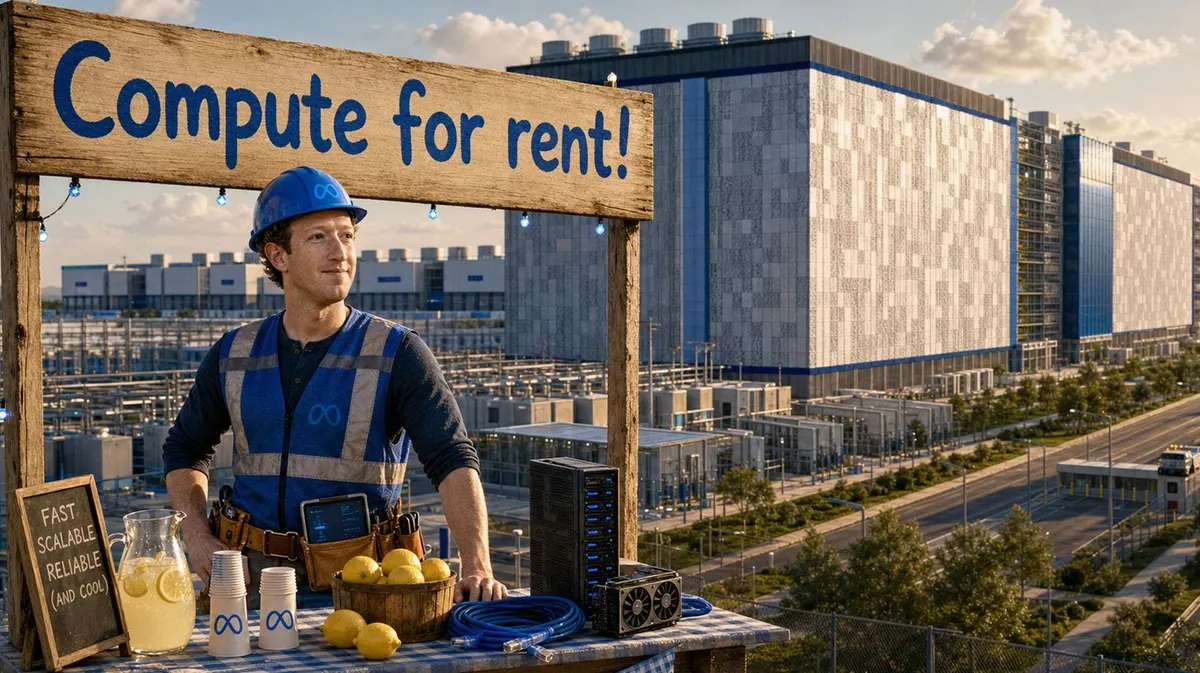
Image source: Images 2.0 / The Rundown
The Rundown: Meta is reportedly working on a cloud service that would put its data centers’ spare capacity up for rent, a plan that drove the company’s stock up 9.3% by giving investors a second path to returns on the tech giant’s $182.9B infrastructure bet.
The details:
-
Options reportedly range from renting compute to charging developers who want to tap Meta-hosted models, including its recently launched Muse Spark.
-
Zuckerberg told investors in May that outside companies ask weekly to buy Meta compute, but said the company still expects to use it internally.
-
SpaceX set the template with xAI’s Colossus, with Anthropic, Google, and Reflection AI all signing leases this year to utilize its compute capacity.
Why it matters: Meta’s AI splurge hasn’t matched its internal efforts for the majority of the industry boom, and this is the first plan that may make the math work without its own models winning. Renting compute is a nice hedge, especially as compute demand continues to drastically outpace how fast the infrastructure can be built out.
AI climbs the freelance value chain
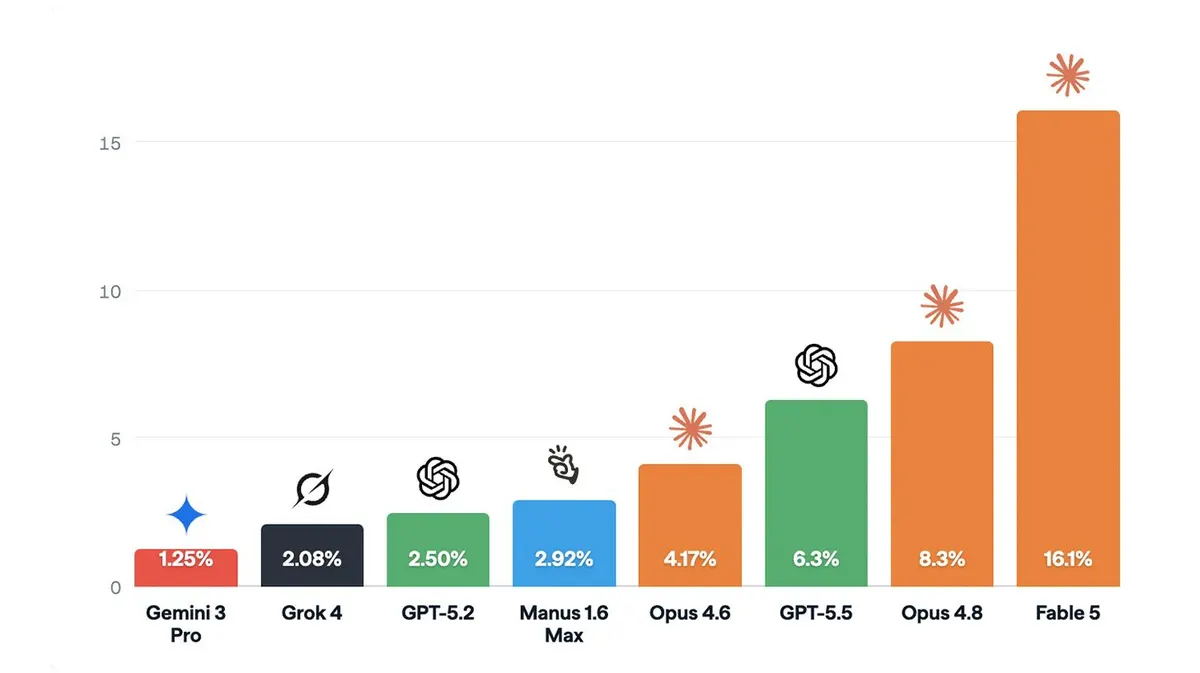
Image source: Center For AI Safety
The Rundown: The Center for AI Safety and Scale Labs released results from Remote Labor Index, a benchmark that tests AI agents on freelance tasks graded by humans - with Fable 5 posting the highest score ever and frontier rates climbing 6x in a year.
The details:
-
The Remote Labor Index was initially released in October 2025, with GPT 5.2 initially leading the field at a 2.5% automation rate.
-
The tasks included 240 real jobs in areas like 3D jewelry design, animated ads, and floor plans, with humans grading models against a professional.
-
Anthropic’s Fable 5 matched or beat the human pro on 16.1% of projects, with Opus 4.8 coming in second at 8.3% and OpenAI’s GPT-5.5 third at 6.3%.
Why it matters: The jump in under a year is a big one, but the reality is that only 1 in 6 freelance tasks got up to professional quality by a model far above the rest of the current field. The more likely scenario feels like massive output increases for freelancers utilizing the tech, with a human still in the loop for judgment and touch.
Trump lifts export ban on Anthropic’s most powerful AI LINK
-
The U.S. Department of Commerce has withdrawn the export controls it placed on Anthropic’s Claude Fable 5 model, letting the company restore global access a day after the ban ended an 18-day standoff.
-
The fix was a single safety filter, tuned to block one technique Amazon researchers used to prompt Fable 5 into identifying software vulnerabilities, with the new classifier catching that method in more than 99% of cases and rerouting requests to Opus 4.8.
-
Fable 5 returns across Claude.ai, the Claude Platform, Claude Code, and Claude Cowork today, with AWS, Google Cloud, and Microsoft Foundry to follow, while the June 12th directive had barred all foreign nationals, including Anthropic’s non-citizen staff.
Meta to rent out its spare AI computing power LINK
-
Meta is looking into starting a cloud infrastructure business that would let customers buy access to its spare AI computing power and its hosted AI models, according to Bloomberg.
-
The plan, known internally as Meta Compute, would put the company in direct competition with major cloud providers including Amazon Web Services, Google Cloud, and Microsoft Azure.
-
The effort is reportedly led by infrastructure chief Santosh Janardhan, Meta Superintelligence Labs head Daniel Gross, and company president Dina Powell McCormick, following a similar approach taken by CoreWeave.
Anthropic unveils Claude Sonnet 5 LINK
-
Anthropic has released Claude Sonnet 5, which the company describes as a cheaper and faster version of Opus 4.8, letting people run agents at a lower cost even though the version number suggests a bigger jump.
-
Despite the number 5 in its name, the model is a relatively minor development, and the writer says it will take a few days to properly get a handle on how it performs.
-
The launch arrives while people still wait for both Claude Fable 5 and GPT-5.6-Sol, and more than 100 American institutions recently regained access to Mythos under a new ad hoc licensing setup.
Anthropic’s Sonnet 5 arrives in Fable’s shadow
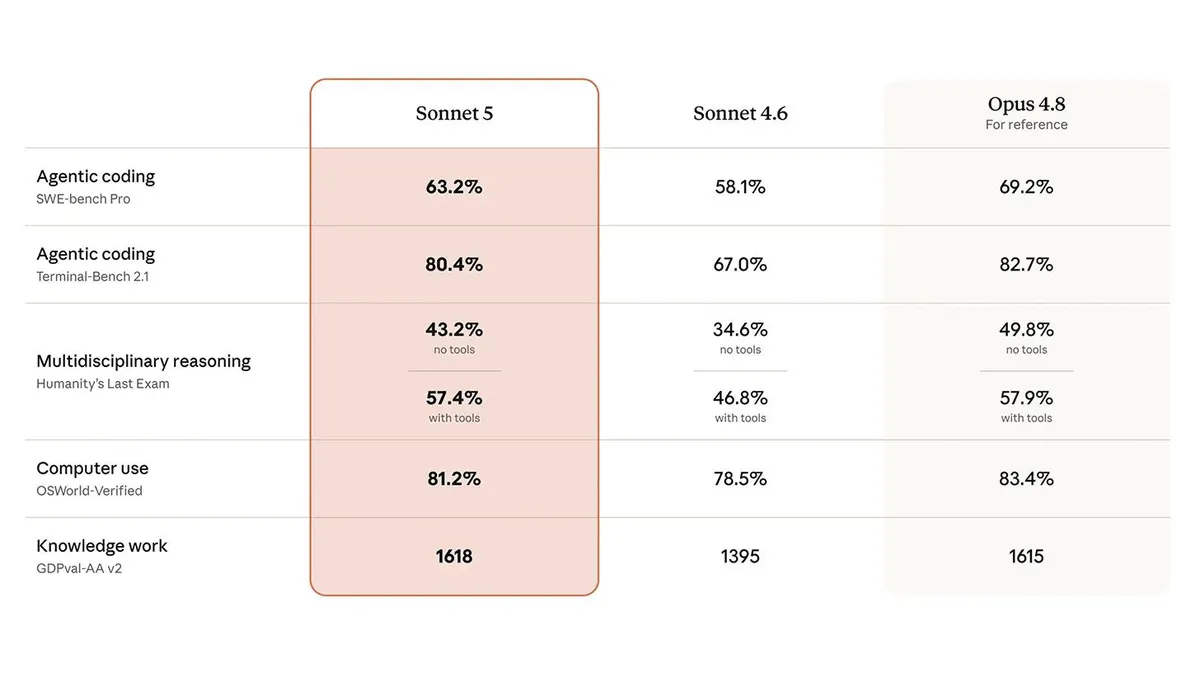
Image source: Anthropic
The Rundown: Anthropic just launched Sonnet 5, the latest upgrade in its mid-tier model class that it calls “the most agentic Sonnet model yet” - coming just before the U.S. Dept. of Commerce lifting export controls on Mythos 5 and Fable 5 after 18 days.
The details:
-
Sonnet 5 shows major jumps in agentic coding and reasoning over its predecessor, with knowledge work capabilities that surpass even Opus 4.8.
-
The new Sonnet can operate a browser or terminal and carry longer jobs, bringing more Opus-style agent behavior into Anthropic’s cheaper tier.
-
The model’s cybersecurity benchmarks come in worse than Sonnet 4.6, with Anthropic saying it “did not deliberately train” 5 on cybersecurity tasks.
-
Sonnet 5 is available across plans, with API rates priced at $2/$10 per M input/output tokens until Aug. 31 and $3/$15 after.
Why it matters: It’s an upgrade over 4.6, but the backdrop of users longing for Fable leaves this feeling like an underwhelming start to the ‘5’ class. Many releases are accused of ‘benchmaxxing’, but Sonnet feels like the opposite for cybersecurity - an awkward, direct result of the Fable and Mythos entanglement the company has been in.
Japan plans sovereign AI and 10 million robots LINK
-
Japan has unveiled a plan to build its own homegrown AI model and put 10 million AI-equipped robots to work across different sectors by the year 2040, led by a consortium called Noetra.
-
Noetra, which includes SoftBank and Sony, will focus on physical AI, meaning artificial intelligence used in real-world settings like self-driving cars, factory robots, and android butlers, with about $6 billion in government money over five years.
-
The effort ties into Japan’s push to cut its reliance on US and Chinese AI models and address its aging, shrinking population, part of a 14-year plan investing 370 trillion yen across 17 sectors.
Sony will stop making PlayStation game discs in 2028 LINK
-
Sony will stop making physical discs for all new PlayStation games in January 2028, shifting to an all-digital model where every new release sells through the PlayStation Store and other retailers.
-
Games released before the January 2028 cutoff will still be available on disc, and Sony said the change reflects how most players already buy games, with digital downloads making up 85% of full-game software sales on PS4 and PS5.
-
The decline of physical games shows up in retail too, as GameStop reportedly closed more than 1,300 stores over the past two fiscal years while more players choose to buy their games online.
Google’s new Nano Banana 2 makes AI images in 4 seconds LINK
-
Google has launched Nano Banana 2 Lite, the fastest and cheapest model in its Nano Banana family, generating AI images in four seconds and costing under four cents per thousand images for developers working at scale.
-
The model is built for speed rather than quality, aimed at rapid ideation and high-velocity developer pipelines, while keeping reliable prompt adherence, strong character consistency, and legible text rendering inside the images it produces.
-
Available now in Google AI Studio, the Gemini API, and the Gemini Enterprise Agent Platform, it replaces the original Nano Banana and rolls out to surfaces like AI Mode, the Gemini app, NotebookLM, and Google Photos.
Google’s new Nano Banana Lite, Omni Flash models
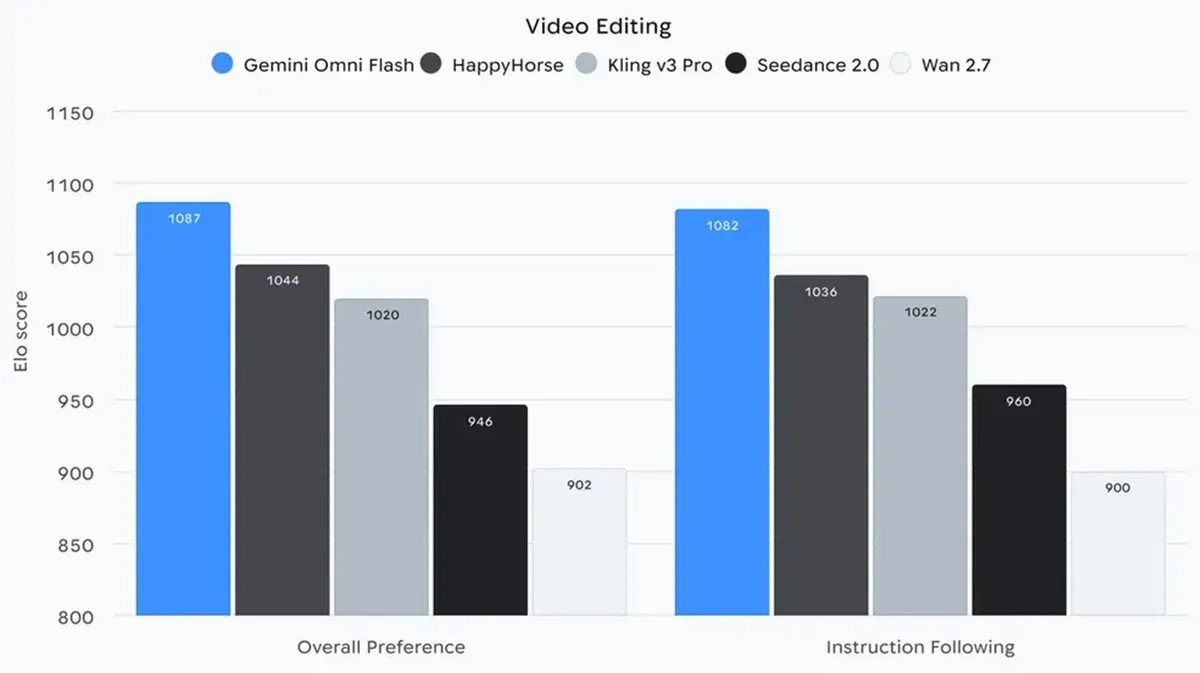
Image source: Google
The Rundown: Google just introduced two new media models into its API for developers, with a lower-cost Nano Banana 2 Lite for fast, bulk jobs and a powerful Gemini Omni Flash with strong video generation and editing capabilities.
The details:
-
Lite can generate an image in just four seconds at $.034 per image, aimed at cost-effective, bulk workflows at quality below the frontier.
-
Gemini Omni Flash also rolled out to developers, a model that generates and edits 10-second video clips at $.10/sec that tops text-to-video leaderboards.
-
Omni Flash trails only Seedance 2.0 in video editing, with Google injecting Gemini’s multimodal reasoning into the video model for real-world knowledge.
-
The pitch is to link the two models, with users able to make an image with Lite, provide it to Omni, and then animate it into a video clip in a single workflow.
Why it matters: Some may be disappointed not to see a massive new jump, but Google is putting capabilities into users’ hands at speed and prices that make creative workflows stronger than ever. With Google’s sprawling ecosystem of apps to power, those qualities are vital to pushing everything forward at scale.
Anthropic debuts new science hub for Claude
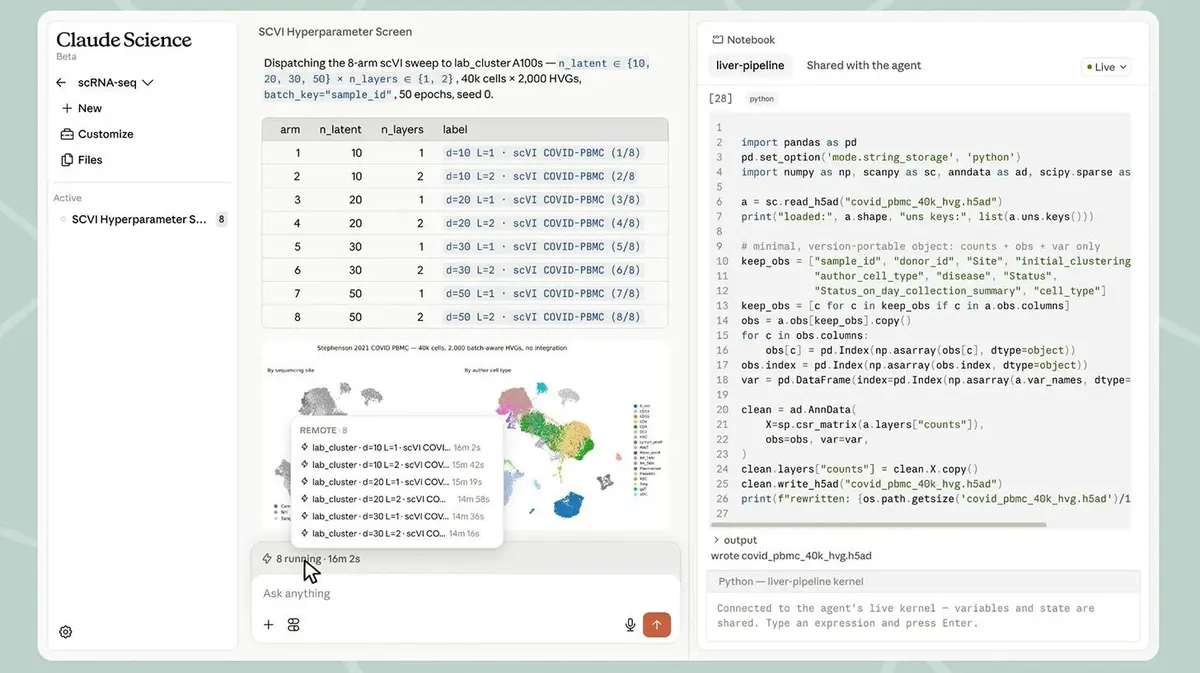
Image source: Anthropic
The Rundown: Anthropic released Claude Science, an AI workspace for scientists that brings paper review, databases, figure-making, and computing jobs in a unified hub - with the company also starting its own preclinical drug discovery program.
The details:
-
The platform is designed to link and trace every step of the research process, keeping an auditable track for better understanding work and fact-checking.
-
The app connects 60+ scientific sources and tools for genetics, proteins, chemistry, and cell data, cutting down on manual database hopping.
-
Claude Science is rolling out across paid plans on both MacOS and Linux, with sensitive datasets able to stay on a lab’s own machines instead of the cloud.
-
Anthropic is also starting its own drug discovery effort targeting “neglected” diseases traditionally skipped by pharmaceutical giants.
Why it matters: Anthropic hadn’t typically been as science-focused as Google and OAI, but that has changed in the past year - with a Life Sciences effort, this release, and a series of splashy hires (including Nobel winner John Jumper from DeepMind) pushing the lab deeply into the scientific arena for AI-enabled research and discovery.
What Else Happened in AI on June 02nd 2026?
Katalyze raised $10.5M to bring agents to pharma manufacturing, cutting batch investigations from months to minutes inside 5 of the top 20 global pharma orgs.*
OpenAI released GeneBench-Pro, a benchmark testing whether AI can make expert judgments in computational biology, with GPT-5.6 Sol solving just 28.7% of problems.
Acclaimed theoretical computer scientist Jelani Nelson joined Anthropic, saying he wants to work on “the defining technology of our time.”
Google’s NotebookLM rolled out Short Video Overviews, allowing users to create 60-second, social media-style educational videos from any topic or source.
Researchers led by Binghui Peng used GPT-5.5 Pro and Opus 4.8 in a pipeline to solve nine long-standing open problems across math and theoretical computer science.
OpenAI found a ‘compute multiplier’ that more than halves its inference costs, according to The Information, coming alongside the recent debut of its Jalapeño chip.
U.S. chipmaker Etched announced $800M in funding, while revealing a working inference chip with the full server rack as well as $1B in customer contracts.
AWS is committing $1B to a new Forward Deployed Engineering org, embedding thousands of engineers inside customer teams to accelerate agentic AI builds.
X rolled out a hosted MCP server, letting AI tools like Grok, Claude, and Cursor easily connect to the X API and read or take actions on the social media platform.
OpenAI teased a new hardware collaboration with Work Louder, believed to be a keyboard device for its Codex platform launching on July 15.