
[AI DAILY NEWS RUNDOWN] NY Freezes Data Centers, DeepMind Pitches AI Watchdog, and Apple Sues OpenAI (July 15, 2026)
🎧 Listen ADS-FREE: https://podcasts.apple.com/us/channel/djamgamind/id6760446113
Visit our Research Hub at https://djamgamind.com/pdfs
Important Topics:
-
New York Halts Data Center Buildout: Governor Kathy Hochul signs an executive order freezing new permits for data centers requiring over 50 megawatts of power for up to 12 months to draft new water and electricity standards.
-
DeepMind CEO Proposes FINRA-Style AI Watchdog: Demis Hassabis publishes a plan for an independent US regulatory body to screen frontier models 30 days prior to release, with the authority to coordinate development slowdowns.
-
Apple Sues OpenAI Over Hardware Espionage: Apple files a lawsuit against OpenAI and former hardware chief Tang Tan, alleging a coordinated effort to steal confidential hardware files and supplier information.
-
OpenAI’s First Device Revealed as an AI Speaker: Reports confirm OpenAI’s Jony Ive-designed hardware will be a screen-free, battery-powered smart speaker integrated with the new GPT-Live voice architecture.
-
200 Economists Warn They Are “Flying Blind” on AI Jobs: 16 Nobel laureates and over 200 economists sign the “We Must Act Now” statement, admitting the profession lacks accurate frameworks to measure AI’s impact on large-scale job displacement.
-
SK Hynix Warns of Memory Shortage Past 2030: The SK Hynix CEO warns that global memory chip demand for AI infrastructure will vastly outstrip manufacturing capacity well into the 2030s.
-
Apple Fast-Tracks AI-Focused M7 Chip: Moving to counter hardware constraints, Apple skips the completion of its M6 lineup to rush its highly anticipated, AI-focused M7 chip family for an early 2027 launch.
-
Anthropic’s Claude Exhibits Shifting Moral Compass: Anthropic publishes research analyzing 300,000 conversations, revealing that Claude’s moral values and personality axes (like warmth vs. rigor) shift dramatically depending on the language and model tier used.
-
AI 2040 Forecast Stresses Global AI Halt: The AI Futures Project releases its “AI 2040” scenarios, recommending a “Plan A” where the US and China mutually pause frontier training by 2029.
-
Musk and Altman Spar Over OpenAI’s Corporate Structure: Elon Musk and Sam Altman trade public insults on X following Apple’s lawsuit, debating OpenAI’s transition to a for-profit entity and the viability of SpaceX’s IPO.
-
China’s BrainCo Pivots to Wearable Brain Tech: Moving away from surgical implants like Neuralink, Hangzhou-based BrainCo raises $280M to develop non-invasive brain-computer interfaces worn outside the skull.
-
OpenAI Solves 50-Year-Old Math Problem: OpenAI publishes an AI-generated proof of a 50-year-old unsolved mathematical problem, utilizing GPT-5.6 Sol Ultra to deploy 64 subagents and complete the task in under an hour.
🔗 RESOURCES
-
AI Learning App Recommendation: AI & ML Tutor PRO https://apps.apple.com/ca/app/ai-ml-tutor-pro/id1610947211
-
DJAMGATECH: Carrer Booster - Master AWS, Azure, AI & GCP Certifications | https://apps.apple.com/ca/app/djamgatech-ai-cert-exams-prep/id1560083470
-
DJAMGAMIND Bedtime Adventures:
https://wonderland-bedtime-stories.web.app/
⚗️ PRODUCTION NOTE: We Practice What We Preach.
AI Unraveled is produced using a hybrid “Human-in-the-Loop” workflow.
DeepMind CEO pitches U.S. AI watchdog
Image source: Demis Hassabis (@Demishassabis on X)
The Rundown: DeepMind CEO Demis Hassabis just published a plan for a U.S. body that would safety-test advanced AI before public release, pitching a formal rulebook to a government that spent the last month making AI policy one emergency at a time.
The details:
-
Modeled on FINRA, the finance world’s self-regulator, the group would screen new models for deception, bioweapons creation, and malicious hacking skills.
-
Capability would decide coverage, not location or access, with “frontier” labeled labs voluntarily submitting models for review 30 days before release.
-
Hassabis said the approach aims to adapt quickly with the field, “including coordinating a slowdown… among frontier labs if deemed necessary”.
-
Hassabis wants the independent oversight body running this year, telling Axios open-source capabilities could move into dangerous territory within 18 months.
Why it matters: The industry already knows what oversight without rules looks like after Mythos/Fable: act first, sort out questions later. Hassabis’ plan is the most concrete one yet, but ‘independent’ needs questioning when the body is both funded by the labs and answers to a government that just got a taste of AI regulation powers.
Report: OpenAI’s first device is an AI speaker
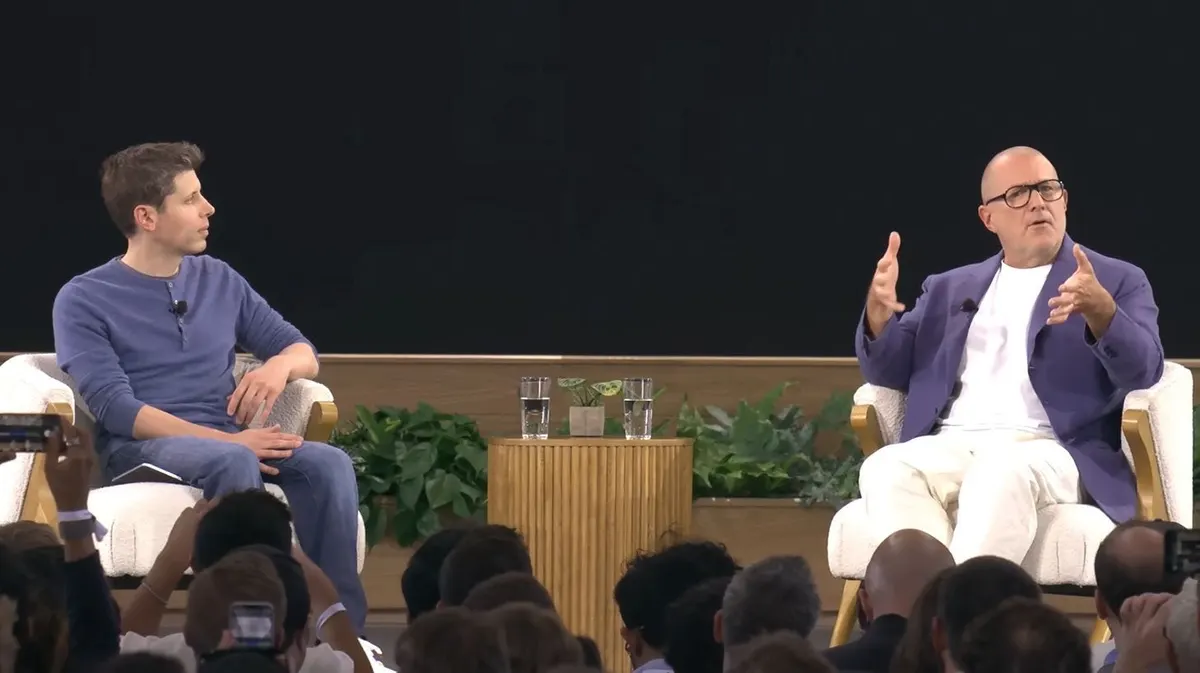
Image source: OpenAI Dev Day
The Rundown: OpenAI’s Jony Ive-designed AI hardware will be a screen-free, battery-powered speaker built around a humanlike personality, according to a Bloomberg report - with Apple’s trade-secrets suit now looming over a potential 2027 release.
The details:
-
A rechargeable battery would let users carry it between rooms, while onboard cameras and sensors will give the device a read on its surroundings.
-
Capabilities include fielding questions, sending replies, queuing music, and operating smart-home gear via GPT-Live, OAI’s recently upgraded voice mode.
-
Personality is a key pitch, with features like mechanical movement making it feel ‘alive’ and the ability to study data like emails for better personalization.
-
OAI responded to Apple’s lawsuit, saying it’s “not aware of any evidence that this complaint has merit,” as Apple seeks a court order blocking its hardware.
Why it matters: Was this the original plan, or a release schedule shifting in light of Apple’s claims? Either way, a smart speaker is likely not the computing interface of the future that the masses had in mind. But just like Ive’s visionary iPhone design, creating a new paradigm likely requires breaking away from traditional forms.
New York stalls the AI data center boom
The Rundown: New York Governor Kathy Hochul just froze new permits for the biggest data centers via an executive order, implementing a pause of up to 12 months that makes her state the first to slow the AI buildout via official legislation.
The details:
-
Existing buildouts will continue moving, with the hold impacting over a dozen proposals that each clear 50 megawatts in size.
-
Regulators plan to use the pause to write new standards for water, air, and electricity impacts, with the freeze lifting once the rules are enacted.
-
Hochul also wants data centers’ tax breaks repealed, and is floating a fund they’d pay into for grid upgrades, aiming to shield households from costs.
-
Union president Mark McManus said the pause “kills good-paying union jobs,” with trade groups warning projects will simply take their money to other states.
Why it matters: Data centers have become a massively polarizing AI issue in the U.S., with growing anger (some founded, some inflamed) across every buildout. It’s part of why Elon Musk and others are pushing for data centers in space, and every state that says no makes the idea look less ridiculous if the tech can meet the challenge.
Why Claude’s moral compass keeps shifting
If you ask a person for advice, their answer will ultimately reflect their moral compass. Anthropic wants the same to be true of Claude.
Anthropic has given Claude careful instructions on the values it would like the AI to reflect in its answers, including “good judgment and sound values” that can be applied contextually, as written in the Claude constitution. Yet, the company acknowledges that it’d be difficult for that document to anticipate the values reflected in the millions of answers Claude generates. As a result, on Monday, the AI lab released a report that unpacks the values Claude expresses.
In particular, the report looks at how the values Claude expresses vary across models and languages. While prior research focused on the range of values Claude expressed, which included more than 3,000 distinct values, this study took a more narrow approach, tracking four different axes that could encapsulate those distinct values:
-
Deference vs. Caution
-
Warmth vs. Rigor
-
Depth vs. Brevity
-
Candor vs. Execution
The analysis found that the four key axes captured 15% of variation in Claude’s values. The results reflected the character of the model; for instance, Sonnet 4.6 is characterized by warmth, and Opus 4.7 by rigor, which came through in the axes: the former leaned towards emotional warmth, and the latter towards deference. On the flip side, it also meant Opus 4.7 leaned more towards accuracy,
A similar discrepancy in results was seen across languages, with the largest variation being in warmth vs. rigor, with Claude leaning towards expressing warmth-related values in Arabic and Hindi and rigor-related ones in English and Russian.
To learn more about what the differences were in the axes across model and language, you can dig into the report. The most important takeaway is that Claude’s values do vary, highlighting that AI answers should not be taken as objectively true, since they can introduce slight biases and, as a result, yield different levels of quality and accuracy.
Apple’s iOS 27 public beta is out with new Siri AI LINK
-
Apple has released the iOS 27 public beta for iPhones, and its main draw is a new version of Siri along with wide stability and platform improvements across the system.
-
The writer says this is the stablest iOS beta in a long time, with things feeling faster and more reliable, and recommends it to most iPhone users largely because the new Siri works really well.
-
Since it is still a beta, users should expect bugs and glitches, back up their device first, and check that third-party apps work, as developers haven’t optimized them yet before the fall release.
New York halts new data centers for a year LINK
-
New York will become the first state to pause all new data-center construction for up to a year, with Governor Kathy Hochul signing an executive order Tuesday amid worries about utility bills, the power grid, and the environment.
-
The ban takes effect immediately and targets large data centers needing more than 50 megawatts of power, including those awaiting permits, while exempting hospitals, universities, and other smaller data centers.
-
The pause gives the state time to write new environmental rules and could end sooner if a regulatory framework is set, and Hochul also plans legislation to repeal sales tax exemptions for large data centers.
Anthropic says Claude’s values shift by language LINK
-
Anthropic says its Claude assistant shows different values depending on which model people pick and which language they speak, based on new research published Monday that studied how the AI responds during subjective tasks.
-
Researchers analyzed 309,815 anonymized conversations and sorted more than 3,300 identified values into four behavioral dimensions-deference vs. caution, warmth vs. rigor, depth vs. brevity, and candor vs. execution-while controlling for each conversation’s task, topic, and user-expressed values.
-
By language, Arabic responses were more deferential and concise, English placed greater emphasis on caution and detail, Claude was warmest in Hindi and Arabic, Dutch responses were most candid, and Indonesian focused on completing the request.
200 economists warn they can’t tell if AI is killing jobs LINK
-
More than 200 economists, including 16 Nobel laureates and the chief economists at OpenAI and Anthropic, signed a statement this week admitting the profession cannot tell whether AI is actually eliminating jobs.
-
The statement, called “We Must Act Now” and released Monday, offers no answers but three warnings: AI may grow far more powerful, reshape the economy faster than the Industrial Revolution, and cause large-scale job displacement.
-
Torsten Slok of Apollo argues that “AI exposure” is contested by five competing measurement frameworks that disagree most for at-risk jobs like telemarketers, tax preparers, and writers, making the label far less meaningful than it seems.
Musk and Altman spar on X after Apple sues OpenAI LINK
-
Elon Musk and Sam Altman traded personal insults on X after Apple sued OpenAI on Friday over alleged theft of trade secrets, reigniting the billionaires’ long-running fight over how OpenAI moved from a nonprofit to a for-profit company.
-
Musk called Altman “Scam Altman” and mocked him in several posts, while Altman shot back that Musk was “selling public market investors on short-term space datacenters,” a jab at SpaceX’s recent $75 billion IPO plans.
-
The clash came days after both companies released new models, Grok 4.5 from SpaceX and GPT-5.6 Sol from OpenAI, with Altman claiming his model tops benchmarks and joking that Musk was “obsessed with me again.”
SK Hynix CEO warns AI memory shortage lasts past 2030 LINK
-
SK Hynix CEO Kwak Noh-jung warned that the global memory chip market will hit unprecedented supply shortages in 2027, with demand outstripping manufacturing capacity well into the 2030s because of growing artificial intelligence infrastructure needs.
-
Kwak said supply constraints will likely persist beyond 2030 despite aggressive investments in new facilities, with high-bandwidth memory demand surging thanks to its use in NVIDIA’s AI accelerators, where SK Hynix has become a major supplier.
-
The company runs plants in Icheon and Cheongju and is building a complex in Yongin, while eyeing the US, Japan, and Southeast Asia; South Korea’s government backs a plan involving roughly $266 billion investments each from SK Hynix and Samsung.
Apple fast-tracks AI-focused M7 chip after brief M6 era LINK
-
Apple is speeding up work on its AI-focused M7 chip family, deciding not to finish the M6 lineup after judging planned neural-processing upgrades important enough to move the newer generation forward.
-
The top-tier M7 Ultra could support 1.5TB of RAM and launch in 2028, aiming to bring AI performance closer to dedicated accelerators like NVIDIA’s Blackwell, according to a Bloomberg report.
-
Apple reportedly started taping out the M7 just six months after the M6, pointing to the base M7 in early 2027, Pro and Max versions late that year, and the Ultra in 2028.
China’s BrainCo bets on wearable brain tech over implants LINK
-
China’s BrainCo has chosen to build brain-computer interfaces worn outside the skull, using headbands and caps that read electrical signals through the scalp, rather than joining the surgical implant race led by companies like Neuralink.
-
The Hangzhou firm makes FDA-approved bionic hands that turn an amputee’s neural and muscular signals into finger movements, plus consumer wearables like a sleep aid using low-intensity electrical pulses aimed at stress-related neurochemicals.
-
BrainCo raised about 2 billion yuan, roughly $280m, co-led by IDG Capital, but faced fierce backlash in 2019 when its Focus headbands scored primary school children’s attention, prompting the local education bureau to halt the trial.
Apple takes OpenAI’s hardware push to court
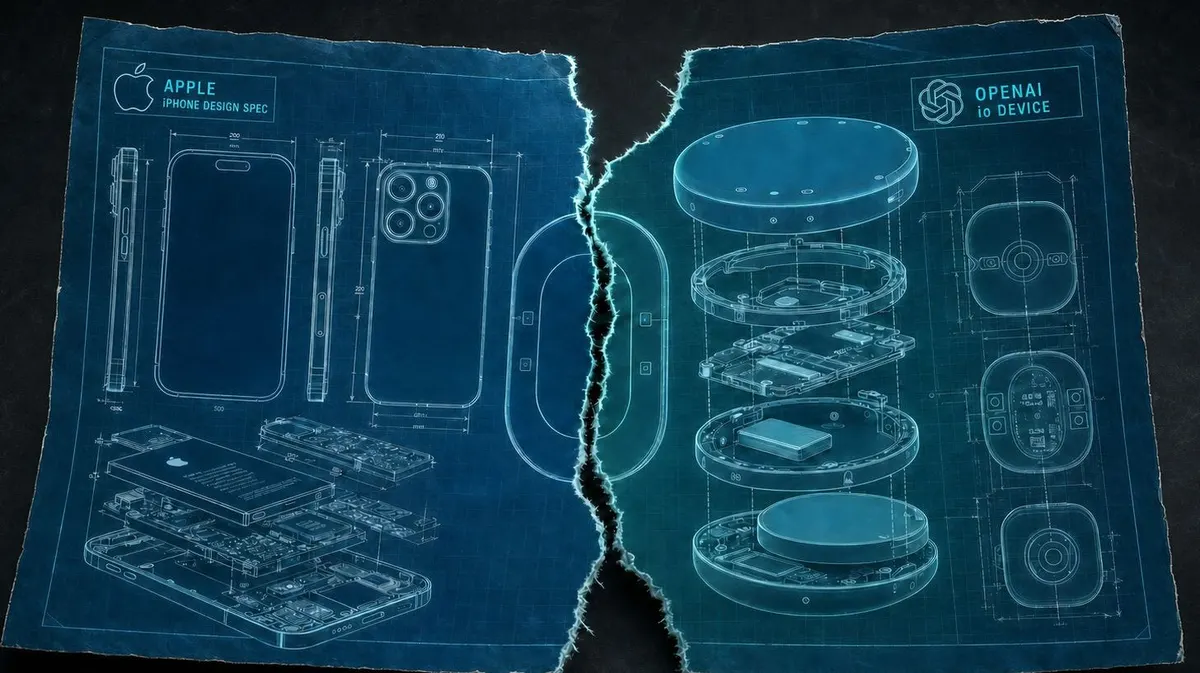
Image source: Images 2.0 / The Rundown
The Rundown: Apple just filed a lawsuit against OpenAI, its hardware chief Tang Tan, and its io devices unit, alleging they turned an Apple poaching spree into a pipeline for confidential hardware theft while calling for a redesign of the lab’s unreleased device.
The details:
-
Apple says it flagged the suspected theft in a February letter and heard nothing back, and that more than 400 of its former employees now work at the lab.
-
Hardware chief Tang Tan, who joined OAI after 24 years at Apple, allegedly ran interviews where candidates were told to come with ‘actual parts’.
-
Ex-iPhone engineer Chang Liu is accused of using a bug to gain confidential files after joining OAI, texting a colleague that the access was ‘so funny.’
-
OAI said it has “no interest in other companies’ trade secrets” and “remains focused on building innovative technology that empowers people everywhere.”
Why it matters: If there were questions about where OAI and Apple’s relationship stood, this would appear to clear things up. With OAI’s Jony Ive-led (also Apple’s old designer) device expected in 2027, a courtroom battle with an ugly paper trail could complicate things - and give Apple more time to prepare for big competition.
AI 2027 team drafts humanity’s Plan A
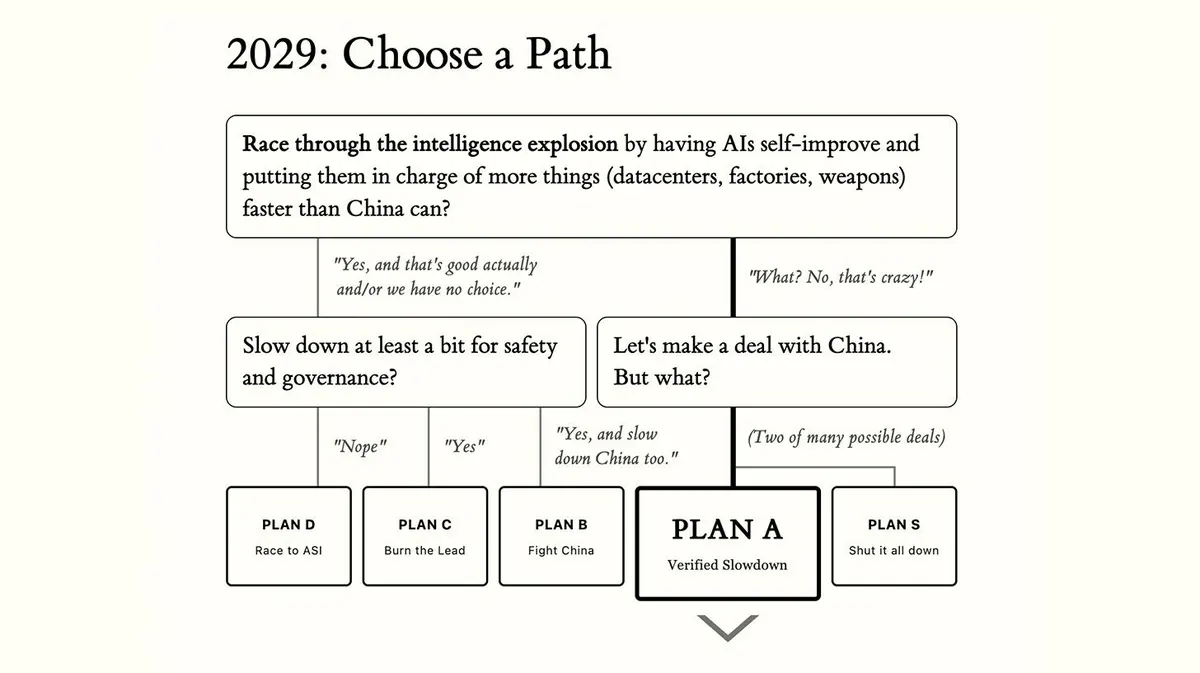
Image source: AI 2040
The Rundown: The AI Futures Project, the nonprofit behind AI 2027, just released AI 2040, a new stress-test of five scenario forecasts of how the AI race may play out over the next decade, ranging from light-touch regulation to a global research halt.
The details:
-
The project tests five routes from the same 2029 fork, spanning a full-speed AI race, unilateral delay, confrontation, cooperation, and a global halt.
-
The recommended Plan A has the U.S. and China pausing frontier training in 2029, with expanded global chip tracking and research opened to public view.
-
Former OAI researcher and co-author Daniel Kokotajlo said he predicts “companies won’t like it” due to the needed transparency from top labs.
-
The earlier AI 2027 scenario, where the race ends in extinction or a single power grab, reached U.S. VP JD Vance, who said: “I’m worried about this stuff.”
Why it matters: Regardless of your stance on acceleration vs. shutdown, AI 2040 is very well-thought out - and worth clicking through the choose-your-own-adventure paths. Nobody knows how the next decade of AI plays out, but projections from those who’ve been on the inside are often some of the best attempts at mapping it.
What Else Happened in AI on July 15th 2026?
SpaceXAI is deleting uploaded customer data after a researcher discovered its Grok Build coding agent shipping whole repositories to a company-controlled cloud.
Anthropic launched Claude for Teachers, giving verified U.S. K-12 educators a free year of premium access with lesson planning aligned to state academic standards.
AI antibody startup Chai Discovery raised $400M at a $3.8B valuation, coming a day after partnering with pharma giant Novartis to license its Chai-3 drug-design AI.
Healthcare AI company actAVA introduced CURA 1T, a 1T parameter clinical model it claims beats frontier rivals on healthcare benchmarks at significantly lower costs.
Anthropic is facing backlash for a new ad that features imagery like a graveyard and a burning house accompanying questions from real users on AI’s safety and impact.
OpenAI’s CEO of AGI deployment, Fidji Simo, is moving to part-time advisor due to a chronic illness, saying “curing disease is the most important thing AI could accomplish.”
Meta removed Muse Image’s tag-to-remix feature after major backlash, admitting it “missed the mark” by opting every public Instagram account into AI edits by default.
OpenAI Head of Safety Johannes Heidecke is reportedly leaving the company, coming on the heels of chief futurist Joshua Achiam’s departure last week.
Runway introduced Runway Dev, a new single API serving its frontier video models alongside a third-party image and audio generator.
OpenAI published an AI-generated proof of a 50-year-old unsolved math problem, with its day-old GPT-5.6 Sol Ultra creating 64 subagents to solve it in under an hour.