
[AI WEEKLY NEWS RUNDOWN] Apple Sues OpenAI for Trade Secret Theft, Geopolitical AI Loopholes Exposed, and Meta Pulls Intrusive Image Tool (July 5 – July 12, 2026)

🎧 Listen ADS-FREE: https://podcasts.apple.com/us/channel/djamgamind/id6760446113
Visit our Research Hub at https://djamgamind.com/pdfs
Summary: In this weekly briefing, we analyze “The Hardware Espionage War, Geopolitical Loopholes, and Algorithmic Arbitrage”. We deconstruct Apple’s high-stakes lawsuit accusing OpenAI of leveraging security flaws to steal proprietary physical hardware data. We evaluate the geopolitical fallout of US frontier models being sold to foreign subsidiaries of blacklisted Chinese firms. We cover OpenAI’s general rollout of the GPT-5.6 series alongside the abrupt shutdown of its Atlas AI browser. Finally, we explore Meta’s rollout of Muse Spark 1.1 and its privacy light update, a $1.4 trillion child-addiction lawsuit targeting Instagram, and China’s first successful “net-based” reusable orbital rocket recovery.
Important Topics:
-
Apple Files Trade Secret Suit Against OpenAI: Apple accuses OpenAI of hardware espionage, alleging that former engineers used an authentication bug to download confidential hardware files and siphoned proprietary metal finishing data for interview candidates.
-
OpenAI and Google Route Models to Blacklisted Chinese Firms: Financial disclosures expose that advanced models were legally sold to Singaporean branches of Baidu, Tencent, and Alibaba, exposing a massive blind spot in US export control regulations.
-
OpenAI Abruptly Shuts Down Atlas AI Browser: After only eight months on the market, OpenAI cancels its native Atlas browser, migrating its core features into a specialized Google Chrome sidebar extension.
-
General Release of GPT-5.6 and ChatGPT Work: OpenAI broadly deploys the GPT-5.6 family (Sol, Terra, Luna) out of its government-mandated preview, simultaneously launching “ChatGPT Work” to automate document and spreadsheet orchestration natively across Mac and Windows.
-
Meta Pulls Instagram AI Feature After Backlash: Meta yanks an invasive toggle from its Muse Image app after users revolted over a setting that allowed anyone to generate AI images from public Instagram accounts using an unannounced automated mention feature.
-
Humanoid Robots Assist in First Surgical Trial: Researchers at UC San Diego record the first instance of humanoid surgery, utilizing human-operated Unitree G1 machines to successfully perform seven gallbladder removals.
-
Federal Reserve Appoints AI Macro Task Force: The Fed names venture capitalist Marc Andreessen, Xbox CEO Asha Sharma, and economist Charles I. Jones to lead an emergency task force assessing the impact of AI on long-term productivity and monetary policy.
-
Meta Drops Aggressively Priced Muse Spark 1.1: Meta introduces its multi-agent API platform at a highly aggressive $1.25 input and $4.25 output token rate, deliberately undercutting the profit margins of closed-source competitors.
-
Apple Locks in $30B Broadcom AI ASIC Contract: Moving to insulate its hardware servers, Apple signs a massive multi-year deal with Broadcom through 2031 to produce custom chips codenamed “Baltra” for M5 Ultra Mac Studio upgrades.
-
Anthropic Pushes Claude Cowork onto Mobile: Anthropic deploys its persistent “Dispatch” multi-engine routing system onto iOS and Android platforms, allowing enterprise knowledge tasks to execute with laptops closed.
-
Meta Smart Glasses Block Modders: Meta deploys a zero-tolerance firmware patch to its smart glasses that permanently disables the integrated recording camera if the onboard privacy LED light is drilled out or covered up.
🔗 RESOURCES
-
AI Learning App Recommendation: AI & ML Tutor PRO https://apps.apple.com/ca/app/ai-ml-tutor-pro/id1610947211
-
DJAMGATECH: Carrer Booster - Master AWS, Azure, AI & GCP Certifications | https://apps.apple.com/ca/app/djamgatech-ai-cert-exams-prep/id1560083470
-
DJAMGAMIND Bedtime Adventures:
https://wonderland-bedtime-stories.web.app/
⚗️ PRODUCTION NOTE: We Practice What We Preach.
AI Unraveled is produced using a hybrid “Human-in-the-Loop” workflow.
Apple sues OpenAI for stealing hardware secrets LINK
-
Apple has filed a lawsuit against OpenAI and two former employees, accusing the ChatGPT maker of stealing confidential information and trade secrets to speed up its push into consumer hardware.
-
The complaint claims former Apple engineer Chang Liu used an authentication bug to download confidential hardware files, while ex-executive Tang Yew Tan emailed himself supplier information and urged job candidates to bring Apple parts to interviews.
-
Apple says OpenAI employees approached suppliers using a confidential metal finishing process, and although over 400 former Apple staff now work there, hiring them does not grant access to trade secrets.
Meta pulls Instagram AI feature days after launch LINK
-
Meta removed a feature from its new Muse Image app days after launch, following backlash over users being able to generate AI images from public Instagram accounts through a simple @ mention.
-
The toggle allowing this was automatically switched on without users’ knowledge, meaning anyone could turn photos into AI images, while people were never told when someone created an AI image of them.
-
Opting out only stops future generations and leaves existing images live, and users can disable it under Sharing and Reuse in settings, though the toggle is still rolling out and unavailable to some.
Fed names Marc Andreessen to co-lead AI task force LINK
-
The Federal Reserve has picked venture capitalist Marc Andreessen to co-lead a new task force studying how artificial intelligence and other general-purpose technologies affect the economy, with the group set to inform the Fed’s policy decisions.
-
Chairman Kevin Warsh personally chose the three external advisors leading the AI task force: Andreessen, economist Charles I. Jones, and Xbox CEO Asha Sharma, all of whom have recently spoken in strongly positive terms about AI’s economic effects.
-
The AI group was one of five task forces the Fed announced Thursday, all expected to finish by year’s end, though some FOMC members remain uncertain about the timing and size of any productivity gains from AI adoption.
OpenAI and Google sold AI to blacklisted Chinese firms LINK
-
Google and OpenAI sold their advanced AI models to Singapore-based subsidiaries of Alibaba, Baidu, and Tencent, Chinese companies the US Pentagon has blacklisted over alleged ties to the Chinese military, according to a Financial Times report.
-
The transactions are legal because current US regulations do not fully ban Chinese-headquartered firms from using advanced US-based AI models outside mainland China, though this may push the US to bring in stricter rules for sanctioned companies.
-
OpenAI told the Financial Times that it blocks direct access to its AI models from mainland China, but allows some Chinese-owned businesses to use its services in other jurisdictions where proper safeguards can be enforced.
OpenAI releases GPT-5.6 and ChatGPT Work LINK
-
OpenAI on Thursday broadly released GPT-5.6 along with a new tool called ChatGPT Work, rolling out the model after staggering its launch at the request of the U.S. government.
-
GPT-5.6 comes in three versions: Sol is the most powerful with a new “ultra” mode that delegates work to submodels, Luna is built for speed, and Terra balances both for everyday tasks.
-
ChatGPT Work, powered by 5.6, is an agent that gathers context across connected apps and files to build documents, spreadsheets, and presentations, first arriving on Mac and Windows apps for all tiers of users.
Humanoid robots perform surgery for the first time LINK
-
Researchers at the University of California San Diego used a humanoid robot to help remove a gallbladder from a living patient, marking the first documented case of such a machine assisting in surgery.
-
The trials in early July 2026 involved Unitree G1 humanoid robots that human operators controlled with motion capture, foot pedals, and tracking systems, letting the robots coordinate both arms to hold tissue while cutting.
-
Led by Professor Michael Yip with surgeons Charles Goldberg and Preetham Suresh, the seven procedures were not autonomous, and clinical use remains years away pending trials, regulatory approvals, and safety evaluations.
OpenAI is shutting down its Atlas browser after 8 months LINK
-
OpenAI is shutting down Atlas, the AI browser it launched only last October 2025, and moving its features into an updated Chrome extension that runs ChatGPT inside Chrome’s sidebar.
-
The company says it folded in what it learned from Atlas and user feedback, and Atlas users will get notified about the switch to the new Chrome extension.
-
Pulling the plug in under eight months puts Atlas on a growing list of scrapped OpenAI products, and it means the company has no way to pull users away from Chrome.
China lands a reusable rocket for the first time LINK
-
China landed the booster stage of its Long March-10B rocket on Friday, the first time the country has launched and partly returned a reusable orbital rocket safely to Earth, matching SpaceX and Blue Origin.
-
The rocket lifted off from the Hainan commercial space launch site at 12:15 pm, and its first stage touched down on a barge roughly six minutes later, caught by a large net in what’s reportedly the world’s first “net-based recovery.”
-
China’s reusable Long March rocket still trails rivals, carrying a maximum payload of 16 tons compared to Falcon 9’s 25 tons and Starship’s planned 100-plus tons, with landings lowering launch costs by avoiding booster burn-up on reentry.
Meta continues shipping with Muse Spark 1.1
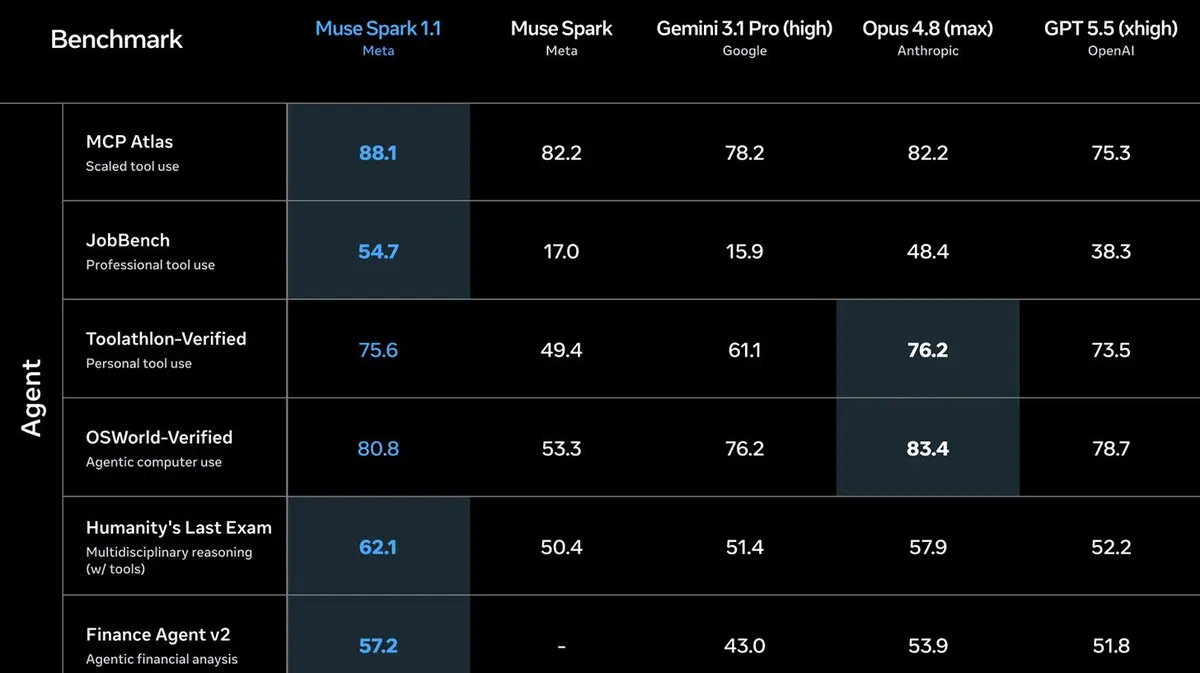
Image source: Midjourney
The Rundown: Meta released Muse Spark 1.1 for agent-style tasks, computer use, and long sessions, and put it behind the company’s paid API, with Mark Zuckerberg promising pricing that undercuts what he calls “very extreme” margins at rival labs.
The details:
-
The release moves Spark beyond Meta’s own apps, with API access priced at $1.25/$4.25 per million input/output tokens, about a quarter of top rivals.
-
Zuckerberg called 1.1 “state-of-the-art or very close to it” on agent reasoning and tool use, leading Opus 4.8 and GPT-5.5 on several related benchmarks.
-
1.1 excels at computer use tasks, able to split jobs across parallel subagents, operate across apps, and use its 1M context window for long jobs.
-
API access begins in public preview with $20 in credits, with Meta still training its heavier ‘Watermelon’ successor for release later this year.
Why it matters: There are a lot of parallels between Meta and SpaceXAI right now. Both Zuck and Elon had to tear down initial lackluster efforts, only to surprise with extremely capable new models that crush on cost and efficiency. The next batch of larger releases will show how far they can continue scaling to keep up with the frontier.
Meta launches its first in-house AI image generator LINK
-
Meta has released Muse Image, its first in-house AI image generator built by Meta Superintelligence Labs, offering it for free through the Meta AI app, Instagram Stories, and WhatsApp.
-
The tool, code-named Mango internally, can make cartoonish images, custom ads, and interior decoration mockups tied to Facebook Marketplace, and it comes with presets and prompt-based editing to erase photobombers or build QR codes.
-
Meta is also adding new AI effects for Instagram Stories powered by Muse, and while everyday creation stays free up to a limit, heavier use requires a subscription plan; Muse Video is already in development.
Apple commits $30B to Broadcom for US-made chips LINK
-
Apple has extended its custom chip partnership with Broadcom through 2031, keeping the longtime supplier on board for AI hardware even as the iPhone maker moves more of its component work in-house.
-
The expanded agreement covers custom ASIC chips that can speed up AI workloads, and it appears Apple lacks the expertise to build these itself, which has prolonged its reliance on Broadcom.
-
Apple reportedly wants advanced AI servers to train models and run inference for Siri by early 2027, using a chip codenamed Baltra, a supersized M5 Ultra headed to the next Mac Studio.
Meta glasses now shut off camera if privacy light is tampered LINK
-
Meta will roll out a software update to its smart glasses that turns off the camera whenever the device detects that someone has tampered with or destroyed the built-in privacy LED light.
-
The change targets modders who drill into the LED light, going further than an earlier measure that prompts users to uncover the recording light when it is blocked with tape or other objects.
-
Meta’s VP of wearables Alex Himel told The Verge the update was coming weeks ago, after cheaper Meta Glasses launched without Ray-Ban branding, and acknowledged the company was aware of rising misuse.
Anthropic’s Claude Cowork now runs on your phone LINK
-
Anthropic has extended Claude Cowork, its agent for general knowledge work, from the desktop app to web and mobile, launching in beta to Max subscribers first so tasks can continue even with the laptop closed.
-
A feature called Dispatch keeps one persistent thread that routes each request to the right engine, sending development work to Claude Code and knowledge work to Cowork, then messaging back the result instead of every step.
-
Anthropic sampled 1.2 million sessions from over 600,000 organisations and found business process work led at 33.4%, content creation followed at 16.4%, while software development made up just 8.7%.
What Else happened in AI this week?
Reve rolled out version 2.1 of its 4K image model, retaking the No. 2 overall spot on Arena while training on under a tenth of rivals’ compute.
OpenAI published new research retracting its endorsement of the coding benchmark SWE-Bench Pro, finding that nearly a third of the benchmark’s tasks had issues.
Embodied AI lab RobbyAnt released LingBot-World 2, a new world model that generates every frame in real time without a 3D engine.
Meta is reportedly starting manufacturing of its in-house ‘Iris’ AI chip in September, with the company also expected to double its computing capacity to 14 GW in 2027.
Anthropic introduced a ‘Reflections’ dashboard to help users analyze how they use Claude, with suggested skill creation and usage habits based on personal data.