
[AI DAILY NEWS RUNDOWN] U.S. Shuts Down Anthropic's Fable 5, OpenAI IPO Faces Pressure, Satya Nadella's AI Warning, and the Rise of Multi-Model AI | June 15, 2026
Visit our Research Hub at https://djamgamind.com/pdfs
🎧 Listen ADS-FREE: https://podcasts.apple.com/us/channel/djamgamind/id6760446113
#DJAMGAMIND
📝 Summary
The AI industry woke up to one of the most consequential regulatory interventions in its history as Anthropic suspended access to its flagship Fable 5 and Mythos 5 models following a U.S. government export control directive. The move marks the first time a frontier AI model has effectively been removed from the market through direct government action, raising major questions about AI governance, national security, and the future deployment of advanced models.
Meanwhile, Anthropic executives have been dispatched to Washington to negotiate with White House officials amid reports that concerns raised by Amazon played a role in triggering the action. The controversy has exposed growing tensions between AI safety advocates, regulators, technology companies, and national security agencies.
Elsewhere, Microsoft CEO Satya Nadella warned that only a handful of companies may capture most of the value created by artificial intelligence unless organizations build their own proprietary knowledge systems. OpenRouter introduced Fusion, a multi-model AI platform combining DeepSeek, Gemini, and Kimi to rival frontier models at lower cost, while OpenAI continues to prepare major pricing changes and its highly anticipated IPO.
We also examine Google’s fight against AI-powered scams, China’s escalating technology confrontation with the United States, the UK’s social media ban for users under 16, and growing concerns about the concentration of power in the AI economy.
Today’s developments reveal that the battle for AI is increasingly becoming a battle over governance, sovereignty, access, and control.
📌 Topics Covered
-
U.S. government suspends Anthropic Fable 5 and Mythos 5
-
Anthropic executives sent to the White House
-
National security concerns and AI export controls
-
Amazon’s role in the Fable 5 controversy
-
Satya Nadella’s warning on AI concentration
-
OpenRouter Fusion challenges frontier AI models
-
OpenAI IPO developments
-
Google’s crackdown on AI-powered scams
-
UK social media ban for under-16s
-
China-U.S. technology tensions escalate
-
SpaceX continues post-IPO momentum
-
Meta’s ongoing AI restructuring challenges
-
AI governance and regulatory precedent
🔗 RESOURCES
Stop scrolling through generic “Top 10” lists and head over to the AI Executive Toolkit at https://djamgamind.com/toolkit
-
AI Learning App Recommendation: AI & ML Tutor PRO https://apps.apple.com/ca/app/ai-ml-tutor-pro/id1610947211
-
DJAMGATECH: Carrer Booster - Master AWS, Azure, AI & GCP Certifications | Djamgatech App for iPhone, iPad & Mac: https://apps.apple.com/ca/app/djamgatech-ai-cert-exams-prep/id1560083470
⚗️ PRODUCTION NOTE: We Practice What We Preach.
AI Unraveled is produced using a hybrid “Human-in-the-Loop” workflow.
Anthropic pulls Mythos, Fable after U.S. order
The Rundown: Anthropic just pulled its two most powerful AI models, the newly released Mythos and Fable 5, worldwide after the Trump administration ordered it to block all foreign access - citing a reported jailbreak the company called minor.
The details:
-
The U.S. implemented an “export control directive” requiring Anthropic to remove access for all non-U.S. citizens, even those within the country.
-
The move was surprisingly traced to Anthropic investor Amazon, which was one of the groups that flagged the potential Fable vulnerability to officials.
-
Anthropic said it was only given “verbal evidence” of the “non-universal jailbreak,” also claiming the same concerns are available in models like GPT 5.5.
-
Semafor reports the move was partly tied to fears that a China-linked group may have accessed Mythos, though details remain unclear.
-
The ruling would have also blocked foreign-national Anthropic employees from the models, pushing the company to suspend access for everyone.
Why it matters: This is a bigger moment than it might look. Amodei has pushed hard for AI regulation, and it’s arriving more chaotically than he probably hoped. Anthropic’s past feuds with Washington - even as the government flirts with taking an equity stake in rival OpenAI - are critical context: this is far more than a jailbreak story.
The Hand Anthropic Was Dealt (TBPN)
Dario Amodei was notably not ringside at UFC Freedom 250. Mark Zuckerberg was. Will this matter long-term? Hard to say, but the aesthetic differences between Anthropic and the Trump administration are quite staggering. Bridging the gap might be difficult, but it’s clearly something all Americans should care about. Private enterprises should be able to flourish in the United States and the government should be able to enact reasonable regulations to protect America’s interests.
Catching up on the play-by-play.
-
March 4th: Anthropic receives DoW supply-chain-risk letter
-
April 7th: Mythos Preview announcement, alongside Project Glasswing
-
June 9th: Fable 5 Launch (Mythos with guardrails around cyber, bio, and AI research)
-
June 12th: Fable 5 suspended after Commerce Department issues export control directive.
Anthropic explained in a blog post that the US government is restricting both Fable 5 and Mythos 5 from being used by any foreign national, whether inside or outside the US, including foreign national Anthropic employees. The sudden compliance burden here led to complete suspension of these models for all users, regardless of their nationality, and a firestorm of coverage over the weekend. The Information reported that Andy Jassy raised concerns with senior administration officials about the risk of jailbreaking Fable, Anthropic countered in their blog post saying: “We reviewed a demonstration of this specific technique being used to identify a small number of previously known, minor vulnerabilities. These vulnerabilities all appear relatively simple, and we have found that other publicly available models are able to discover them as well without requiring a bypass.”
The rollout of Fable 5 has been rocky, with incredible demos and benchmarks offset by the odd decision to silently degrade the quality of answers related to frontier AI development instead of just refusing the request, like cyber and bio prompts. The rationale behind AI development refusal is sound. If a model doesn’t let you hack a system, just have the model build you an unrestricted model that does let you hack your target. But the choice to silently degrade responses was not well received.
These are important issues and there’s another timeline where AI leaders are cut from the same cloth as America’s elected officials, but we are in a world where Anthropic has to make their case for safety in an age of RSI during a UFC fight on the White House lawn. Most of the big tech CEOs have figured out how to work with the administration effectively, showing up to large dinners, photo ops, and movie screenings to make their case about hot topics. Many of these CEOs also have business relationships with Anthropic, so you’d hope they can potentially bridge the gap a bit and land the conversation on more stable ground. At the same time, they are always renegotiating contracts, and competing across multiple markets, so expect the 4D chess to be on full display in Washington all summer long. - John
Anthropic sends top engineers to the White House LINK
-
Anthropic dispatched senior staff to the White House on Sunday to reach a deal with the Trump Administration after a federal order forced the company to disable its flagship Claude models the previous Friday.
-
The export control order required that non-U.S. nationals be blocked from using Claude Fable 5 and Claude Mythos 5, two “Mythos-class” models built on the same core technology as the unreleased Claude Mythos Preview.
-
The Trump Administration has been unsatisfied with Anthropic’s handling of the jailbreak complaint, with the company reportedly failing to “engage in a serious manner” after officials raised the issue on Friday before the models went offline.
Anthropic’s Fable 5 scramble By Maria Curi
Anthropic CEO Dario Amodei. Photo: Jason Henry/Bloomberg via Getty Images
Anthropic’s much-anticipated, powerful Fable 5 AI model lasted just days in the public’s hands, after an urgent report from Amazon triggered a scramble inside the White House that ended in a dramatic Friday night takedown.
Why it matters: The episode shows how the government and AI industry are making up the rules in real time as increasingly powerful models raise national security concerns.
-
It also raises questions about why Amazon would strike such a disruptive blow against a company in which it is a major investor.
Driving the news: The Trump administration gave Anthropic 90 minutes Friday to take down Fable and Mythos - its most powerful models - before subjecting them to sweeping export control rules, according to an Anthropic source.
Catch up quick: At 1pm ET on Friday, Anthropic received a call from the government instructing it to roll back the release of the Mythos and Fable models because of a “national security threat,” but with no further details, the source said.
-
The government and Anthropic had already worked on pre-release testing of Fable - which is a general-use version of Mythos - and the company had received explicit approval to deploy.
-
“We immediately sought to understand the specific nature of the threat so we could remediate it,” the source said, but the government held firm on the demand.
-
On Friday about 5:30pm ET, the White House sent Anthropic a letter, first reported by Axios, informing the company the Fable and Mythos models would be subject to sweeping export control rules. By about 10pm, users lost access to Fable.
Behind the scenes: On Thursday, Amazon CEO Andy Jassy expressed concerns to Treasury Secretary Scott Bessent that Anthropic’s most powerful models could be jailbroken.
-
Amazon shared a report showing how its researchers were able to jailbreak and access portions of the Mythos model that pose a national security threat, sources familiar told Axios.
-
During the conversations, Anthropic officials laid out how the alleged Amazon jailbreak was relatively simple, could be achieved with other models, and did not demonstrate a flaw in Fable 5’s safety systems.
What they’re saying: “As a leading cloud provider that serves a large number of private and public sector customers, it’s not uncommon for governments to seek our counsel on potential security risks. When they occur, we don’t share the details of these discussions,” an Amazon spokesperson said in a statement.
The big picture: The export control letter targets one company, but people across the industry are watching because it could become a precedent.
-
Under the controls, not only would Anthropic’s most advanced models be inaccessible to foreign adversaries - something Anthropic says it was already preventing - but they would also be inaccessible to U.S. allies or foreign nationals in the U.S.
-
The implications were immediately felt inside Anthropic, where many foreign-born workers need access to the company’s models.
Between the lines: The government’s response “seems way out of line with what’s actually in the research report,” Luta Security CEO Katie Moussouris, who Anthropic shared the Amazon report with, told Axios.
-
Moussouris said the researchers were able to find security vulnerabilities by asking questions normal defenders would ask AI, which is exactly what the model was intended to do.
-
“All AI models need to be able to help defenders in exactly this way, or we won’t be able to scale our defense against attackers,” Moussouris said.
The other side: Anthropic failed to “honor” a recent cyber executive order, administration officials claim, and the company’s purported failure to take the matter seriously led to this current scramble.
-
“Anthropic has not done a great job at trying to speak to the administration and appreciate the ideological differences,” one source familiar with the administration’s thinking said.
-
“It’s like they just speak in different languages,” the source said, adding that the company has not figured out how to communicate with this administration.
What we’re watching: Senior technical Anthropic staff are in Washington to meet with White House officials and try to repair the dispute, a source close to the company tells Axios.
-
Anthropic is also set to meet today with the CIA, Commerce Department and White House official Michael Kratsios to work through adhering to a cyber executive order, officials told Axios.
Microsoft CEO warns a few companies will grab all AI value LINK
-
Microsoft CEO Satya Nadella has warned that a handful of AI providers could capture most of the economic value in the AI age, while entire industries risk losing ownership of their own knowledge and expertise.
-
In a post on X, Nadella argued that winners will not be those with the most advanced models, but companies that build their own learning system around their expertise, comparing frontier models to an engine and the vehicle built around it as the real differentiator.
-
He said every firm needs both human capital, meaning the knowledge and judgment of its people, and token capital, the AI it builds and owns, warning against repeating the outsourcing mistakes that hollowed out industrial economies during globalisation.
Google’s AI scam fight may be coming too late
AI has supercharged scammers with an entirely new arsenal of tools. Google is cracking down.
On Friday, the company filed a lawsuit to dismantle a Chinese cybercrime group known as “Outsider Enterprise,” which it alleges has used Gemini and other AI tools to generate thousands of fake text campaigns. According to Google, the group has used AI-generated government and brand websites to obtain people’s credit card numbers and personal information, using the targets’ trademarks and logos in these phishing campaigns.
“You’ve seen the texts: fake package alerts, urgent bank warnings, panicked messages about your compromised account,” the company said in its announcement. “Behind them is an AI-powered cybercrime network built to steal your passwords and credit cards.”
The tech giant claims that more than 100,000 Americans have been impacted, and losses are “estimated in the millions.” Additionally, more than 9,000 fake websites and one million fraudulent URLs are connected to this group.
But the lawsuit isn’t the only action Google is taking against these scams:
-
The company said it is coordinating with the FBI to go after Outsider Enterprise, as well as working with telecom providers like AT&T, T-Mobile and Verizon to block texts before they reach users. Halimah DeLaine Prado, Google’s general counsel, told The New York Times that it represents the company’s first coordinated effort and lawsuit of this nature. “That speaks to the breadth of impact that this particular scam has,” she said.
-
The company is also backing seven bipartisan bills that aim to fight back against these scams, including legislation that specifically protects elders against these kinds of attacks, and a bill for public awareness and education around AI.
It’s also not Google’s first attempt at warding off scammers: In early June, Google launched fake call detection for Android, which flagged suspected spoofed calls. According to Google, 55,000 spam texts were flagged by Android users over a two-week period in May, and more than 2.5 million messages by this organization were sent to Android users during that same period.
UK officially bans social media for under-16s LINK
-
The UK is set to ban social media for under-16s, with Prime Minister Keir Starmer saying that “children will be given back their childhoods thanks to government action”.
-
Following Australia’s move in December 2025, the UK has promised “world-leading additional restrictions” on features like live streaming and strangers communicating with children, with the government saying it is “backed by 9 in 10 parents”.
-
The legislation is expected to be brought before Parliament before Christmas and could then come into force in Spring 2027, locking teens out of popular social media apps.
Fox makes a $22 billion play for your TV LINK
-
Fox is buying Roku in a $22 billion deal that gives the cable-reliant media company access to more than 100 million households on Roku’s streaming platform, helping it target ads and cut reliance on traditional distribution.
-
The combined company would become the third-largest player in U.S. television by viewership, with Fox shareholders owning about 73% and Roku investors holding the rest after the deal closes in the first half of 2027.
-
Fox plans to fund the cash portion through new debt and cash on hand, backed by $12 billion in bridge financing from Morgan Stanley, with the merger expected to generate about $400 million in annual cost savings.
China vows payback after Pentagon blacklists its tech giants LINK
-
China has warned the United States that it could retaliate after the Pentagon added major Chinese companies, including Alibaba, Baidu, BYD, and NIO, to a list tied to Beijing’s military.
-
The updated Section 1260H list, which US law requires the Defense Department to refresh yearly through 2030, also names solar panel makers Trina Solar and JA Solar Technology, and companies can submit evidence to challenge the label.
-
Alibaba said there was “no basis” for its inclusion, noting the 1260H list does not automatically ban exports or block American customers, unlike the Commerce Department’s separate Entity List that limits access to US technology.
SpaceX goes 19% higher in first day of trading By Madison Mills
Data: Financial Modeling Prep; Chart: Erin Davis/Axios Visuals
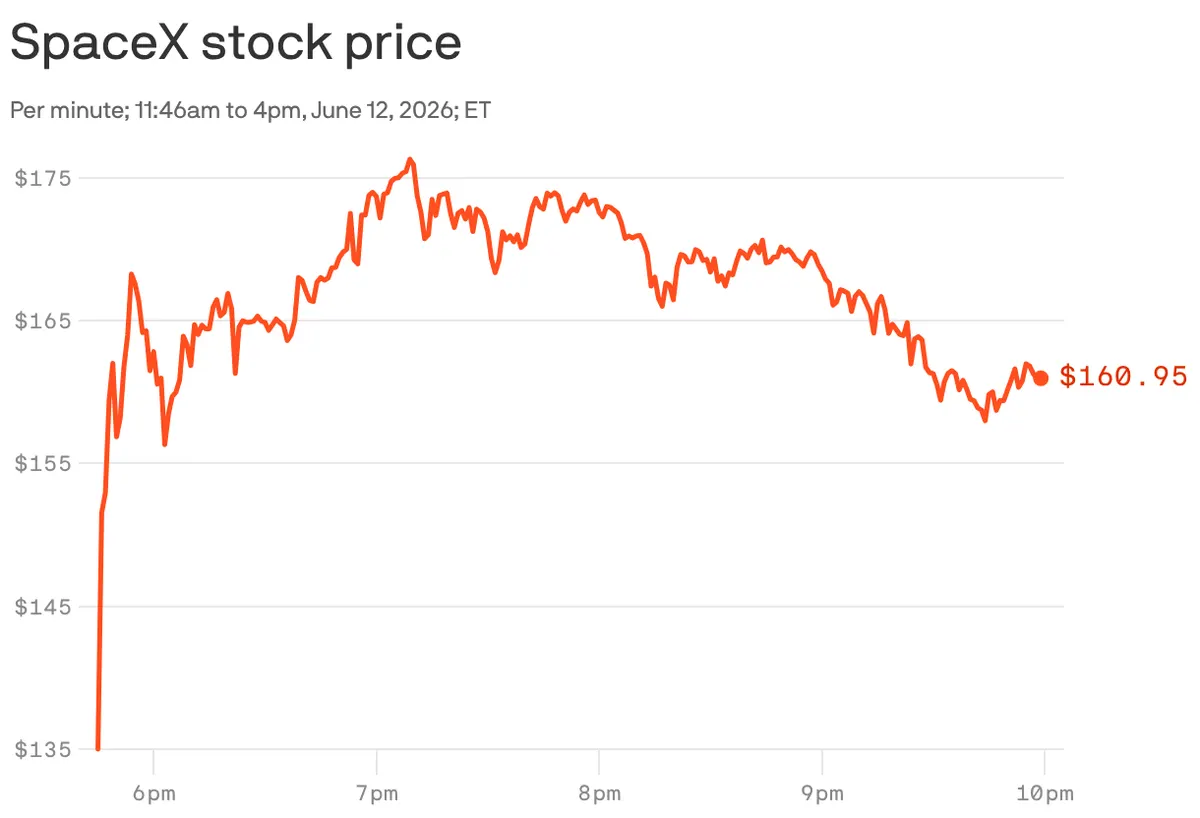
SpaceX shares rose 19% in their first trading day, landing it as the sixth-largest company in the U.S.
Why it matters: Elon Musk’s company ended Friday with a $2.1 trillion market cap, officially the biggest IPO in U.S. history.
Driving the news: SpaceX shares priced at $135 late Thursday afternoon.
Friction point: SpaceX went into its IPO trading at 90 times its sales. (Not profits. Sales.)
-
That indicates a valuation that is divorced from underlying business fundamentals, Adam Johnson, portfolio manager at the Bullseye American Ingenuity Fund, told Axios.
-
Historically, the majority of companies that go public underperform the market in the first three years, according to analysis from University of Florida finance professor Jay Ritter.
Yes, but: The top-performing companies in the S&P 500 are all trading at a premium to their underlying earnings, a dynamic that has been exacerbated by the euphoria around the AI boom.
-
“Hype is a borrowing, if you will, in the short term against future performance, so some companies will repay it,” Isabelle Freidheim, founder at Athena Capital, told Axios.
What we’re watching: What happens when the lock-up period ends.
OpenRouter fuses models into frontier rival
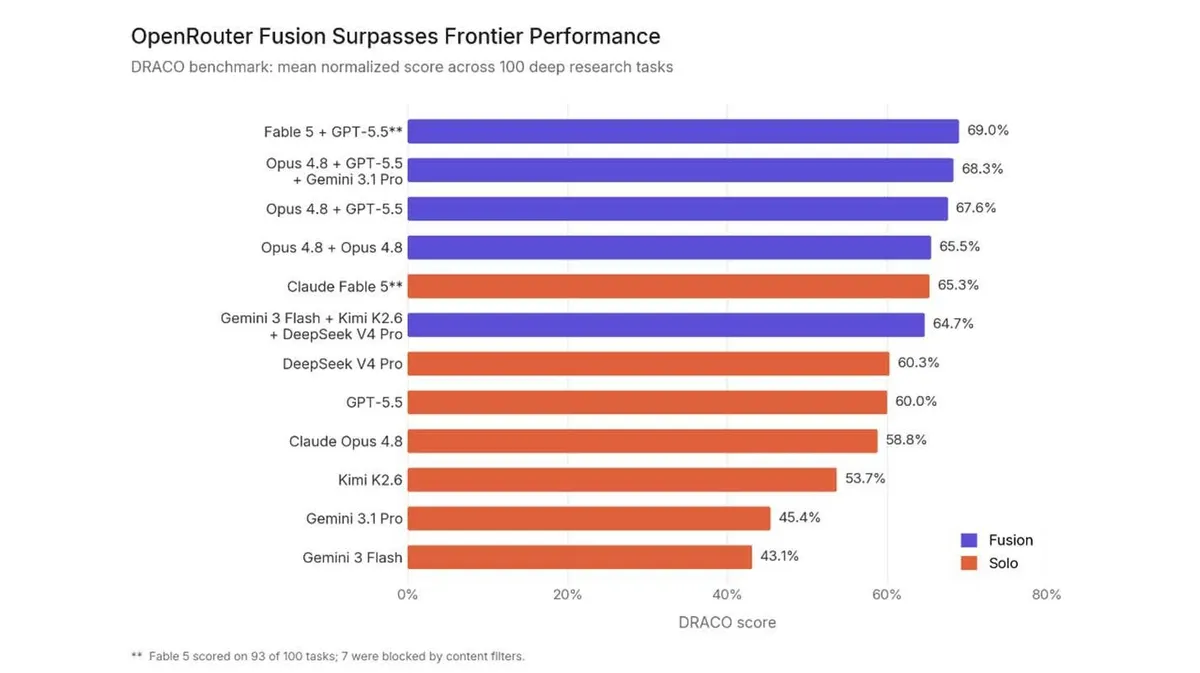
Image source: OpenRouter
The Rundown: OpenRouter just launched Fusion, an API that pools responses from multiple AI models into a single answer, with benchmarks showing the model panel nearly matches Fable 5’s deep-research performance at lower cost.
The details:
-
Fusion sends user prompts to several models at once, has a separate model evaluate each response, then merges them into one final reply.
-
A trio of DeepSeek V4 Pro, Kimi K2.6, and Gemini 3 Flash hit 64.7% on a Perplexity benchmark, just below Fable’s 65.3% for about half the spend.
-
CEO Alex Atallah pitched Fusion as a bet against one-model dominance, saying, “The future of AI is neurodiversity, not single-model takeovers.”
Why it matters: Model council-type solutions aren’t new, with Perplexity Computer, Grok, and others utilizing them. But OpenRouter’s easy API solution comes at an important time given the Fable restrictions, with some users potentially having to get creative with their ability to access frontier-level performance in the near future.
What Else Happened in AI on June 15th 2026?
Mark Zuckerberg is reportedly scrambling to contain a revolt inside Meta’s Applied AI unit after he admitted in a memo that Meta “made mistakes” with its AI restructuring.
Moonshot AI released Kimi-K2.7-Code, an open-source coding model posting double-digit gains over K2.6 on agent benchmarks while cutting reasoning-token use by 30%.
McDonald’s is piloting ArchIQ, a Google-powered AI drive-thru system at five locations, two years after it shelved its last AI test when wrong-order videos went viral.
China’s universities have scrapped more than 12K programs over the last five years, swapping arts and languages for tech fields as AI alters the graduate job market.
Meta has reportedly begun unwinding its $2B Manus deal after Beijing ordered the acquisition reversed, cutting off data sharing while the Chinese AI agent startup’s founders rush to raise $1B for a buyback.
Anthropic: Statement on the US government directive to suspend access to Fable 5 and Mythos 5
Anthropic to meet with Trump administration over Mythos dispute
Tyler Cowen: A few thoughts on the recent Mythos brouhaha
Ben Thompson: Anthropic’s Safety Superpower
WSJ: Anthropic Sued Over Limits on Its $200-a-Month AI Plans
OpenAI introduces OpenAI Partner Network
WSJ: OpenAI Investigated by Coalition of State Attorneys General
Satya Nadella: A frontier without an ecosystem is not stable
Dylan Patel announces SemiAnalysis Teardown Engineering & Evaluation Lab (STEEL)
NVIDIA Targets $20 Billion in Its First Corporate Bond Sale Since 2021
Salesforce acquires Fin for $3.6B
Google Earth makes flight sim available to all users
Google files lawsuit against group using Gemini to send scam texts
UK government bans social media for British citizens under 16
SFGate: Airbnb host alleges $12K in damage after SF startup tested a robot in his house