
[AI DAILY NEWS RUNDOWN] Five Eyes Issue AI Cyber Warning, OpenAI Deploys Daybreak, and SpaceX Bags $6.3B Compute Deal (June 23, 2026)

🎧 Listen ADS-FREE: https://podcasts.apple.com/us/channel/djamgamind/id6760446113
Visit our Research Hub at https://djamgamind.com/pdfs
Today’s Sponsor:
-
AIRIA: The premier enterprise AI management platform engineered to deliver multi-model orchestration, deep token optimization, and zero-trust pipeline compliance. Access link available below.
Important Topics:
-
Five Eyes Alliance Issues AI Cyber Alert: Cybersecurity intelligence agencies from the US, UK, Canada, Australia, and New Zealand warn that automated AI models capable of taking down governments and corporations are mere months away, demanding immediate zero-trust and backup maturity.
-
OpenAI Launches GPT-5.5-Cyber and Project Daybreak: OpenAI updates its restricted cyber model to hit an 85.6% success score on CyberGym vulnerability benchmarks, rolling out the Daybreak Cyber Partner Program for enterprise security vendors.
-
“Patch the Planet” Open-Source Initiative Deployed: OpenAI collaborates with Trail of Bits, HackerOne, and Calif to fund automated AI patching for critical foundational codebases, including Python, Go, and cURL.
-
SpaceX Secures $6.3B Reflection AI Compute Deal: SpaceX signs a massive $6.3 billion computing power rental contract with Reflection AI, monetizing its Colossus data center clusters originally built for Grok model training.
-
Sakana AI Drops “Fugu” Multi-Agent API: Japan’s Sakana AI launches a multi-model orchestration platform to deliver frontier capabilities without the risk of US export controls, hedging against the government restrictions that muzzled Anthropic.
-
Trump Signs Dual Quantum Executive Orders: The White House mandates federal agency transition to post-quantum cryptography by 2031 and triggers a collaborative public-private push to build a scientifically viable quantum computer by 2028.
-
Radical Numerics Launches Omnii Genome Model: Spun out of Stanford with $50 million in seed funding, the lab introduces a proprietary genome language model capable of reading and writing DNA sequences at scale.
-
Meta Debuts Self-Branded Smart Glasses: Meta bypasses Ray-Ban and Oakley branding to launch standalone $299 “Meta Glasses” (Fury and Adventurer styles) manufactured by EssilorLuxottica as a silent industrial partner.
-
Google and DeepMind Bankroll A24 Studio: Google invests $75 million into indie film studio A24 to develop specialized, AI-powered storyboard and filmmaker workflows rather than raw text-to-video generation.
-
Walmart Acquires Ad Platform Vibe.co
-
Nvidia Rolls Out 100% Liquid-Cooled Rubin Servers: Nvidia announces that its next-generation Rubin architecture utilizes full liquid-cooling operating at hot-tub temperatures, completely eliminating water consumption waste.
🔗 RESOURCES
-
AI Learning App Recommendation: AI & ML Tutor PRO https://apps.apple.com/ca/app/ai-ml-tutor-pro/id1610947211
-
DJAMGATECH: Carrer Booster - Master AWS, Azure, AI & GCP Certifications | https://apps.apple.com/ca/app/djamgatech-ai-cert-exams-prep/id1560083470
-
Read Aloud wonderland bedtime Adventures:
https://wonderland-bedtime-stories.web.app/
⚗️ PRODUCTION NOTE: We Practice What We Preach.
AI Unraveled is produced using a hybrid “Human-in-the-Loop” workflow.
OpenAI’s new cyber model By Sam Sabin

Illustration: Allie Carl/Axios
OpenAI is releasing a more permissive version of its cybersecurity model, which the company says is designed for advanced, authorized security work.
Why it matters: Even as Anthropic remains in limbo with the U.S. government, the race to get advanced AI models into the hands of cyber defenders continues to heat up.
Driving the news: OpenAI is updating its GPT-5.5-Cyber model - which is only available to vetted cybersecurity companies and researchers - so it is both “more permissive and more capable for advanced, authorized cybersecurity work,” according to a blog post.
-
The updated model can perform deeper analysis across large codebases, identify security-relevant components, validate likely vulnerabilities, and develop and test software patches.
-
OpenAI says the updated GPT-5.5-Cyber achieved an 85.6% score on CyberGym, a benchmark that measures whether an AI agent can reproduce known software vulnerabilities in testing environments, compared with 81.8% for GPT-5.5.
The big picture: OpenAI is expanding access to its cybersecurity tools at a time when policymakers are paying closer attention to how advanced AI systems are evaluated, tested and deployed.
-
AI developers face a difficult balancing act: getting powerful cyber capabilities into the hands of legitimate defenders and researchers while limiting opportunities for malicious use.
Between the lines: OpenAI is also rolling out a series of new programs and capabilities designed to let vetted cybersecurity companies use its models to help secure customer environments.
-
The company is launching the OpenAI Daybreak Cyber Partner Program, which allows participating security vendors to use GPT-5.5 with Trusted Access for Cyber in the products and services they provide to customers.
-
Previously, approved organizations primarily used the company’s cyber models on systems they owned or were authorized to test.
-
OpenAI is also helping fund Patch the Planet, an initiative founded with Trail of Bits and developed in collaboration with HackerOne and Calif, aimed at helping open-source maintainers manage and remediate vulnerabilities identified with AI-assisted tools.
AI warning from intel agencies should be heeded
AI may soon be capable of completely dismantling our cybersecurity defenses.
In a joint statement, the Five Eyes cybersecurity alliance, which includes intelligence agencies from the US, UK, New Zealand, Australia and Canada, called for leaders to “act now” on AI’s cyber threats. The statement warned that AI models capable of taking down businesses and governments are mere months away.
The agencies said that frontier models are anticipated to “exceed current industry expectations,” fundamentally transforming both cyber offense and defense. While the tech provides cyber defenders with a new arsenal of tools to better protect systems, it also enables malicious actors to make their attacks faster and more complex and shrinks the window between discovering a vulnerability and acting on it. “The timeline is not years, it is months,” the agencies said.
Five Eyes urged business and government leaders to preempt these threats in several ways:
-
First, understand and assess the current risk, as well as the current state of preparedness, and be flexible to adapt to the quickly evolving threat landscape
-
Prioritize foundational cybersecurity best practices, including reducing attack surfaces, implementing strong identity controls, addressing vulnerabilities in legacy systems and accelerating the patching process
-
Give cyber leaders the authority and resources to defend properly
“It is not enough to have controls,” the statement said. “Leaders must be confident those controls will perform during a real incident. This requires reassessing long-standing trade-offs and using AI deliberately to strengthen defense - not just improve efficiency.”
Now, the race is on for organizations to solidify their security fundamentals and prepare for “machine-speed” attacks, Erik Avakian, technical counselor at Info-Tech Research Group, told The Deep View. This means that areas such as backups, asset inventory, zero trust, vulnerability management, and incident response need to be at a mature level.
“Now is the time to start exploring automation where it makes sense,” said Avakian. “AI speed and agility are too fast now and will only get faster. It’s going to end up forcing defenders to embrace more automation.”
The warning comes amid heightened fears about AI’s cybersecurity capabilities, especially following the release (and subsequent US government muzzling) of Anthropic’s Fable 5 and Mythos 5, the most powerful models in its lineup thus far. Anthropic itself said the Mythos Preview could quickly find software exploits, creating opportunities for attackers and other bad actors.
Rival OpenAI, meanwhile, is putting out its own offerings targeting cyberdefenders, including a slew of new tools as part of Project Daybreak debuted on Monday. OpenAI’s line-up includes an update to the Codex Security plugin, an expanded release of GPT‑5.5‑Cyber, a partner program to give organizations more access, and an initiative called “patch the planet,” which helps find and fix vulnerabilities in popular open source projects.
But solving this problem may extend beyond just any one model provider, organization or enterprise, said Avakian.
“I believe strongly that this is a shared responsibility,” he said. “Governments and AI providers both certainly have responsibilities around guardrails, standards, and safety. But business organizations can’t just outsource accountability for their own cyber risk.”
Sakana’s orchestration model aims at the frontier
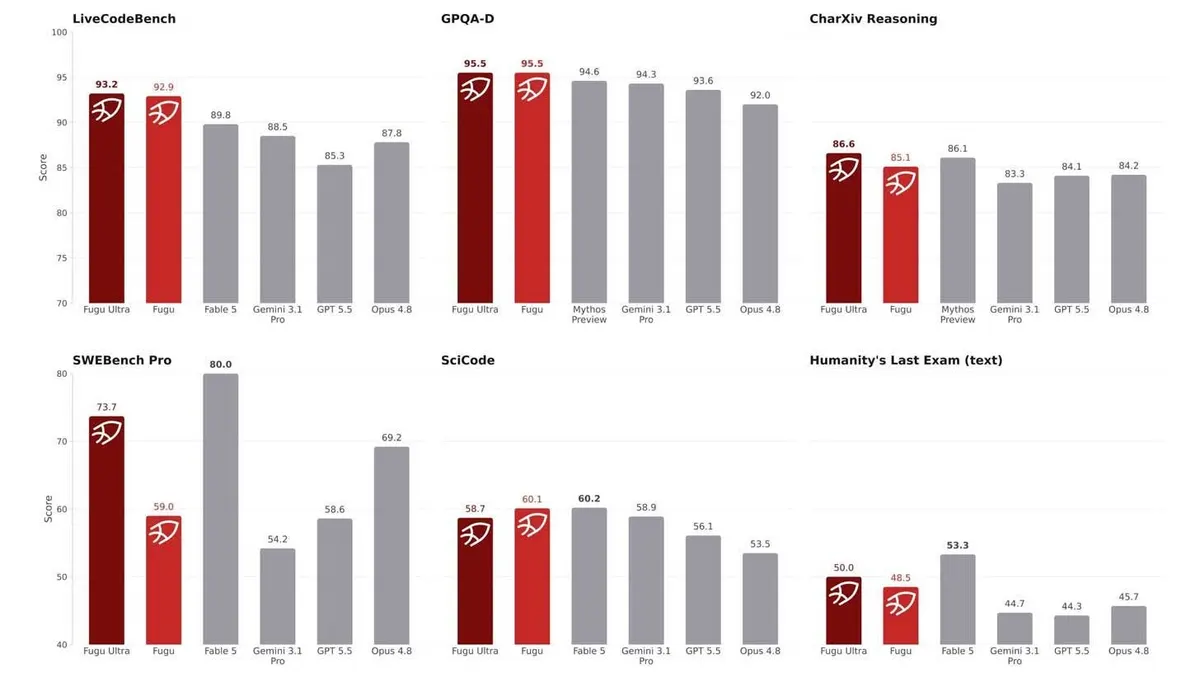
Image source: Sakana
The Rundown: Japan’s Sakana AI launched Fugu, a model that farms each request out to a pool of models through a single API, pitching multi-agent orchestration as a hedge against the export controls that pulled the plug on Anthropic’s Mythos and Fable.
The details:
-
The core model chooses helpers, assigns work, checks results, and merges answers, hiding the multi-agent setup behind one API.
-
It comes in two versions on one API, with a faster Fugu for everyday coding and chat, and a heavier Ultra built for jobs like patent research and security testing.
-
Sakana claims both Fugu models perform above or near Fable 5 and the Mythos preview on several coding, reasoning, and science tests.
-
Sakana also pitched Fugu as “delivering frontier capability without the risk of export controls” following the ban of Anthropic’s top models.
-
Reception has been mixed, with users reporting the model not performing at the frontier level and skepticism on model mix and cost.
Why it matters: Similar to OpenRouter’s Fusion, model orchestration is leading to interesting outcomes for labs trying to reach the frontier in creative ways. But the cost and lack of visibility for Fugu’s underlying models, combined with early reviews that don’t match the benchmarks, have us putting this in the wait-and-see file for now.
SpaceX leases Colossus compute to Reflection AI
The Rundown: SpaceX signed a deal with AI startup Reflection AI to rent $6.3B of Nvidia computing power, adding another new tenant to its Colossus data centers that are becoming a big AI moneymaker despite initially being built for its own Grok models.
The details:
-
The deal is the smallest of SpaceX’s compute customers, with Anthropic at $1.25B a month, Google at $920M, and Cursor now acquired entirely for $60B.
-
The Colossus supercomputers began as Grok’s training engine before shifting to provide compute capacity for other labs over the last year.
-
Reflection launched in October to build open frontier systems for government and enterprise, though it has yet to release a public model.
Why it matters: Grok may not be at the frontier, but that isn’t stopping Elon Musk and co. from cashing in on the other end of the equation - turning Colossus’ into rental centers for the compute crunch. Between an infra surge and space data center plans, SpaceX is looking well-positioned regardless of model performance.
Google bankrolls A24 to build AI filmmaker tools
Image Source: A24 / Google DeepMind
The Rundown: Google just put $75M behind indie film studio A24, pairing it with DeepMind to provide access to AI infrastructure and researchers - positioning the coming tools as filmmaker-shaped workflows rather than complete AI movie generation.
The details:
-
The deal gives Google its first studio stake, while A24 gets DeepMind research support across several projects without handing over any film library or data.
-
A24’s tech arm, led by ex-Adobe exec Scott Belsky, is building AI storyboards that he said “won’t look anything like the prompted generation type of AI”.
-
The move ironically comes following A24’s ‘Backrooms’ success, with director Kane Parsons calling AI “a symptom of a broader cultural and economic rot.”
Why it matters: Hollywood keeps swinging between suing AI firms and signing with them. This partnership looks to avoid some of the core knocks on the tech’s use in the industry - but as we recently saw with director Martin Scorsese, even the lightest of AI touches can still be a bridge too far for a fanbase increasingly hostile towards it.
Trump signs order to boost quantum research LINK
-
President Trump signed two executive orders on Monday meant to push research into quantum computing forward and tighten security practices in preparation for the risks a post-quantum world could bring to online systems.
-
One order calls for building a quantum computer strong enough for scientific research, tells federal agencies to plan for quantum-enabled technology, and seeks to boost domestic supply chains for quantum infrastructure and materials.
-
The second order aims to speed migration to post-quantum cryptography by 2031, protecting systems against quantum threats that could break the encryption algorithms long used to secure private information online.
Meta launches its own smart glasses LINK
-
Meta is launching its own line of smart glasses called Meta Glasses, dropping the Ray-Ban and Oakley branding entirely while still making them with EssilorLuxottica and selling them through the same retail stores.
-
The new glasses start at $299, undercutting the $379 Ray-Ban Gen 2 and $499 Scriber and Blazer Optics models, while keeping the same comfort fit, battery life, camera quality, and dual-camera AI rocker button.
-
The lineup includes the chunky “Fury” frame, the more compact “Adventurer,” and a Kylie Jenner design called the Starfire Kylie Edition, which has oval lenses, an embedded gem, and a charging case with a vanity mirror.
OpenAI’s ‘Patch the Planet’ takes on Anthropic LINK
-
OpenAI has teamed up with cybersecurity firm Trail of Bits on a program called Patch the Planet, which uses AI to find and fix security flaws in widely used open-source software that enterprises depend on.
-
The program starts each engagement by consulting maintainers, then uses OpenAI’s models and Codex Security to investigate vulnerabilities, while Trail of Bits engineers review findings to filter out false positives before they reach the projects.
-
Initial participants include Python, Go, cURL, and python.org, and the work has already identified hundreds of security issues and merged dozens of patches, with HackerOne and Calif supporting triage and disclosure.
China retakes world’s fastest supercomputer crown LINK
-
China has taken back the title of world’s fastest supercomputer for the first time since 2017, with its LineShine machine hitting 2.198 Exaflops and beating the previous leader, El Capitan, at the Lawrence Livermore National Laboratory.
-
LineShine got around US technology embargoes by avoiding GPUs entirely, instead running on a custom 304-core processor with 13.79 million cores at 1.55GHz, drawing 42.2 megawatts for an efficiency of 52.07 Gigaflops per watt.
-
The previously unlisted machine, built by the National Supercomputer Center without public funding, kept some details hidden, including which company made the CPUs and the type of chip technology used in its design.
One startup’s quest to make a DNA language model
We typically think of AI models as built around language. But one startup is creating models built around the “grammar of our DNA.”
Radical Numerics, an AI research lab spun out from Stanford University on the quest to build “general biological intelligence,” emerged from stealth last week with $50 million in seed funding. Additionally, the company announced its latest model: Omnii, a “genome language model” built for researchers and biologists, in research preview.
“Most of the DNA in the human genome, we still don’t actually understand what it does. We don’t understand the grammar, so to speak, of our DNA,” Eric Nguyen, CEO and co-founder of Radical Numerics, told The Deep View. “We thought this was a way to accelerate our understanding of disease, and hopefully to make treatments to cure disease.”
Though the company has only just revealed itself to the public, it’s been at work for almost a year, said Nguyen, and has already created and released models.
-
Evo and Evo 2, its first two models, are the first AI models capable of both reading and writing DNA at scale. The project is entirely open source, Nguyen said, and was used to design novel CRISPR systems and create the first complete AI-designed genome, called a bacteriophage.
-
Because the field is so nascent, the company released these models open source as a means of pushing innovation and getting it in the hands of researchers “in an open way,” he said. “We felt that we had to show people the recipe and make it open source to actually drive adoption.”
However, amid a growing discussion of AI’s potential use in developing bioweapons, Nguyen said that the company approaches its technology in a “dual prong” way, considering the tech for both biological design and biological defense. It’s why the company decided to keep Omnii proprietary, compared to its Evo predecessors: Being able to control who has access to its models is vital. “We don’t want this to be an academic toy anymore,” Nguyen said.
“We realized that this technology has this tremendous potential, obviously, to understand human health, but it can be potentially misused to create something very dangerous,” he added.
Meta debuts self-branded smart glasses:
After collaborative smart glass releases alongside Ray-Ban and Oakley, Meta is striking out on their on (sorta). The social media giant announced a new line of smart glasses under the Meta label - $299 Meta Adventurer and Fury styles, along with the $399 Starfire model that’s co-branded alongside Kylie Jenner - all coming in at a significantly lower price than the Gen 2 Ray-Ban Wayfarers. Note the “sorta” above: that’s because Ray-Ban and Oakley parent co EssilorLuxottica SA is still designing and manufacturing the glasses, just as a silent partner this time around. The question around these wearable AI accessories remains the same: are mainstream consumers lagging behind because they’re not interested in smart glasses? Is it due to privacy concerns? Or is the lack of interest so far just because no one has released the RIGHT smart glasses, that satisfying nail both form and function. Meta and soon Apple aim to finally find out.
Walmart acquires Vibe.co:
Vibe’s platform helps advertisers design their own digital ads, then purchase spots for them on major streaming platforms. Of course, Walmart spends a lot on advertising each year, but that’s not the play here. They’re looking to SELL more ads on platforms like Walmart Connect - which offers ad inventory in Walmart stores and the retail giant’s own advertising - along with the native ad-supported streaming apps on Vizio smart TVs. Walmart hopes that Vibe’s tech will encourage more ad buys from small businesses that are traditionally left out of the digital ad landscape. Vibe co-founders Arthur Querou and Frank Tetzlaff will ease the transition by joining the Walmart Connect team full time. No word on how much Walmart paid for these immaculate Vibes.
POTUS signs quantum computing EOs:
The new orders attempt to boost the nascent quantum computing industry while also prepping the country’s frequently-threatened cybersecurity infrastructure for its arrival. One order directs the Energy Dept. and other federal agencies to start working with private interests and academics on a functioning quantum computer, with 2028 set as the goal for completion (or at least next steps). Another order directs federal agencies and national security experts to investigate possible counter-measures against the decryption and hacking potential of a future quantum system. WSJ reports that the Commerce Dept. is pumping “billions of dollars” into various companies exploring quantum projects, including IBM, Microsoft, and Google. Quantum computing is no longer merely theoretical: Google’s Willow chip is already capable of lightning-fast computations that would take conventional systems trillions of years or more to resolve. But it remains to be seen how practical or useful quantum could be in real-world scenarios, particularly considering the fragility of qubits, their essential building blocks.
What Else is Happening in AI on June 23rd 2026?
The Five Eyes cyber agencies released a warning that AI is changing cyber risk in “months, not years,” urging execs to harden defenses as attacks speed up.
OpenAI expanded its Daybreak cyber program, adding a Codex Security plugin, the full GPT-5.5-Cyber model, and a “Patch the Planet” effort to fix open-source flaws.
Micron signed a new strategic deal with Anthropic to supply memory and storage chips and co-design AI infrastructure, also investing in the lab’s Series H round.
California Rep. Sam Liccardo introduced the SKILL Act, which would offer companies up to $5,000/worker in tax credits to fund AI job-training at colleges.
AI compute company Baseten announced a $1.5B funding round at a $13B valuation, after revenue grew roughly 20x in a year and its platform hit 1B+ daily inference calls.
NVIDIA said its Rubin servers are the first with 100% liquid cooling, running coolant at hot-tub temperature to cut cooling energy and reducing water use by “up to 100%”.