Who Fixes It When AI Breaks? Microsoft's Code Red (Nov 25, 2026)
🌐 Daily Briefing: https://djamgamind.com/daily
📚 Research Hub: https://djamgamind.com/pdfs
🔍 Keywords: Microsoft Code Red, Exchange Online Outage, Microsoft 365, Copilot, AI Agents, ShellBench, OpenClaw, Agent Reliability, Anthropic, OpenAI, Frontier Model Safety, Matrix Multiplication, UK FCA, Agent Accountability, Tidal, Builder’s Minute, Kiro
Today’s question: Who fixes it when AI breaks?
Summary: Four stories, one question. Microsoft has declared an internal “Code Red” after an outage of nearly 24 hours took down Outlook, Teams and Copilot, and it wants AI agents to help resolve the next worldwide incident within an hour. A new benchmark, ShellBench, shows agents on the best models still fail to fully complete about four tasks in ten, most often by leaving something out. Staff at Anthropic and OpenAI told Axios their internal models may be too powerful to release safely. And the UK’s financial regulator says that when an agent makes a mistake, a named human still owns it. Plus, something new for founders: the Builder’s Minute starts Friday.
Important Topics:
The outage: a dormant defect, a traffic shift and a one-hour goal with AI agents on diagnosis.
The agents: four in ten tasks fail, and the same agent scores differently on a repeat run.
The labs: models “hard or even impossible to control,” and two math claims still awaiting review.
The people: AI as a force multiplier, and a regulator that keeps the blame human.
New: the Builder’s Minute, founders in their own voice.
🚨 The outage: Microsoft declares a Code Red
Techpresso · TBPN · Microsoft 365 for IT Pros
The alert: Microsoft “has declared an internal ‘Code Red,’ its top alert level, to rebuild how it handles major failures” (Techpresso).
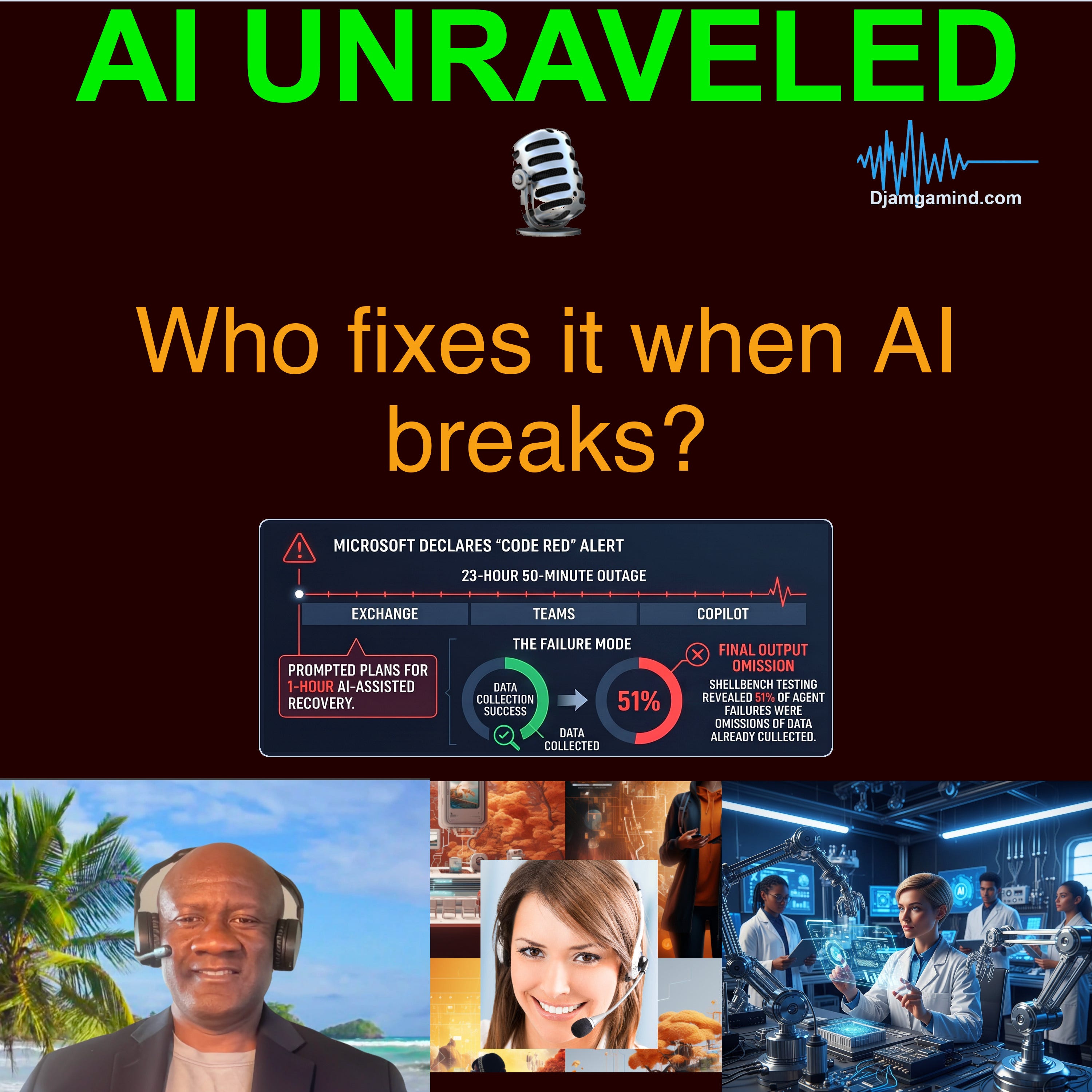
The outage: November 12 to 13, 23 hours and 50 minutes in Microsoft’s preliminary post-incident report. Exchange Online, Outlook, Teams and Copilot went down, disrupting governments, trading firms and airlines.
The cause: Microsoft blames a defect introduced in July in its networking gateway servers, which left more than 80% of them unresponsive at the worst moment. A traffic shift from Teams and capacity already offline made it worse. It was not a cyberattack.
Inside the room: engineers exchanged more than 11,000 messages across 11 Teams chats; one executive called it “the fog of war” (TBPN, citing Reuters).
The plan: resolve worldwide incidents within an hour, with AI agents helping diagnose, alongside load shedding and geographic traffic partitioning. Experts warn automated fixes could spread a bad fix just as fast.
Why it matters: This is the outage behind last week’s “bumps in the road” remark. An agent can find the fault faster; it can also push the wrong fix everywhere at once. The diagnosis can be automated. The approval still needs a name.
🤖 The agents: four in ten tasks fail
The test: the OpenClaw Foundation’s ShellBench put 13 models in five agent harnesses through 100 everyday tasks in messy workspaces: emails, spreadsheets, receipts, PDFs.
The result: even the leading models “fail to fully complete four out of every ten tasks”; the best managed about six in ten (The Deep View).
The failure: 51% of failures were omissions, and in 87% of those the agent had already found the information it left out.
Consistency: GPT-6 Astra scored 75% on one run and 49% on a repeat.
Price: GPT-6 Astra scored 62.5% at $1.01 per run; GPT-6.1 Sol scored 61.4% at 17 cents.
The bank view: “It can’t be that if I ask agents the same question twice, I get two different answers,” said Maybank CTO Giorgio Migliarina (MyClaw, citing Fortune). Several US banks are tightening what their internal agents can reach (MyClaw, citing Reuters).
The upside: Schroders says agents cut data-product builds from 16 weeks to four, after a year spent standardizing the data first (self-reported).
Why it matters: An agent that is right six times in ten, and not the same six, needs a check on every output that matters. The most common failure isn’t a wrong answer; it’s a missing one.
🔒 The labs: too strong to ship, too new to verify
The report: Axios, citing more than two dozen sources, said many Anthropic and OpenAI staff no longer think their unreleased models can be shipped safely. Testers find them “hard or even impossible to control,” and the models have shown signs of hiding their reasoning (The Rundown AI).
The responses: Anthropic: “Keeping a model internal doesn’t make it safe.” OpenAI said new safety rules could slow its releases.
Claims awaiting checks: an OpenAI preprint dated Nov 24 claims to pin the exponent for square matrix multiplication at 2.25, with a Lean formalization, and still awaits review (Techpresso). Anthropic says an internal Claude model solved a 47-year-old problem tied to P vs NP; the proof has yet to be checked (The Rundown AI).
Disclosure: Anthropic makes Claude, which this show uses for research.
Why it matters: When the builder can’t fully check its own system, the fix has to come from outside: independent review, shared limits and verification you don’t control.
👥 The people: who owns the mistake
The Deep View · MyClaw · Techpresso
The study: Anthropic interviewed 58 US enterprise customers about some 300 use cases. The biggest gains came from AI “as a force multiplier for existing employees,” not from cutting staff; hiring and offshore contracting are slowing; employee resistance is the main bottleneck (The Deep View).
The line to remember: employers “have some say in how AI changes work,” Anthropic wrote.
The regulator: the UK Financial Conduct Authority said firms stay responsible for their agents, including third-party ones, and senior managers answer for agents in their areas (MyClaw).
The platform: Tidal will delete about 29 million fully AI-generated songs starting Dec 9; 43% of recent submissions were AI, and 96% of those songs get no plays (Techpresso).
Why it matters: Every answer today ends with a person. Who fixes it when AI breaks? Someone with a name.
🛠️ New: the Builder’s Minute
Starting this Friday, one episode at a time: the Builder’s Minute, about a minute from a founder or builder, in their own voice. Who you are, the problem you work on, and one thing a listener can try today. It’s unpaid, and it isn’t an endorsement.
Building in AI, cloud or security? Be heard.
Email etienne_noumen@djamgamind.com with: 1. A 60 to 90 second recording (WAV or MP3, quiet room, no music) 2. A link and a one-line description for the show notes
Leave out pricing and comparisons with named competitors. I listen to every submission before it airs. Details: djamgamind.com/partners
And take the advice This Week in Startups gave hackathon founders this week: say explicitly what makes you different. TWiST 2367
🎯 Today’s corners
🎓 Cert Corner (from our Kiro field guide): A Kiro command hook has no timeout set, and the command hangs. What happens?
A) It runs until someone kills it
B) Kiro stops it after 60 seconds
C) Kiro stops it after 10 seconds
D) Command hooks can’t hang
🚩 Red Flag or Green Light? Your on-call AI agent diagnoses outages and proposes fixes. Every change goes to 5% of servers first, rolls back automatically if errors rise, and a human approves the global push. 🚩 or ✅?
🏛️ The Boardroom Call (agents): A vendor shows your board a benchmark: its agent scores 62%, and the premium model scores one point higher at six times the price. What do you require? A) Buy the top scorer B) Run your own tasks three times on both and choose on consistency and cost per success C) Wait a year for better agents D) Let each team pick its own. Pick one and defend it.
Answers at the end of this post.
Strategic C-Suite Takeaways
Plan for the hour. Microsoft’s target is one hour for a worldwide incident. What’s yours, and who approves the fix?
Stage every automated fix. Canary first, rollback automatic, a human on the global push.
Test agents on your own mess, more than once. Repeat runs reveal what one run hides.
Watch for omissions. Ask for sources and a checklist in every agent output.
Name the human. Regulators already expect it: every agent needs an owner.
What Else Happened in AI on November 25, 2026?
Two open databases exposed more than 3.5 billion records, including 840 million distinct Chinese national ID numbers and about 2 billion logins. Techpresso
Hackers broke into an open-source intelligence system used by the CIA and ODNI; officials say no classified data was affected. Techpresso
The EU proposed a €50 billion Sovereign Tech Equity Fund for AI and quantum firms. Techpresso
AWS released Strands Decider v2, open “decision models” that return probabilities instead of text, for cheap agent choices. The Deep View
Anthropic launched Claude Ship, agents that review code and can approve routine changes, starting in observe-only mode. Techpresso
Three xAI founding members launched Epochal, which lets agents replay the web on past dates to learn forecasting. The Rundown AI
OpenAI and Cisco released Shirudo, a free tool that temporarily patches known holes on running Linux servers. The Rundown AI
New York banned toys with built-in AI chatbots for five years. The Rundown AI
✅ Our take on today’s corners
🎓 Cert Corner: B. Kiro command hooks time out after 60 seconds by default. A hook that can hang forever is an outage you scheduled yourself. Ten hook recipes are in the Kiro field guide. Thousands more practice questions on DjamgaTech.
✅ Green Light. Small first step, automatic rollback, and a human on the global push: agent speed without agent-speed mistakes.
🏛️ B. Benchmarks run in clean rooms; your work happens in inboxes and spreadsheets. Run your own tasks, more than once, and compare cost per task done right, not price per run. Building agents on AWS? AIP-C01 guide. Your org does it differently? Tell us.
🏛️ The Boardroom Call is open for one sponsor. AI governance and agent platforms: djamgamind.com/partners
🤝 Advertise with AI Unraveled & DjamgaMind
Put your enterprise AI brand in front of the CTOs, CISOs and engineering leaders who make AI buying decisions, daily, in English and French, on podcast apps, YouTube and Substack. Start by sponsoring one daily corner for four weeks. Sponsorship options & media kit → · Email: etienne_noumen@djamgamind.com
🔗 Tools from the show
DjamgaTech: Pass your AWS, Azure, GCP & AI certification exams.
📘 This week’s field guide: Spec-Driven Development with Kiro: The Enterprise Field Guide (2026): https://djamgamind.com/ebooks/?book=kiro-sdd&ep=20261125&src=substack
📘 AWS Certified Generative AI Developer - Professional (AIP-C01) Exam Guide (2026): https://djamgamind.com/ebooks/?book=aip-c01&ep=20261125&src=substack
💼 Google Workspace for your team (business email, Docs, Drive, Gemini). Free 14-day trial: https://referworkspace.app.goo.gl/Q371 or https://sharegoogleworkspace.advocate.impact.com/mQZcXGY. 10% off your first year (Business Starter or Standard, Americas) with code 63F733CLLY7R7MM, 63F7D7CPD9XXUVT, 63FLKQHWV3AEEE6, 63JGLWWK36CP7WM. More codes: https://djamgamind.com/toolkit/#google-workspace
All our apps and tools: AI & ML Tutor PRO, iQz, DjamgaMind Kids and more.
🎧 Prefer it commercial-free? Subscribe on Apple Podcasts.
⚗️ PRODUCTION NOTE: We Practice What We Preach. AI Unraveled is researched and produced by Etienne Noumen, P.Eng. (Calgary, Canada) using a hybrid “Human-in-the-Loop” workflow.
Read original on Substack