
AI Daily News Rundown: Google "Deep Think" Crushes Benchmarks, OpenAI's Ultra-Fast "Spark", & Anthropic's $30B Raise
Full Audio at
🚀 Welcome to AI Unraveled (February 13th, 2026): Your strategic briefing on the business, technology, and policy reshaping artificial intelligence.
This episode of AI Unraveled is made possible by AIRIA:
🛑 Stop fearing Shadow AI. Orchestrate it.
Your employees are using AI whether you approve it or not. The problem isn’t the innovation; it’s the lack of visibility.
Airia is the “Control Plane” for your entire enterprise AI stack. It allows you to say “Yes” to innovation without compromising security or blowing up your API budget.
Why we are partnering with them:
-
Unified Security: Get automated threat detection and governance across all your models and agents.
-
Real-Time Cost Control: Stop guessing your token usage. Manage budgets and quotas from a single dashboard.
-
Model Agnostic: Whether your devs want low-code or pro-code tools, they can prototype safely in a production-like environment.
👉Secure Your Stack: Get the Airia Demo: https://airia.com/request-demo/?utm_source=AI+Unraveled+&utm_medium=Podcast&utm_campaign=Q1+2026
Today, we cover Google’s massive comeback with Gemini 3 Deep Think, which is obliterating reasoning benchmarks. We also break down OpenAI’s new ultra-fast Spark coding model (powered by Cerebras chips), Anthropic’s historic $30B funding round, and the controversial plans for facial recognition in Meta’s smart glasses.
Timestamps:
-
00:00 – Headlines: Google Crushes Benchmarks, OpenAI’s Speed Shift, & Anthropic’s $30B Raise
-
00:15 – Host Intro: The AI Unraveled Flash Briefing
-
00:23 – Google Gemini 3 Deep Think: Crushing Reasoning Benchmarks (84% on ARC-AGI-2)
-
00:39 – OpenAI Spark: Ultra-Fast Coding on Cerebras Chips
-
00:54 – Anthropic Raises $30 Billion ($380B Valuation)
-
01:05 – Meta’s Facial Recognition Plans & The “AI Ruins Lunch” Study
-
01:22 – Sponsor Message: Secure Your Enterprise AI Stack with AIRIA
-
01:45 – Outro: Listen to the Full Deep Dive
Keywords:
Google Deep Think, Gemini 3, OpenAI Spark, Cerebras Chips, Anthropic Funding, Meta Facial Recognition, MiniMax M2.5, Apple Siri Delay, Workplace AI Study, DeepSeek Distillation.
🚀 Reach the Architects of the AI Revolution
Want to reach 60,000+ Enterprise Architects and C-Suite leaders? Download our 2026 Media Kit and see how we simulate your product for the technical buyer: https://djamgamind.com/ai
Connect with the host Etienne Noumen,
LinkedIn: https://www.linkedin.com/in/enoumen/
Youtube: https://youtube.com/@enoumen
X: @enoumen https://x.com/enoumen
⚗️ PRODUCTION NOTE: We Practice What We Preach.
AI Unraveled is produced using a hybrid “Human-in-the-Loop” workflow. While all research, interviews, and strategic insights are curated by Etienne Noumen, we leverage advanced AI voice synthesis for our daily narration to ensure speed, consistency, and scale. We are building the future of automated media-one episode at a time.
Google’s Deep Think crushes reasoning benchmarks
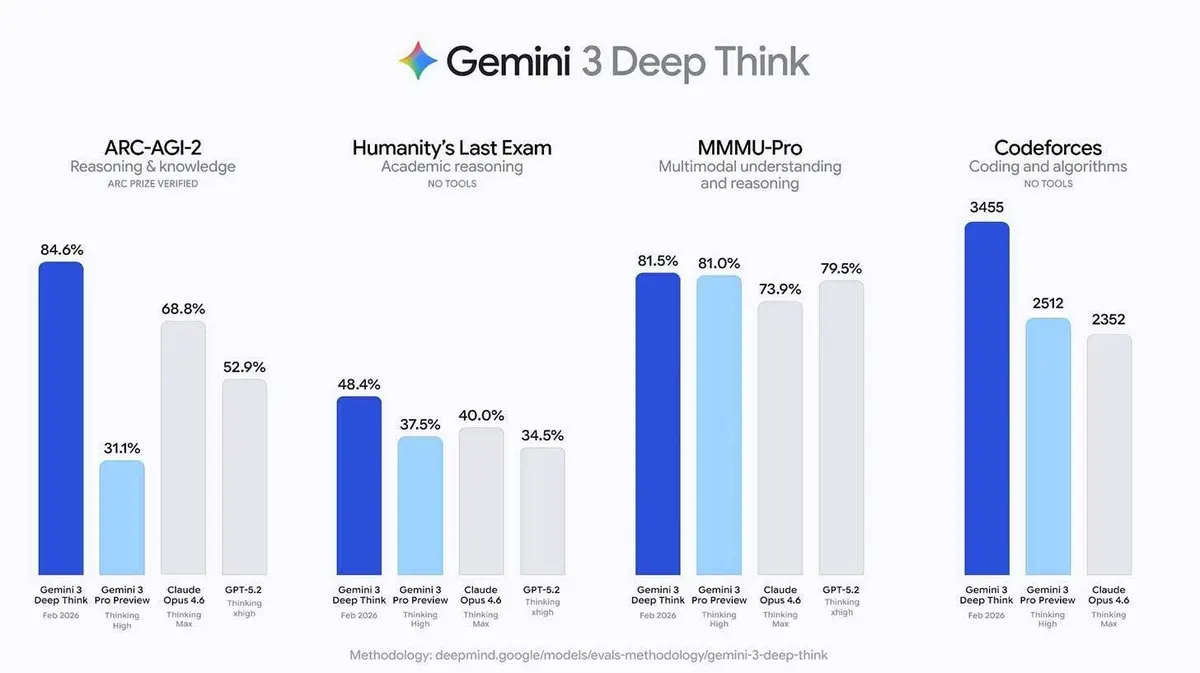
Image source: Google
Google just released a major update to its Gemini 3 Deep Think reasoning mode, posting dominant scores across math, coding, and science - while also introducing its Olympiad-level math research agent driven by the new upgrade.
The details:
-
Deep Think hit 84.6% on ARC-AGI-2, obliterating Opus 4.6 (68.8%) and GPT-5.2 (52.9%), and set a new high of 48.4% on Humanity’s Last Exam.
-
It also reached gold-medal marks on the 2025 Physics & Chemistry Olympiads and scored a 3,455 Elo on Codeforces, nearly 1,000 points above Opus 4.6.
-
Google also unveiled Aletheia, a math agent that autonomously solves open problems, verifies proofs, and hits new highs across domain benchmarks.
-
The Deep Think upgrade is live for Google AI Ultra subscribers in the Gemini app, with API access open to researchers via an early access program.
Why it matters: After Google dominated benchmarks and headlines to close 2025, the focus has been more on Anthropic and OpenAI in 2026 - but don’t forget about the tech giant as arguably the biggest powerhouse in the AI race. Deep Think’s scores are wild, and the frontier for math and science is quickly moving into uncharted territory.
OAI launches ultra-fast coding model on Cerebras chips
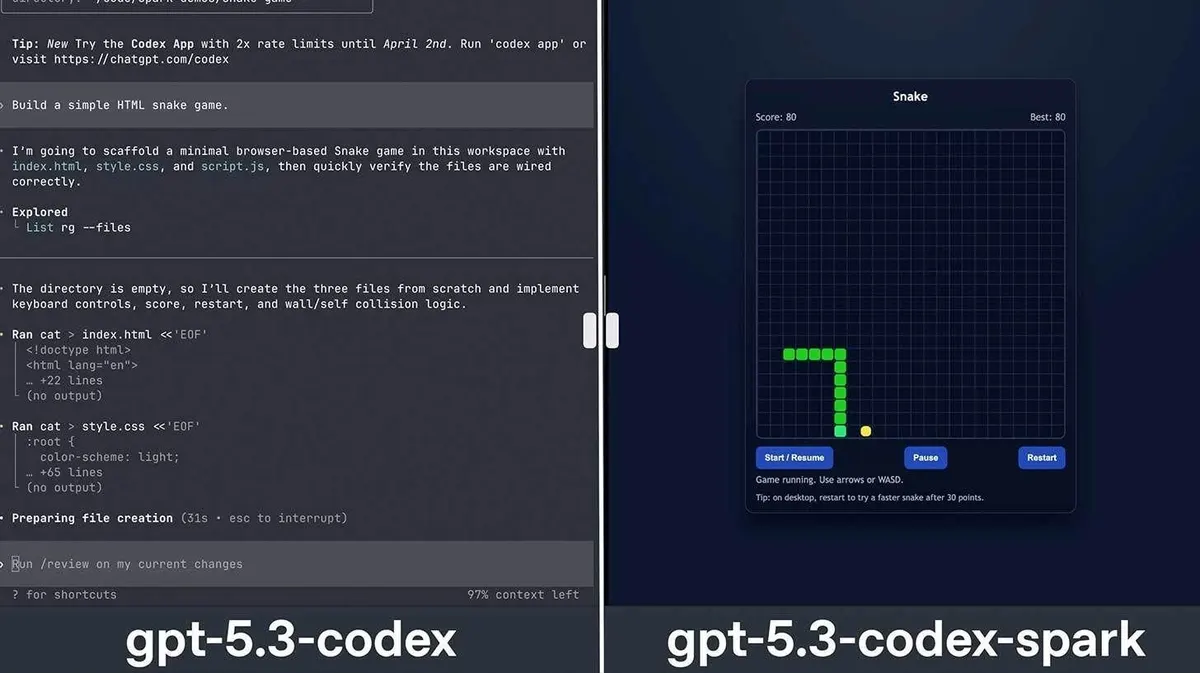
Image source: OpenAI
OpenAI released GPT-5.3-Codex-Spark, a new speed-optimized coding model that runs on Cerebras hardware, cranking out 1,000+ tokens per second and marking the company’s first AI product powered by chips beyond its Nvidia stack.
The details:
-
Spark trades intelligence for speed, trailing the full 5.3-Codex on SWE-Bench Pro and Terminal-Bench but finishing tasks in a fraction of the time.
-
The release comes just weeks after OAI inked a $10B+ deal with Cerebras and separate agreements with AMD and Broadcom, diversifying away from Nvidia.
-
OAI’s vision is for Spark to handle quick interactive edits while the full Codex tackles longer autonomous tasks in the background.
-
The model is rolling out as a research preview for ChatGPT Pro subs, with API access initially limited to a handful of enterprise design partners.
Why it matters: Codex’s main criticism has been its speed, and OpenAI just addressed it in a big way - while making its chip diversification play real with the first product built on Cerebras hardware. Real-time coding with instant feedback will definitely change workflows for development tasks that are able to compromise a bit of power for speed.
OpenAI’s new Spark model codes 15x faster thanks to new chip
-
OpenAI released GPT-5.3-Codex-Spark, a smaller model that generates code 15 times faster than its predecessor, powered by Cerebras’ Wafer Scale Engine 3 chip in the first result of their partnership.
-
Spark is built for real-time coding with quick, targeted edits rather than long-running tasks, cutting per-roundtrip overhead by 80% and time-to-first-token by 50% through streaming optimizations and persistent WebSocket connections.
-
The speed comes with trade-offs: Spark scores lower than GPT-5.3-Codex on software engineering benchmarks and falls short of OpenAI’s “high capability” threshold for cybersecurity under its Preparedness Framework.
Meta plans facial recognition for its smart glasses
-
Meta is planning to add a facial recognition feature called “Name Tag” to its Ray-Ban smart glasses, possibly launching as soon as this year, according to a New York Times report.
-
Name Tag would let wearers identify people and pull up information about them through Meta’s AI assistant, though the company is still deciding who should be recognizable through the technology.
-
An internal document shows Meta discussed releasing the feature since early last year, despite shutting down its Facebook facial recognition system five years ago over privacy and legal concerns.
Anthropic raises $30B at $380B valuation
-
Anthropic closed a $30 billion funding round at a $380 billion post-money valuation, more than doubling its worth since September and making it the second-largest private tech fundraising round on record.
-
The round was led by Coatue and Singapore sovereign wealth fund GIC, and includes portions of previously announced investments from Microsoft and Nvidia, which committed up to $5 billion and $10 billion respectively.
-
Anthropic said its annualized revenue has climbed to $14 billion, up from roughly $10 billion last year, driven by enterprise customers who are increasingly relying on Claude for how businesses work.
Amazon’s Ring cancels Flock partnership amid Super Bowl ad backlash
-
Amazon’s Ring and surveillance company Flock Safety have jointly cancelled their planned integration, which would have made it easier for police to request and receive footage from users’ personal cameras.
-
Ring blamed the cancellation on resource issues, but the partnership had faced significant criticism over privacy concerns, with some users disconnecting or destroying their devices over Flock Safety’s ties to ICE.
-
The cancellation came days after Ring’s Super Bowl ad for its AI-powered Search Party feature drew backlash, with viewers noting the pet-tracking technology could easily be used to track humans.
OpenAI accuses DeepSeek of distilling US AI models
-
OpenAI told a U.S. House committee that DeepSeek has been distilling its models - training smaller systems on outputs from OpenAI - and accused the Chinese company of bypassing access restrictions.
-
OpenAI claims it found accounts linked to DeepSeek employees using obfuscated third-party routers to extract outputs from its models, violating rules against building imitation frontier AI models.
-
A RAND Corporation researcher suggested OpenAI may be escalating now to block DeepSeek and other Chinese companies from acquiring more chips, helping U.S. firms keep their leading position.
Waymo launches next-gen Ojai robotaxis
-
Waymo has started running its sixth-generation driverless system on Ojai robotaxis, built on a base vehicle from Chinese automaker Geely, giving rides to employees first.
-
The company plans to expand Ojai service from San Francisco and Los Angeles to new cities, with a goal to open rides to public passengers later this year.
-
GOP lawmakers have criticized Waymo for using Chinese electric vehicles, but the company says it will not share its autonomous driving technology, sensor data, or rider information with Zeekr.
Apple delays its Siri overhaul again
-
Apple has delayed its AI-powered Siri overhaul again after testing in recent weeks uncovered problems with processing queries, slow response times, and accuracy issues in the software.
-
The company originally announced the revamped Siri in June 2024, promised it by early 2025, then pushed it to March 2026, and is now spreading features across iOS 26.5 and iOS 27.
-
Apple is also building a separate chatbot-style Siri for iOS 27, code-named “Campo,” powered by Google Gemini servers, alongside new features like web search and custom image generation.
AI pushes employees to work harder with fewer breaks
-
New research from UC Berkeley found that generative AI tools push employees to work harder, take on more tasks, and fill breaks with AI prompts, creating a workday with fewer natural pauses.
-
Despite saving hours each week, a Workday survey found employees spend nearly 40 per cent of their time checking AI output and fixing mistakes, with only 14 per cent seeing clear positive outcomes.
-
Researchers found the extra projects and responsibilities “accumulated into a meaningful widening of job scope,” and once the excitement fades, workers feel stretched from juggling everything suddenly on their plate.
Anthropic pledges to cover data center electricity cost increases
-
Anthropic has promised to cover electricity price increases that consumers face as a result of the company’s data centers, saying AI companies shouldn’t leave American ratepayers to pick up the tab.
-
The company will pay for 100% of grid upgrades needed to connect its data centers and work to bring net-new power generation online to match its electricity needs.
-
Anthropic is also investing in curtailment systems that cut its data centers’ power usage during periods of peak demand and supports federal permitting reform to speed up energy development.
Pentagon pressures AI firms to loosen military restrictions
-
The Pentagon is actively pushing major AI companies to remove their usual safety limits and allow U.S. military access to AI tools inside classified networks used for mission planning.
-
OpenAI struck a deal this week to put ChatGPT on an unclassified military network called genai.mil that reaches over 3 million Defense Department employees, removing many normal usage restrictions.
-
Several AI researchers are quitting companies like Anthropic and OpenAI, warning that risks are being ignored, while Anthropic has pushed back against letting its tech be used for automatic targeting or domestic spying.
MiniMax’s open-source M2.5 hits frontier coding levels
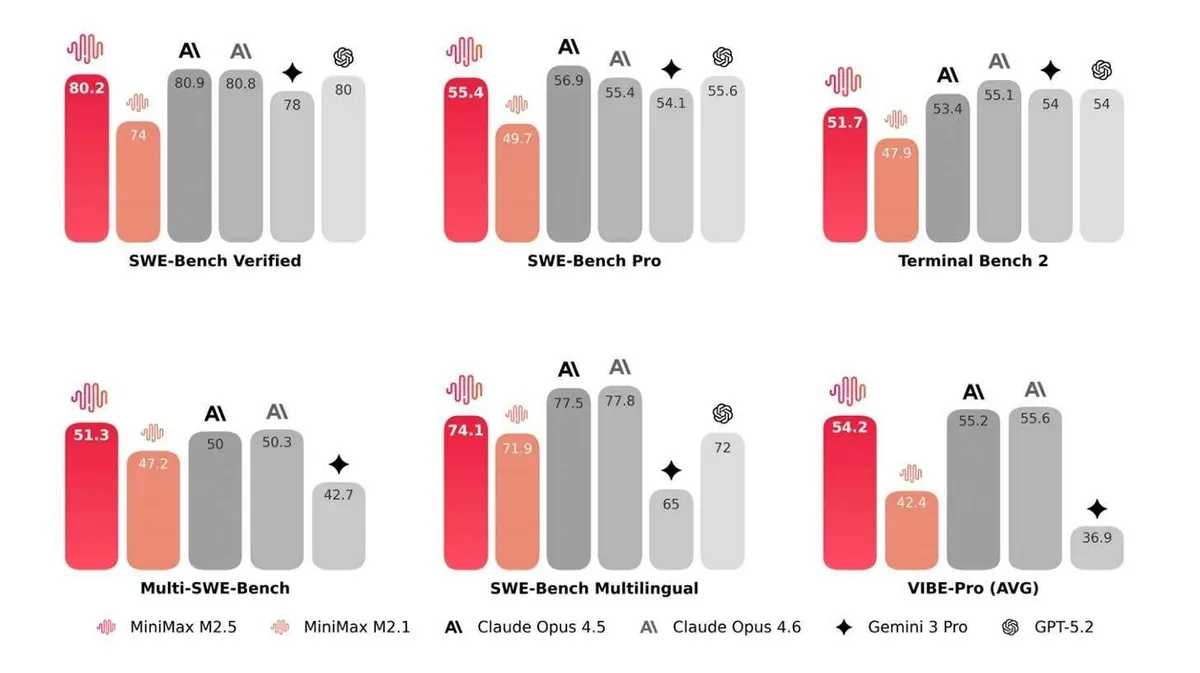
Image source: MiniMax
Chinese AI lab MiniMax launched M2.5, an open-source model that rivals Opus 4.6 and GPT-5 on agentic coding benchmarks - but at a fraction of the cost, making it cheap enough to power AI agents running around the clock.
The details:
-
M2.5 shows especially strong coding performance, scoring roughly even with Opus 4.6 and GPT-5.2 across key development benchmarks.
-
Two APIs are available: a faster M2.5-Lightning ($2.40/M output) and a standard M2.5 ($1.20/M output), both priced much lower than Opus ($25/M).
-
MiniMax revealed that M2.5 now handles 30% of daily company tasks across R&D, product, sales, HR, and finance, as well as 80% of new code commits.
-
The models are available via API, though the open-source weights and license have yet to be published.
Why it matters: Every few months, it feels like a Chinese lab drops a model that changes the cost math for the entire industry. M2.5’s frontier-level coding at this price makes “intelligence too cheap to meter” feel closer than ever, an important development as agents handling longer autonomous tasks become more common.
What Else Happened in AI on February 2026?
ByteDance officially launched Seedance 2.0, the company’s viral SOTA video model, publishing benchmark results and a technical blog, but access still remains restricted.
Mustafa Suleyman told FT that most white-collar work will be “fully automated by AI within 12 to 18 months,” with Microsoft pursuing “true self-sufficiency” with its models.
Elon Musk said that xAI’s wave of departures was forced, not voluntary - calling it a reorg for “speed of execution” after losing ten co-founders and engineers this week.
OpenAI is retiring GPT-4o, GPT-4.1, and o4-mini from ChatGPT today, coming amid pushback from users calling for 4o’s preservation.
Anthropic officially announced a new $30B funding round at a $380B valuation, with its revenue run rate hitting $14B - $2.5B of which comes from Claude Code alone.
OAI researcher Zoë Hitzig resigned after the launch of ChatGPT ads, warning OAI’s archive of human thought creates “unprecedented potential for manipulation.”