What a Generative AI Leader Actually Does
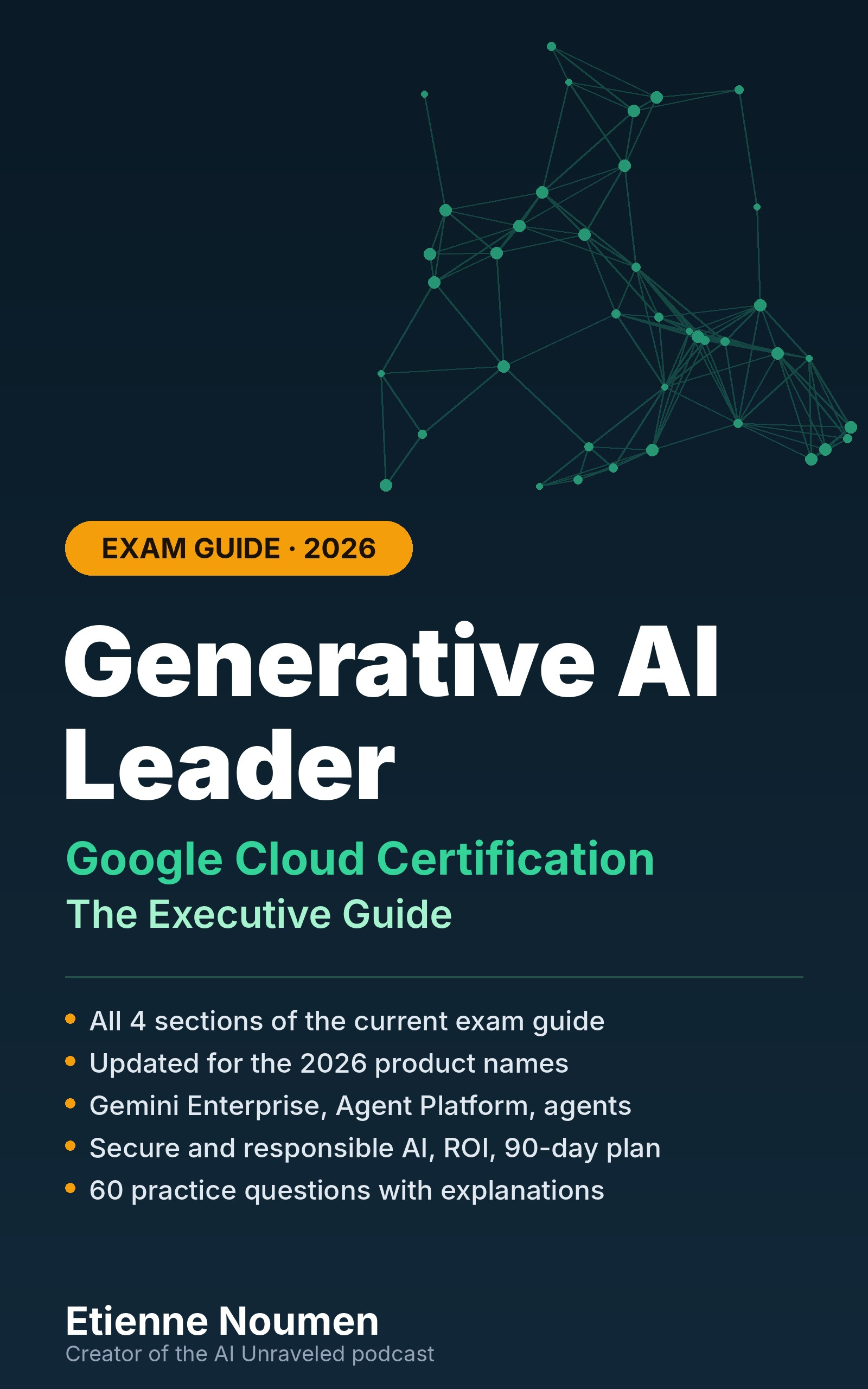
📚 Get the book: https://djamgamind.com/ebooks/?book=gcp-gail&ep=20261107&src=substack
🔍 Keywords: Generative AI Leader, AI leadership, AI strategy, Google Cloud certification, Gemini Enterprise, executives, AI adoption, ROI
Every company I talk to has the same story. Someone bought AI licenses. A few teams ran pilots. A dashboard shows thousands of chats a month. And when the CFO asks “what did we get for it?”, nobody has a clear answer.
The problem is rarely the technology. The models are good enough. What’s missing is a person who knows what the technology can do, what it can’t, and how to turn it into a result the business can measure.
Google gave that person a name. Its certification is called Generative AI Leader, and Google’s own exam guide says the role’s expertise is in “strategic leadership and influence, not technical implementation.” No coding. No prerequisites. Any job role.
I spent this week writing the 2026 edition of my study guide for it. Here is what I think the job actually is.
1. Decide which layer you’re investing in
Google describes five layers of generative AI: infrastructure, models, platforms, agents and applications. Every AI proposal lives in one of them, and the cost and risk change completely from one layer to the next.
“Roll out Gemini in Workspace” is an applications decision: weeks, low risk, mostly change management. “Build our own model” is a models decision: months, specialist skills, real money. A leader’s first question about any idea is: which layer, and why not a cheaper one?
2. Buy before you build
The fastest value comes from prebuilt tools. I think of it as a ladder, and you only climb a rung when the one below can’t do the job:
Individual productivity (an AI assistant, reusable custom assistants)
AI inside the tools people already use (email, documents, meetings)
Enterprise search and agents across company systems
Customer experience (virtual agents, help for human agents, conversation insights)
Custom applications and agents on an AI platform
Most organizations jump to rung 5 because it’s exciting. Most of the value is on rungs 1 to 3.
3. Ground it before you tune it
When an AI assistant gives a wrong or outdated answer, the instinct is to “train it on our data.” Usually that’s the expensive answer to the wrong problem.
If the issue is facts (current prices, policies, product details), the fix is grounding: connecting the model to your real sources, often through retrieval-augmented generation (RAG). If the issue is behavior (tone, format, house style), start with better prompts, and fine-tune only when that isn’t enough. And no setting, including “temperature”, fixes a fact the model doesn’t have.
4. Put a human where the stakes are
Google’s guidance is clear on this: human in the loop for sensitive fields like healthcare and finance, for high-risk decisions, and for reviewing outputs before and after they reach people. A Generative AI Leader decides, use case by use case, where a person must stay in the loop and who is accountable for the outcome. That decision is never “the AI team’s problem.”
5. Measure value, not usage
Chat counts are not impact. Before launch, measure a baseline: cost per contact, cycle time, error rate, customer satisfaction. After launch, report against it. If you can’t show the before, you can’t prove the after, and the program loses its budget at the next planning cycle.
6. Make it safe enough to scale
Security and responsibility are what let you move from pilots to production. That means controlling who can access what, watching your security posture, and following a framework (Google’s is the Secure AI Framework, SAIF). It also means knowing the details that trip up smart people. Example: pseudonymized data is not anonymous. If a key can link it back to a person, privacy rules still apply.
A vocabulary problem nobody warned you about
There’s one more reason this matters right now. In 2026 Google renamed most of its AI products. Vertex AI is now Gemini Enterprise Agent Platform. Vertex AI Search is Agent Search. NotebookLM is Gemini Notebook. The contact-center suite is Gemini Enterprise for Customer Experience.
If your vendors, your team and your board are using different names for the same thing, you will waste meetings. A leader keeps the vocabulary straight.
A 90-day plan you can start Monday
Days 1 to 30, vision and guardrails: a one-page AI vision tied to business goals, an acceptable-use policy, a clear rule on what data can go into AI tools, and one named executive sponsor.
Days 31 to 60, first wins: two or three high-value, low-risk use cases live on prebuilt tools, with baselines measured before launch and a champion in each function.
Days 61 to 90, measure and scale: results against baselines, a scale, fix or stop decision on each use case, and a roadmap for next quarter.
Then report four numbers to the board every quarter: value delivered, adoption, risk and capability.
Why the certification is worth it
You can do all of this without a certificate. But the Google Cloud Generative AI Leader exam is a structured way to make sure you, and your leadership team, share the same mental model and the same vocabulary. It’s 90 minutes, 50 to 60 multiple-choice questions, $99 on Google’s page today, with no prerequisites, and it’s valid for three years. It covers four areas: gen AI fundamentals (about 30%), Google Cloud’s offerings (about 35%), improving model output (about 20%) and business strategy (about 15%).
I’d go further: if you lead a team that’s adopting AI, have your managers take it together.
The book
I wrote Google Cloud Generative AI Leader Exam Guide (2026): The Executive Guide for exactly this reader.
All four sections of Google’s current exam guide, in plain business language
The full old-to-new product name table for 2026
The Executive Playbook: a use-case scoring grid, the build-or-buy ladder, the 90-day plan and the board scorecard
“Exam trap” boxes in every chapter and an exam-day keyword table
60 original practice questions, weighted like the exam, with an explanation for every answer
A two-week study plan
82 pages, PDF and EPUB. Get it on Google Play or Shopify →
Independent publication; not affiliated with or endorsed by Google. Practice questions are original and are not actual exam questions.
What’s the hardest of these six decisions in your organization right now? Reply or comment. I read every one.
🔗 Practise on your phone
DjamgaTech: Pass your AWS, Azure, GCP & AI certification exams.
AI & ML Tutor PRO: AI certification practice questions, with an explanation for every option.
💼 Google Workspace for your team (business email, Docs, Drive, Gemini), with discount codes: https://djamgamind.com/toolkit/#google-workspace
🤝 Advertise with AI Unraveled & DjamgaMind
Put your brand in front of the engineers, analysts and leaders who are building AI skills, daily, in English and French, on podcast apps, YouTube and Substack. Start with a 4-week trial on one named segment. Sponsorship options & media kit → · Email: etienne_noumen@djamgamind.com
⚗️ PRODUCTION NOTE: We Practice What We Preach. AI Unraveled is researched and produced by Etienne Noumen, P.Eng. (Calgary, Canada) using a hybrid “Human-in-the-Loop” workflow.
Read original on Substack