THE DEVELOPER AGENTIC ARENA: CURSOR vs. DEVIN DESKTOP vs. CLAUDE CODE vs. AGY vs. KIRO vs. AIDER
Author & Lead Analyst: Etienne Noumen, Professional Engineer & Founder at DjamgaMind (Calgary, AB, Canada)
Publication Date: Saturday, October 10, 2026
Dossier Classification: Special Edition Executive Whitepaper & Research Dossier
Research Archive: https://djamgamind.com/pdfs
Daily Intelligence: https://djamgamind.com/daily
INTRO:
Two of these six tools have been renamed. One was sold for $60 billion. One is built for enterprises on AWS. And one has not shipped a feature release in over a year.
I spent the week mapping where each one stands. Here is the short version.
1. THE SHORT VERSION & THE 2026 CONVERGENCE
Two of these six tools have been renamed, one was acquired for $60 billion in stock, one is built for enterprises on Amazon Web Services, and one has not shipped a feature release in over a year.
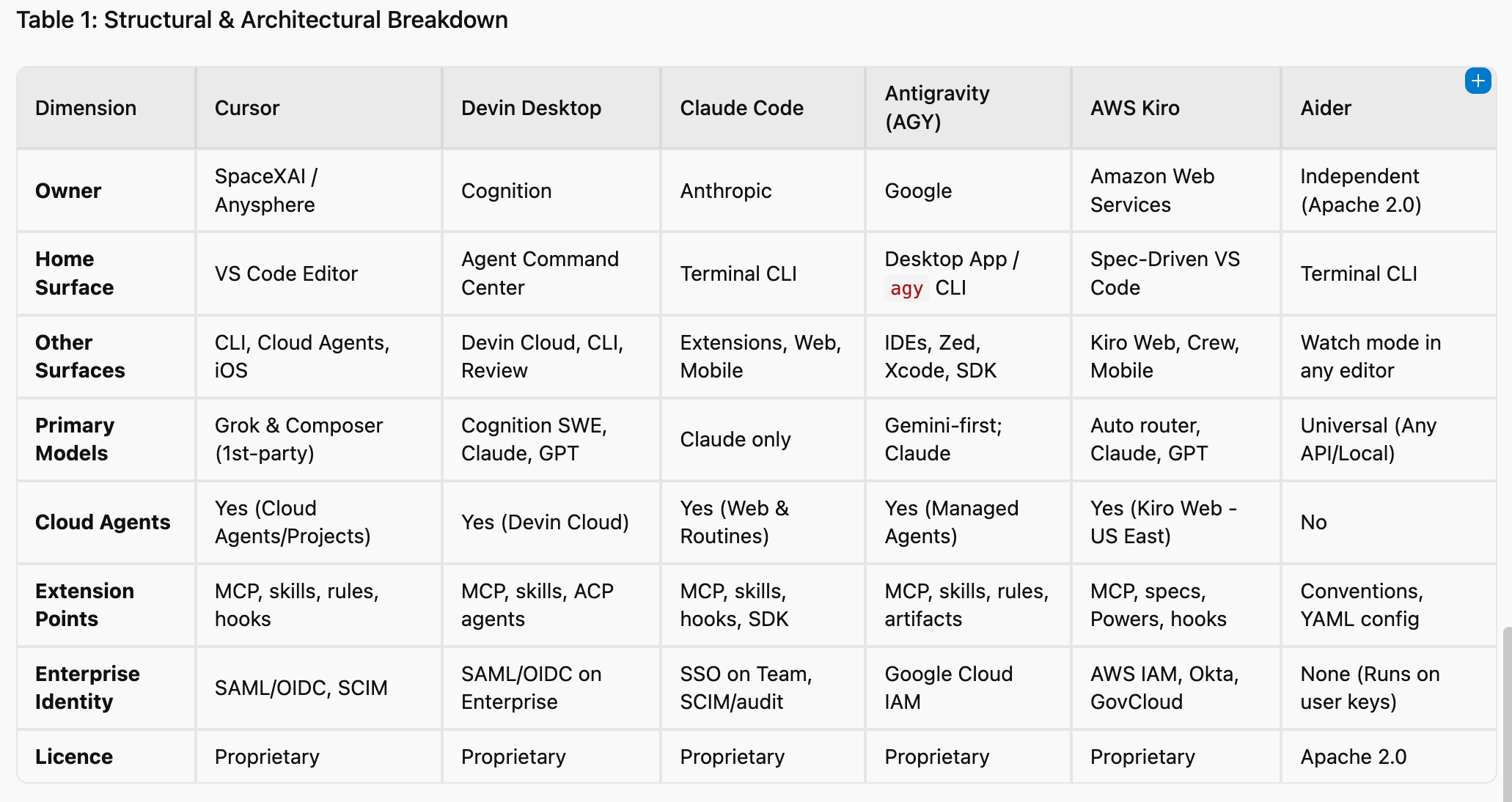
By October 2026 the developer tooling market has converged. Cursor, Devin Desktop (the former Windsurf), Claude Code, Google Antigravity (AGY) and AWS Kiro now ship much the same core kit:
An editor or desktop agent manager
A terminal command-line interface (CLI)
Cloud-hosted background agents
Extensibility through Model Context Protocol (MCP) servers, skills, hooks and subagents
Where they diverge, and where enterprise procurement decisions are won or lost, is corporate ownership, which model families they favor, how quotas and overages are metered, and how exposed they are to prompt-injection attacks.
The crucial industry developments:
The names developers still say. Two names are officially obsolete. Windsurf, which Cognition acquired in 2025, became Devin Desktop on 2 June 2026 and switched off its signature Cascade agent on 1 July in favor of Devin Local. AGY is the command name of Google’s Antigravity CLI, which replaced Gemini CLI for consumer accounts on 18 June 2026.
The $60 billion megadeal. SpaceX, which absorbed xAI in February 2026, agreed on 16 June to acquire Cursor’s parent company, Anysphere, for $60 billion in stock. The deal closed on 14 August, and Cursor’s pricing now tilts toward Grok and Composer models.
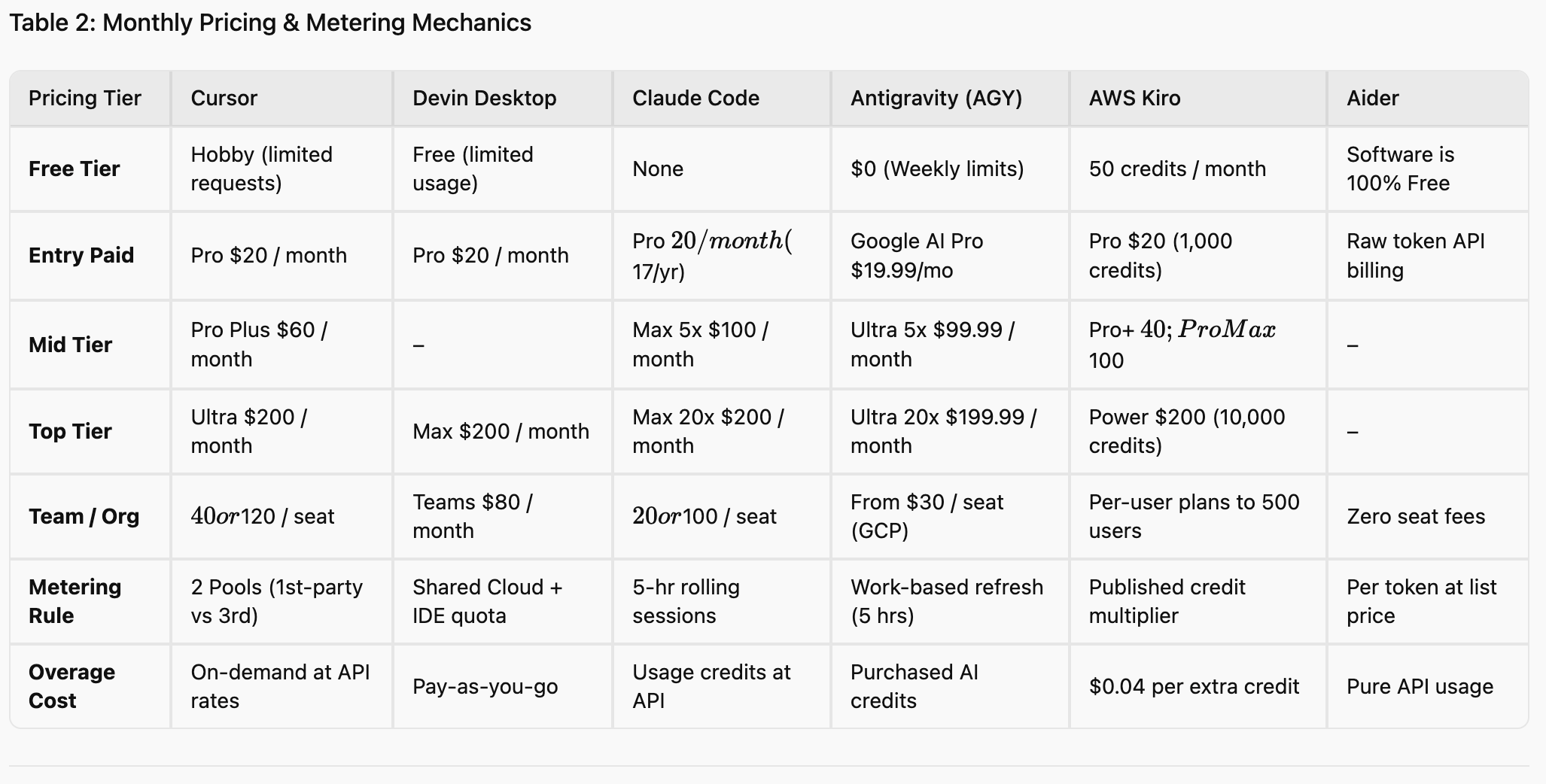
The pricing mirage. Headline individual plans have converged at roughly $20, $100 and $200 per month. What that money buys differs widely: the same $20 gets different models, allowances and overage rules in each product.
The AWS enterprise dark horse. Kiro is AWS’s agentic development environment, built around spec-driven development. It has enterprise sign-in through AWS IAM Identity Center, AWS billing, a GovCloud edition, and the most transparent per-model credit pricing of the group.
The stagnant pioneer. Five of the six tools belong to a model lab or a cloud hyperscaler: SpaceXAI, Cognition, Anthropic, Google and Amazon. Aider is the lone independent, open-source tool, and it has not shipped a feature release since August 2025.
The universal Achilles’ heel. Security is the shared weak point of 2026. Prompt injection through repository content, pull requests, issue descriptions and MCP tool metadata produced remote-code-execution and data-exfiltration vulnerabilities in several of these tools this year.
2. TIMELINE: HOW THE ARENA GOT HERE (2023–2026)
2023: Aider’s first public releases establish the terminal pair-programmer pattern, proving an LLM can edit a git repository without wrecking it.
May 2025: Anthropic fully launches Claude Code after a research preview.
July 2025: Google hires Windsurf’s founders in a licensing deal reported at $2.4 billion. Cognition signs an agreement to acquire the Windsurf product, brand and remaining team.
July 2025: AWS launches Kiro in preview. By Kiro’s account, more than 100,000 developers try it within five days.
17 November 2025: Kiro reaches general availability with team administration. The Amazon Q Developer CLI becomes the Kiro CLI under a proprietary license.
November 2025: Google launches Antigravity alongside Gemini 3 as a free, agent-first IDE.
February 2026: Aider ships v0.86.2, a patch release that is still the latest on PyPI. Claude Code’s annualized run-rate revenue is reported above $2.5 billion.
19 March 2026: Windsurf replaces credits with quotas and raises Pro from $15 to $20 a month.
19 May 2026: Google unveils Antigravity 2.0 at Google I/O: a standalone desktop app, a Go-based CLI (agy), a Python SDK and a new $100 Ultra tier.
2 June 2026: Windsurf is officially rebranded as Devin Desktop.
16 June 2026: SpaceX agrees to acquire Cursor’s parent, Anysphere, for $60 billion in stock.
18 June 2026: Gemini CLI stops serving free and individual paid accounts, which move to AGY.
14 August 2026: The SpaceX/Cursor acquisition closes, two days after Grok 4.6 arrives in Cursor.
10 September 2026: Cursor launches Projects, a coordinator agent that delegates to parallel subagents.
2 November 2026 (scheduled): Antigravity removes Claude 4.6 and GPT-OSS-120b, leaving its free tier Gemini-only.
30 April 2027 (scheduled): AWS ends support for the Amazon Q Developer IDE plugins and directs remaining users to Kiro.
3. SIX QUICK TAKES
Cursor. The most mature editor and the broadest menu of frontier models. Its own guidance puts daily agent use at $60–100 a month.
Devin Desktop (Windsurf). The home screen is now a board for supervising many agents, including rivals’ agents.
Claude Code. Terminal-first, and it runs everywhere from CI to your phone. Claude models only, and no free tier.
AGY (Google Antigravity). Starts at $0 and reviews agent work through plans, screenshots and recordings. Limits are unpublished.
Kiro. Sold in credits: two cents per included credit, four cents per extra one. No Gemini or Grok.
Aider. Runs on your own API keys, and every change is a git commit.
4. TWO MORE THINGS LEADERS SHOULD KNOW
Model neutrality is fading. Four of the five commercial tools have a house model and a financial reason to prefer it. Kiro is the exception.
An agent acts with whatever permissions it is handed. The Financial Times reported that Kiro caused a 13-hour AWS disruption last December. Amazon blamed a misconfigured role. Either way, the lesson is the same.
The products now look alike
Cursor, Devin Desktop (the former Windsurf), Claude Code, Google Antigravity and AWS Kiro all ship much the same kit: an editor or agent manager, a terminal CLI, cloud-hosted agents, and extension through MCP, skills, hooks and subagents. Prices have lined up too, at about $20, $100 and $200 a month. The differences are in who owns the tool, which models it favours and how usage is metered.
Six quick takes
Cursor. Now owned by SpaceXAI after a $60 billion deal that closed in August. It has the broadest menu of frontier models, but pricing tilts toward the owner’s Grok and Composer. Cursor’s own guidance puts daily agent use at $60–100 a month.
Windsurf. It became Devin Desktop on 2 June. The home screen is a board for supervising many agents, including rivals’ agents.
Claude Code. Terminal-first, and it runs everywhere from CI to your phone. Claude models only, and no free tier.
AGY (Google Antigravity). Starts at $0 and reviews agent work through plans, screenshots and recordings. Limits are unpublished, and the free tier narrows on 2 November.
Kiro. AWS’s spec-driven tool, with the strongest enterprise controls and the clearest pricing: two cents per included credit, four cents per extra one. No Gemini or Grok.
Aider. Open source, runs on your own API keys, and every change is a git commit. Its last feature release was August 2025.
Three things leaders should know
The same $20 buys different things. Only Kiro states its allowance as a number. Everyone else describes limits in relative terms.
Model neutrality is fading. Four of the five commercial tools have a house model and a financial reason to prefer it.
An agent acts with whatever permissions it is handed. The Financial Times reported that Kiro caused a 13-hour AWS disruption last December. Amazon blamed a misconfigured role. Either way, the lesson is the same.
How to choose
Run a two-week trial on your own repository. Give each candidate the same three tasks: a bug with a failing test, a multi-file change and a dependency upgrade. Then measure cost per merged change, not cost per seat.
The full article has profiles of all six tools, two comparison tables, a security baseline and 46 linked sources.
📄 Read the full PDF: https://djamgamind.com/pdfs/Developer-agentic-arena_1.pdf
🎧 Listen/watch ADS-FREE:
🔗 RESOURCES
AI Learning App Recommendation: AI & ML Tutor PRO https://apps.apple.com/ca/app/ai-ml-tutor-pro/id1610947211
DJAMGATECH AI Cloud Cert Prep: Carrer Booster - Master AWS, Azure, AI & GCP Certifications | https://apps.apple.com/ca/app/djamgatech-ai-cert-exams-prep/id1560083470
DJAMGAMIND KIDS Bedtime Adventures: https://djamgamindkids.com
iQz: I built a puzzle app because I noticed I was getting worse at thinking: It’s 65 puzzles: matrices, sequences, number series, verbal analogies and logic. Every answer explains the rule rather than just showing the letter. Free, fully offline, no ads, no account. https://apps.apple.com/app/id1603487636
Visit DjamgaMind AI Toolkits for all our AI Tools recommendations: https://djamgamind.com/toolkits
Read original on Substack