[SPECIAL EDITION] 💊AI vs. Cancer & Incurable Disease: What Google, Anthropic, OpenAI, Microsoft & Isomorphic Have Actually Proven (Oct 13, 2026)
🎧 Listen ADS-FREE:
🌐 Daily Briefing: https://djamgamind.com/daily
📚 Research Hub: https://djamgamind.com/pdfs
🔍 Keywords: AI Cancer Research, Incurable Disease, Google DeepMind, Anthropic Claude Science, OpenAI GPT-Rosalind, Isomorphic Labs, Insilico Rentosertib, Microsoft GigaTIME
Summary:
This week, Google CEO Sundar Pichai wrote that “Google’s models are helping scientists and clinicians turn research into real-world treatments.” He isn’t alone. In 2026, Anthropic launched Claude Science, OpenAI released GPT-Rosalind, Microsoft open-sourced a cancer-mapping model, and Google DeepMind, Isomorphic Labs and Meta joined a $1.8 billion virtual-cell effort. The results are real but uneven. The AI-discovered drug furthest along in human trials comes from none of these giants, and the best-funded cancer-AI company hasn’t dosed a patient yet.
Important Topics:
Cancer detection: Google’s DeepSomatic found 10 new mutations in childhood leukemia; its NHS mammography AI caught 25% of missed interval cancers across 125,000 women.
Cancer maps from a $5 slide: Microsoft’s GigaTIME, tested on 14,256 patients across 24 cancer types.
Claude designs drug starting points: working binders for 14 of 15 targets, including EGFR, PD-L1 and VEGF-A in the lab only.
Isomorphic Labs: oncology first, no trial yet, valuation talks at $40–50B.
The drug in Phase III: Insilico’s rentosertib for idiopathic pulmonary fibrosis, a lung disease with no cure.
Platforms: Claude Science, GPT-Rosalind and Biohub’s $1.8B virtual cell.
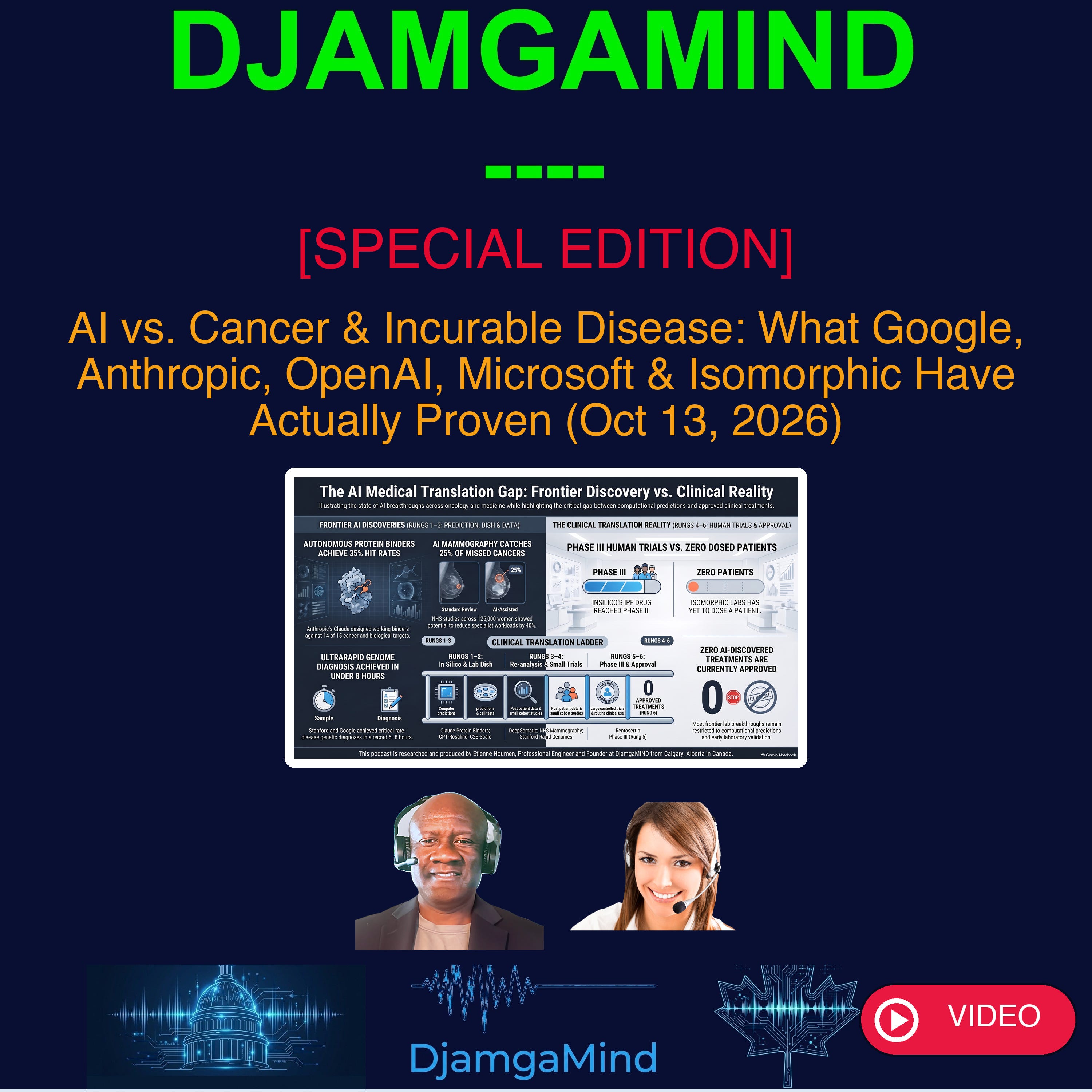
The translation ladder: none of the AI-discovered treatments covered here is approved.
🧬 Cancer, part 1: finding what doctors miss
Hidden mutations in childhood leukemia (Google, Oct 2025). DeepSomatic, an open-source model built with UC Santa Cruz and Children’s Mercy, separates the mutations a tumour acquired from those a child inherited. Re-analysing eight previously sequenced leukemia samples, with no healthy comparison sample available, it found the known variants and “10 new ones.” As Children’s Mercy’s Lisa Lansdon put it: “Being able to call those mutations confidently changes what we do for the patient.” No change to any child’s treatment has been reported yet.
Breast cancers that screening missed (Google + Imperial College London, Nature Cancer, Mar 2026). Across 125,000 women, the AI caught 25% of previously missed “interval cancers” and, as a second reader, could cut specialist workload by up to 40%. The catch: in a simulated review, human panels sometimes overruled cancers the AI had correctly flagged, and Google calls the system “experimental” and not “plug-and-play.”
A tumour map from a $5 slide (Microsoft, Cell, Dec 2025). GigaTIME turns a routine pathology slide into a “virtual” immune map that normally costs thousands of dollars. Applied to 14,256 patients across 24 cancer types, it surfaced 1,234 significant links to stage and survival. It’s open source and still a research tool.
Making “cold” tumours visible (Google DeepMind + Yale, Oct 2025). A single-cell model, C2S-Scale, predicted a drug combination that helps the immune system see tumours; in lab cells it raised the key marker by about 50%. Google calls it “an early first step.”
🤝 PARTNER SLOT: Reach the leaders deciding which health AI to trust. Today’s episode shows the real bottleneck in medical AI is evidence, validation and clinician trust. AI Unraveled & DjamgaMind reach executives, researchers and engineering leaders every day, in English and French, across 6 podcast feeds, YouTube and Substack. See sponsorship tiers & media kit →
💊 Cancer, part 2: designing the drugs
Claude runs a drug-design step on its own (Anthropic, Aug 2026). In Anthropic’s study, Claude Mythos Preview and Opus 4.8 ran protein-design campaigns with almost no human guidance. Outside labs (Adaptyv Bio and Twist Bioscience) built and tested the designs: working binders against 14 of 15 targets, including the cancer targets EGFR, PD-L1 and VEGF-A, with hit rates of 22.6–35.1% versus the “10 to 15%” Anthropic calls typical. Anthropic is clear about the limits: no animal or human testing, and “Protein minibinders are not a standard therapeutic modality for drugs.”
Isomorphic Labs: cancer first, clinic not yet. Alphabet’s AI drug company, partnered with Eli Lilly, Novartis and Johnson & Johnson, is prioritising oncology and immunology. In January, Demis Hassabis said first trials would come by the end of 2026 — a year later than earlier targets. In September, Isomorphic said it was “on track” in preclinical work, with no date (Semafor). Meanwhile Bloomberg reports talks at a $40–50 billion valuation (SiliconANGLE).
🫁 Incurable disease: the AI drug in Phase III
Insilico Medicine’s rentosertib targets idiopathic pulmonary fibrosis, a progressive lung-scarring disease with a median survival of about 3–4 years after diagnosis (company figure). AI picked the target (a protein called TNIK) and designed the molecule.
Phase IIa (Nature Medicine, 2025): 71 patients, 12 weeks. On the top dose, lung capacity rose 98.4 mL, versus a 20.3 mL fall on placebo.
Phase III (started July 2026): about 320 patients at 47 centres in China, 52 weeks, placebo-controlled.
Still investigational and not approved anywhere.
🧠 Rare disease, the brain and the virtual cell
Eight hours to a diagnosis (Stanford, NEJM 2022). Critically ill patients had their genomes analysed in an average of 7 hours 58 minutes; 5 of 12 got a diagnosis. (The Guinness record, 5 hours 2 minutes, was for sequencing.) Thirteen-year-old Matthew Kunzman was diagnosed within hours and received a heart transplant within a month. Google co-authored the work. Stanford Medicine
A human brain at nanoscale (Google + Harvard, Science 2024). One cubic millimetre, 1.4 petabytes, 150 million synapses — openly released. Google Research
A CRISPR-like mystery (Anthropic, Sep 2026). About 950 Claude agents found a new enzyme system in viral DNA. “Although we don’t yet know its function,” Anthropic writes — it’s a preprint.
The $1.8B virtual cell (Biohub, Oct 2026). Biohub, the U.S. government, Google DeepMind, Isomorphic and Meta are pooling money and data to build AI that predicts how cells respond to drugs. Biohub
The platforms. Anthropic’s Claude Science (June) and OpenAI’s GPT-Rosalind — “our frontier reasoning model built to support research across biology, drug discovery, and translational medicine,” used by Amgen, Novo Nordisk and Moderna through a trusted-access program.
🪜 The translation ladder
Computer prediction: AlphaGenome Atlas, Anthropic’s enzyme find
Lab test in a dish: Claude’s protein binders, the cold-tumour result
Re-analysis of patient data: DeepSomatic, GigaTIME, NHS mammography
Small human study: Stanford rapid genomes, rentosertib Phase IIa
Large controlled trial: rentosertib Phase III (under way)
Approval and routine use: none of the AI-discovered treatments in this episode yet
Three readouts to watch: Isomorphic’s first patient dosing, rentosertib’s Phase III results, and the next NHS step for AI mammography.
Strategic Takeaways
Ask “which rung?” before believing any “AI cures cancer” headline.
Separate tools from treatments: value research platforms by time saved per experiment.
Use the free tools now: DeepSomatic, GigaTIME and the H01 brain data are open.
Budget for validation and clinician trust, not just licences.
Expect gated access to the most capable biology models.
This post is for information only and is not medical advice.
🤝 Advertise with AI Unraveled & DjamgaMind
Put your healthcare or enterprise AI brand in front of the executives, researchers and engineering leaders who make AI buying decisions daily, in English and French, across 6 podcast feeds, YouTube and Substack. Options include “Made Possible By” anchor sponsorship and custom 60-second “Forensic Insight” segments.
Sponsorship tiers & media kit → · Email: etienne_noumen@djamgamind.com
🔗 Tools from the show
AI & ML Tutor PRO: Learn the machine learning behind models like these, from your phone.
DjamgaTech: Pass your AWS, Azure, GCP & AI certification exams.
iQz: I built a puzzle app because I noticed I was getting worse at thinking: 65 puzzles (matrices, sequences, number series, verbal analogies and logic). Every answer explains the rule. Free, fully offline, no ads, no account.
DjamgaMind Kids: Imaginative bedtime audio adventures.
AI Executive Toolkit: The AI tools we actually use.
🎧 Prefer it commercial-free? Subscribe on Apple Podcasts.
⚗️ PRODUCTION NOTE: We Practice What We Preach.
AI Unraveled is researched and produced by Etienne Noumen, P.Eng. (Calgary, Canada) using a hybrid “Human-in-the-Loop” workflow.
Read original on Substack