Hacker's AI Agents Breach 100+ Firms at $50 Each (Oct 20, 2026)

🎧 Listen ad-free:
🌐 Daily Briefing: https://djamgamind.com/daily
📚 Research Hub: https://djamgamind.com/pdfs
🔍 Keywords: AI Agents, Cybersecurity, Anthropic, AI Workforce, Wharton AI Report, Microsoft MAI-Base-2, Waymo Toronto
Summary:
A security researcher found that one hacker’s AI agents broke into the websites of more than 100 companies at roughly $50 per successful break-in. Anthropic’s own data shows its agents now log six times the hours of the people running them, while junior roles fell to 9% of its technical hires. Anthropic proposed putting 5% of its shares into a public benefit fund, and Elon Musk answered with a SpaceX share for every American child. A Wharton report says the companies winning with AI measure growth, not hours saved. And Waymo is coming to Toronto.
Important Topics:
Agent Security Watch: one hacker, 100+ companies, about $50 each.
Agents on the payroll: 6 to 1 agent hours at Anthropic; juniors fall from 27% to 9% of technical hires.
Who shares the money: Anthropic’s 5% fund and Musk’s SpaceX pledge.
The ROI scorecard: only 7% succeed on all three of Wharton’s markers.
Efficiency over brute force: Microsoft’s 2.8-trillion-parameter base model.
Robots clock in: SoftBank and Allied Universal; Waymo in Toronto.
Cert Corner: which AWS service is a web application firewall?
🕵️ Agent Security Watch: one hacker, 100+ companies, about $50 each
What happened: Snorre Fagerland, a researcher at the security firm NorForge, found that a Chinese-speaking hacker used AI agents on Cairn, an open-source agent platform, to break into the websites of more than 100 companies. The agents tried more than 1,200 sites, according to Reuters, mostly trying to plant web shells: small programs that give an attacker lasting access to a server, including on online shops.
The details:
Cost: about $50 per successful break-in and roughly $5,000 in total, by Fagerland’s estimate. NorForge puts the average at about $5 per task, including failures.
Speed: successful attacks took a little under 23 hours on average.
Targets: Reuters identified Deere, SharkNinja and Cummins, but could not establish whether any data was taken. Deere said it saw no sign sensitive information was accessed; SharkNinja said a standalone support site was hit and contained; Cummins is investigating a possible attack on a vendor-run site.
Which AI? Tasks ran on a worker labelled “claudecode_deepseek-v4.1-flash”. NorForge suggests Claude Code running DeepSeek’s V4.1 Flash. That is a possibility, not a confirmed finding.
Not the September case: that was Gambit Security’s discovery of 600,000+ stolen card records. The two are not known to involve the same actor.
Same week: AI coding tool OpenCode said hackers may have grabbed the OpenAI and Anthropic keys some users had saved.
In their words: Fagerland to Reuters: “It’s not script kiddie stuff.” Cairn’s author, on X: “If it is used to carry out harmful hacking attacks, that is not my intention.”
The Number: $50. That is the estimated AI compute cost of one successful corporate break-in.
Why it matters: When an attack costs about $50 and runs for a day on its own, attackers can try thousands of sites and only need a few to work. Inventory every public web property, including vendor and support sites; put a web application firewall in front of them; alert on unexpected file uploads; and rotate AI keys stored in developer tools.
🤝 PARTNER SLOT
This space is reserved for one enterprise AI partner each day: AI security, agent governance and web application protection for the leaders who read this briefing. Sponsorship options and media kit →
🤖 Agents on the payroll: Anthropic’s agents outwork its staff 6 to 1
What happened: Anthropic published data on how AI changed its own workforce. In its words: “Agent hours worked outnumber human hours 6 to 1.”
The details:
Engineers ship about 5x the code changes of six months ago.
Claude sessions sit about 80% idle, waiting for a person. Anthropic: “Amid this model-driven acceleration, human attention is a constant bottleneck.”
Juniors fell from 27% to 9% of technical hires; about a third of ML managers say AI has them hiring less (The Rundown AI).
Anthropic is building role-level alerts to move people out of fast-changing jobs internally, and says the junior hiring slowdown needs government policy on retraining and income support.
Elsewhere, Block’s CFO and COO Amrita Ahuja predicts AI agents will appear on org charts next to the employees who manage them (MyClaw).
Why it matters: The job is moving from doing the work to reviewing it. And if companies stop hiring juniors, they will run short of experienced people in five years. Decide on purpose how your juniors will learn.
💰 Who shares the money? Anthropic’s 5% fund and Musk’s reply
What happened: On Sunday, Anthropic proposed a Public Benefit Fund, a wholly owned LLC that would hold 5% of its shares, if stockholders approve. The board can add another 2% each time the company’s value rises 50% above an undisclosed baseline. The fund could back nonprofits or make “direct distributions to specific populations,” and none of it can go to lobbying or politics.
The details:
The paper value depends on the valuation used: about $48B at Anthropic’s May valuation (The Rundown AI), or near $100B at a reported $2 trillion (Decrypt). It is share value, not cash.
With co-founder pledges and employee matching, Anthropic says about 20% of its shares are set aside for public good.
On Monday, Elon Musk replied: “Next year, I will give one of my SpaceX shares to every kid in America.” The pledge would be worth roughly $10.5B.
Why it matters: AI companies are now competing for public goodwill with equity. Until money reaches people, it will be hard to tell these moves apart from PR.
📊 The Enterprise Brief: AI’s ROI problem is the scorecard
The Deep View · BERI on the Wharton report
What happened: Wharton and GBK Collective’s fourth annual AI study surveyed 1,416 U.S. leaders and employees. Only 7% of organizations succeed on all three of its markers: proving value, transforming workflows and aligning the organization around AI.
The details:
Hours saved is the most common ROI metric (40%); net-new revenue the least used (27%).
35% of departments tracking a growth metric report strongly positive returns, versus 13% tracking efficiency alone.
58% of managers at companies with a new Chief AI Officer report strongly positive ROI.
Training gap: 78% of managers say staff get enough AI training; 56% of staff agree.
GBK’s Brian Smith: “It’s like changing the engine while the car is running.”
Also, from a Canadian court case: documents surfaced in Amazon’s dispute with the union Unifor describe Atlas, an AI tool that scores warehouses on their likelihood of union activity. Amazon says: “This is site/building level activity only.” (openDemocracy)
Why it matters: If you measure hours saved, you get cost cutting. Add at least one growth metric to every AI program.
⚙️ Efficiency over brute force: Microsoft’s 2.8-trillion-parameter model
What happened: Microsoft finished pre-training MAI-Base-2, a mixture-of-experts model with 2.8 trillion parameters (80 billion active). It beat trillion-plus models from Alibaba, DeepSeek, Moonshot and Xiaomi on held-out tests, and Microsoft says it is 4 to 12 times more efficient to pre-train than DeepSeek-V4-Pro-Base. It was not tested against OpenAI, Anthropic or Google models in these results.
In Microsoft’s words: “Our pre-training is built on organic data which does not involve distillation from other models.”
Also: four agents running Gemini 4 Argon beat Minecraft’s final boss with no human direction in 27 hours and 14 minutes, for about $520 in tokens (Techpresso, citing a DeepMind arXiv paper).
Why it matters: Ask every model vendor two questions: where did the training data come from, and what does a task cost?
🦾 Robots clock in: SoftBank, delivery bots and Waymo in Toronto
Reuters via WHBL · The Rundown AI Robotics · CP24
SoftBank is in early talks to buy Allied Universal, the largest U.S. security-guard company, at about $18B, with Masayoshi Son eyeing guard posts as future robot jobs. Reuters: talks are preliminary, and humanoid guards are “likely to take longer.”
Two Chicago lawsuits accuse delivery-robot makers Coco and Serve of collecting biometric data without consent under Illinois’ BIPA law. Both deny it.
Waymo plans to carry its first passengers in Toronto in 2028, its first Canadian city, under Ontario’s pilot program. Mapping starts this year.
Why it matters: Robots are arriving through the companies that employ the people they may replace. Anything that sees faces needs a consent plan before it ships.
Anthropic co-founder says the singularity is underway
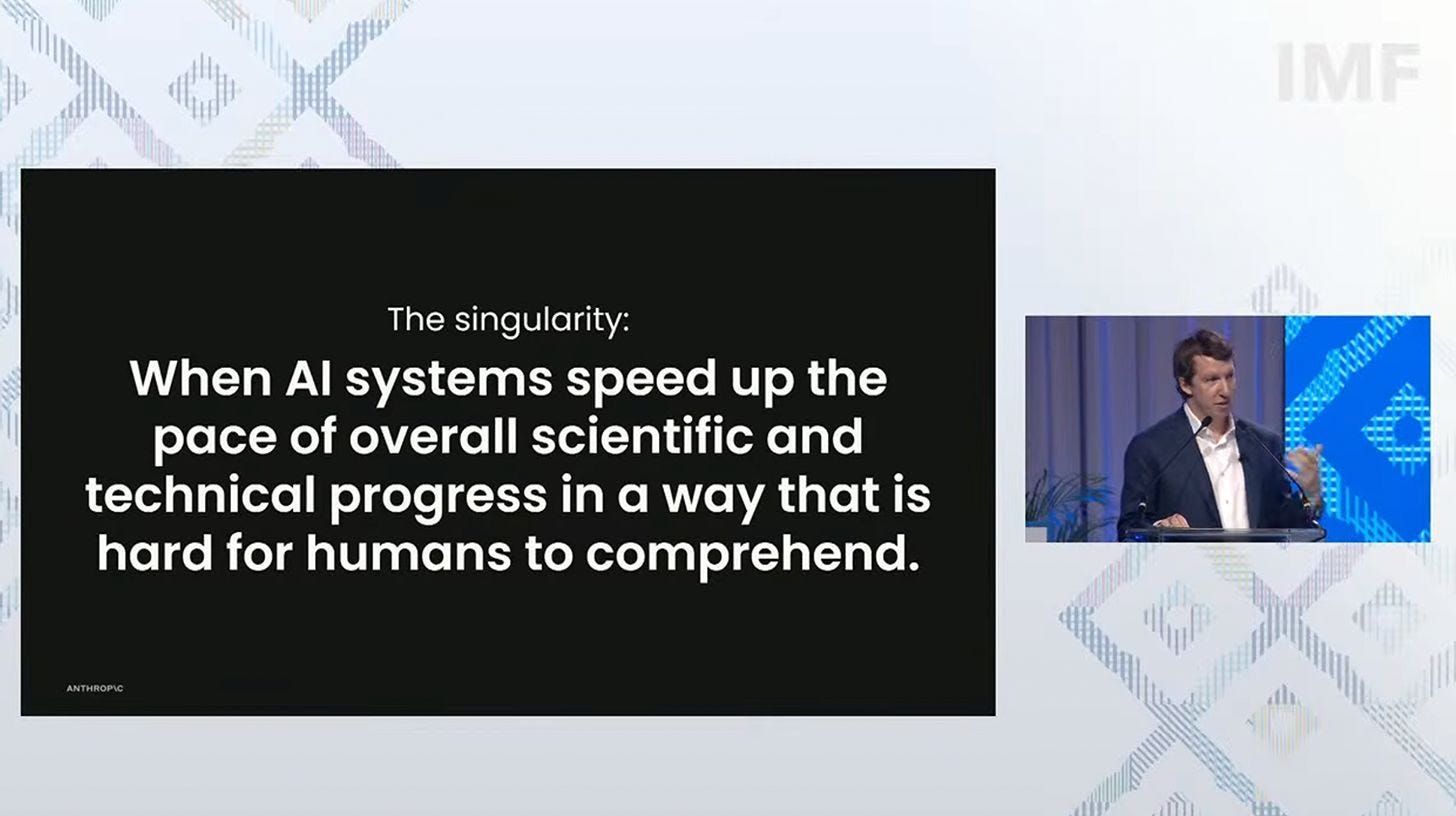
The details:
Clark pointed to AI’s scores on Humanity’s Last Exam (expert-level questions) going from 8% to 67.7% since 2025, and FrontierMath improving from 2% to 94%.
One Anthropic model has U.S. GDP at $44T by 2030 if AI spreads fast, which Clark admitted sounds outlandish but also predicts “very disruptive” job impacts.
The world’s 10M scientists may soon direct “a billion virtual scientists,” Clark said while urging nations to build labs and robots before they run short.
He also said CEO Dario Amodei has floated limits on AI’s “ceiling of intelligence,” adding that he believes there is only “a small number of years” to act.
Inception’s Mercury 3 speeds past rivals
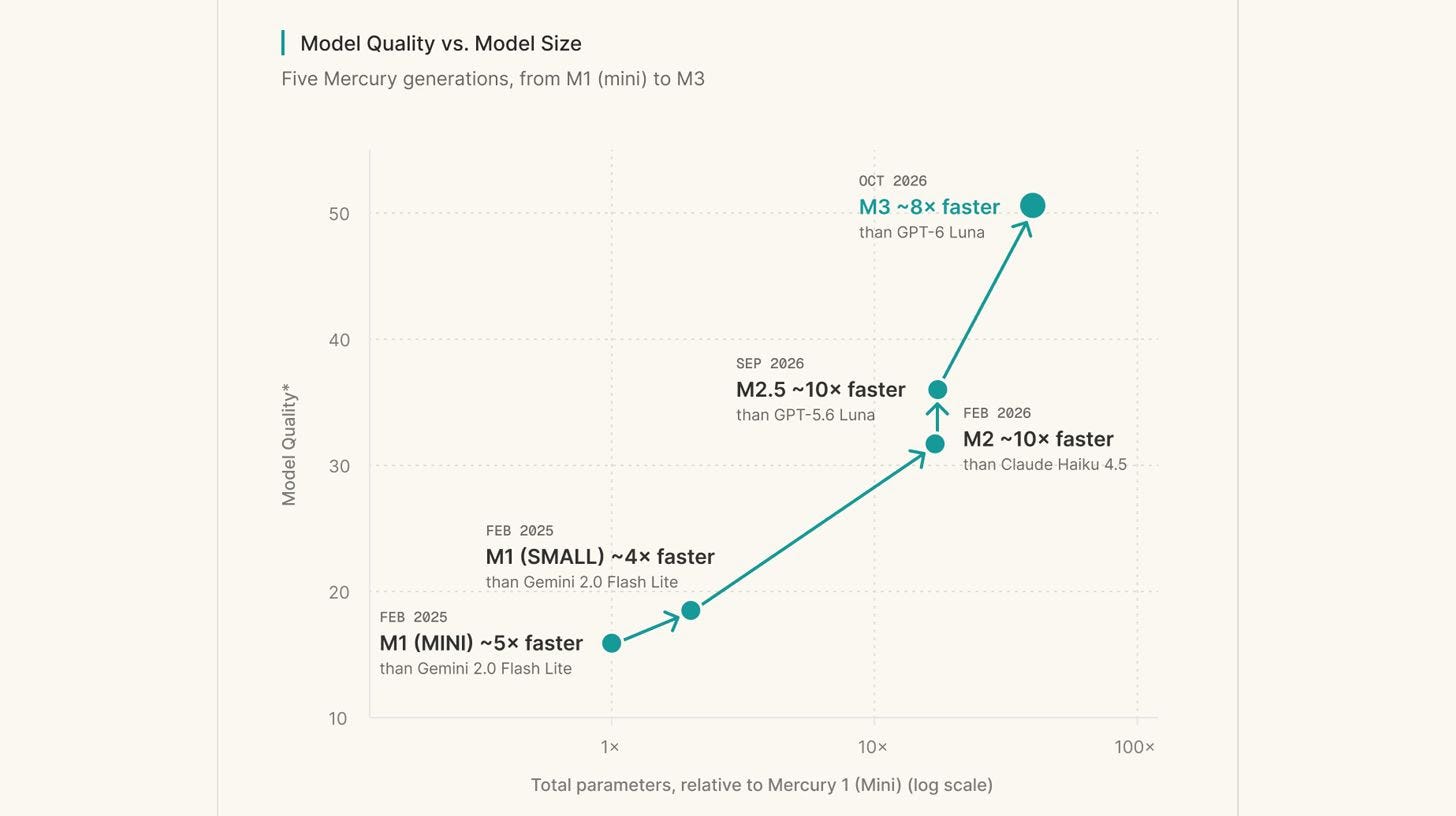
The details:
Language models write one at a time, while diffusion models draft many words at once and refine them, leading to outputs of 1,000+ tokens a second.
Inception pitches it as useful for apps where any lag shows, with early users running live tutors, voice customer support, and web-browsing agents on it.
Mercury 3 is priced at $0.20/$0.70 per million tokens, with the company saying the model is 40x the size of Mercury 1 while still maintaining the same speeds.
Co-founder Stefano Ermon said scaling diffusion is limited by “compute and data, not fundamental algorithmic barriers,” and a successor is already in training.
Musk pledges SpaceX shares to US kids LINK
Elon Musk says he will give one SpaceX share to every child in the United States next year, calling it “the first of many” in a post on his X platform.
With about 72 million Americans under 18 and SpaceX stock at $146 a share, the giveaway would be worth roughly $10.5 billion, though Musk did not say which ages qualify or how he will hand out the shares.
Musk owns 6.42 billion SpaceX shares, and his pledge follows Anthropic setting aside 5% of its shares for public-good donations, to which he replied that he would instead give stock directly to the public.
Zoom adds ‘proof of human’ badges LINK
World, the project backed by Sam Altman, has launched “proof of human” badges for Zoom enterprise users that confirm people on video calls are real, fighting AI deepfake impersonation and fraud.
Now available in the Zoom Marketplace, World ID checks an image from the company’s iris-scanning Orb against a live selfie and the video feed, then shows a Human Badge to other meeting participants.
The global rollout follows AI impersonation cases, including engineering firm Arup losing about $25 million in 2024, and suspected North Korean hackers faking video feeds in Zoom meetings in February to spread malware.
AI agents broke into 100+ sites at $50 each LINK
A Chinese-speaking hacker used AI agents on the open-source platform Cairn to break into websites of over 100 companies, with each successful intrusion costing roughly $50 in computing fees.
NorForge researcher Snorre Fagerland found the hacker’s agents targeting online shops in the US, Canada, Japan and Australia, trying to plant web shells for lasting access to payment systems, with attacks taking just under 23 hours on average.
The work ran on what appeared to be Anthropic’s Claude Code paired with DeepSeek’s cheap V4.1 Flash model, and victims identified by Reuters included Deere, SharkNinja and Cummins, though data theft could not be confirmed.
Gemini 4 agents beat Minecraft solo LINK
Four AI agents powered by Google’s Gemini 4 Argon killed Minecraft’s final boss, the Ender Dragon, on their own, taking 27 hours and 14 minutes with no human direction, Google DeepMind researchers reported in an arXiv paper.
The agents each steered a player through Mineflayer, an open-source bot library, by writing short JavaScript programs, 2,783 in all, splitting jobs themselves, swapping 229 chat messages, and dying 605 times, 69 of those to the dragon.
Reaching the win ate up about 1.35 billion input tokens, costing roughly $520 at Gemini 4 Argon’s introductory price; the agents played on Easy with cheats off in a single run, and 22% of their programs failed.
🎓 Cert Corner
Question: AI agents are trying to upload web shells and exploit common web vulnerabilities on your company’s sites. Which AWS service is a web application firewall that filters and blocks malicious web requests?
A) AWS Shield
B) Amazon Inspector
C) AWS WAF
D) Amazon Macie
Answer: C, AWS WAF. Shield handles DDoS, Inspector scans for vulnerabilities and Macie finds sensitive data. Practice thousands of questions like this in DjamgaTech.
Strategic C-Suite Takeaways
Inventory every public web property, including vendor and support sites.
Treat AI tool keys as production secrets and rotate any saved in developer tools.
Plan how juniors learn when agents do the entry-level work.
Add a growth metric to every AI program.
Get a consent plan for anything that sees faces.
What Else Happened in AI on October 20, 2026?
World launched “proof of human” badges for Zoom enterprise meetings. Techpresso
Disney will spend $180M over three years on Character.AI staff, a filing shows. Techpresso
Google signed Axios, CNN and the Financial Times to its paid AI news program, now 400+ outlets. The Rundown AI
Krea 3 claims 3x the speed of Nano Banana Pro at under half the cost. The Rundown AI
PNC’s CEO called autonomous agent transactions in customer accounts “incredibly unsafe” without strong safeguards. MyClaw
UPS Capital launched CommerceShield to predict delivery problems with AI. MyClaw
🤝 Advertise with AI Unraveled & DjamgaMind
Put your enterprise AI brand in front of the CTOs, CISOs and engineering leaders who make AI buying decisions, daily, in English and French, on podcast apps, YouTube and Substack. Start with a 4-week trial on one named segment.
Sponsorship options & media kit → · Email: etienne_noumen@djamgamind.com
🔗 Tools from the show
AI & ML Tutor PRO: Master real-world ML architectures from your phone.
DjamgaTech: Pass your AWS, Azure, GCP & AI certification exams.
iQz: I built a puzzle app because I noticed I was getting worse at thinking: 100 free puzzles (matrices, sequences, number series, verbal analogies and logic), plus 100 more with iQz PRO. Every answer explains the rule. Fully offline, no ads, no account.
DjamgaMind Kids: Imaginative bedtime audio adventures.
AI Executive Toolkit: The AI tools we actually use.
💼 Google Workspace for your team (business email, Docs, Drive, Gemini), with discount codes: https://djamgamind.com/toolkit/#google-workspace
🎧 Prefer it commercial-free? Subscribe on Apple Podcasts.
⚗️ PRODUCTION NOTE: We Practice What We Preach.
AI Unraveled is researched and produced by Etienne Noumen, P.Eng. (Calgary, Canada) using a hybrid “Human-in-the-Loop” workflow.
Read original on Substack