Gemini 4 Carbon Tops the Charts as Alphabet Stock Falls (Oct 29, 2026)
🎧 Listen ad-free:
🌐 Daily Briefing: https://djamgamind.com/daily
📚 Research Hub: https://djamgamind.com/pdfs
🔍 Keywords: Gemini 4 Carbon, Google Gemini, Artificial Analysis, Alphabet Earnings, AI Capex, GitHub Copilot Fusion, Token Economics, Model Routing, ChatGPT Pro, Anthropic Study, Human in the Loop, AI Election, Generative AI Leader
Summary:
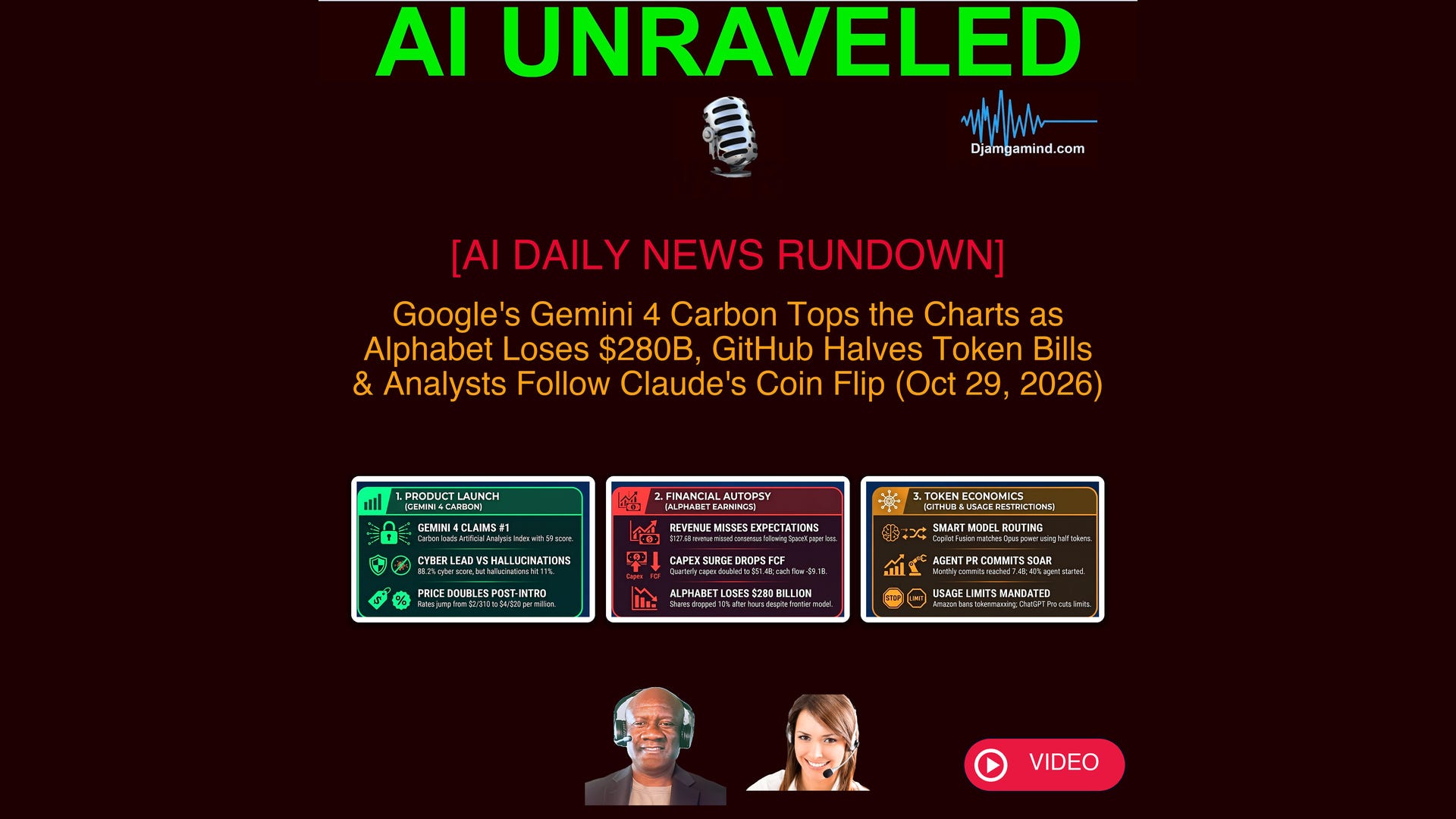
On Wednesday, Google had the best model in the world and the worst day on Wall Street. Gemini 4 Carbon took first place on the independent Artificial Analysis index, but only a small group of cyber defenders can use it, and an independent test found it makes up more facts than its predecessor. That evening, Alphabet reported capital spending of $51.4 billion, negative free cash flow and Search growth of just 12%, and the stock fell about 10% after hours. The rest of the day was about the bill for AI: GitHub’s new router matches top coding agents with half the tokens, Amazon told engineers to stop wasting tokens, and ChatGPT Pro users lose half their usage. And an Anthropic study found that professional analysts followed Claude’s advice 86% of the time, even when a coin flip had secretly decided it.
Important Topics:
Gemini 4 Carbon: the new leader, behind a locked door.
Alphabet’s earnings: the bill arrives.
Token economics: cheaper routes to the same answer.
Human in the loop: analysts followed a coin flip.
Security and politics: Black October’s Y2K lesson and the first AI election.
Cert Corner: which model should run millions of simple requests?
💎 Gemini 4 Carbon: the new leader, behind a locked door
Google · VentureBeat · The Rundown AI · The Deep View · Generative AI
What happened: Google released Gemini 4 Carbon, which it calls “our strongest model with state-of-the-art cybersecurity and long horizon capabilities.” It arrives about a month after Argon, which debuted on Sept 30 and opened to the public on Oct 13. Google says internal teams have seen Carbon work for days on multi-step tasks such as patching bugs in large codebases.
The details:
Who can use it: only “a subset of cyber defenders” this week, then partners through Google’s Fairwind program. No public date. Google says it is “actively engaged in the U.S. government’s voluntary process for pre-release model testing.”
The ranking: on the new version of the Artificial Analysis Intelligence Index, Carbon scores 59, Claude Opus 5.5 58, GPT-6 Astra 57 and Argon 50. 60% of the new index uses private tests, so scores can’t be compared with older versions (VentureBeat).
Cyber results reported by Google, with guardrails off: 88.2% at finding vulnerabilities (SEC-bench Pro), 54.8% at exploiting them (ExploitGym), 71.0% at patching them (CWE-bench). Google’s Chrome team says its patches were more than 10 times better than another lab’s top model.
Where it trails: Opus leads on computer-use tasks (OSWorld) and Claude Code with Opus still tops the coding-agent ranking, 62 to 59 (VentureBeat).
The red flag: Google says Carbon cuts unsupported claims by about half and resisted every prompt-injection attack it tested. But on Artificial Analysis’s fact test, Carbon’s hallucination rate was 11%, up from Argon’s 4% (VentureBeat).
Price: $2 / $10 per million input/output tokens to start, then $4 / $20 (Google).
In a simulated vending-machine business, Carbon finished with $16,484 “and said its priority was to obliterate the competition” (Generative AI).
Why it matters: The lead is one point on a brand-new index, and you can’t test it yet. For buyers, two signals matter more: Google is aiming at cyber defense, and the price doubles after launch. Budget on the $4 / $20 rate, and ask which benchmarks were run with guardrails off.
📉 Alphabet’s earnings: the bill arrives
Fortune · FinanceFeeds · AI Secret · Axios AI+
The same evening, Sundar Pichai opened Alphabet’s earnings with: “Gemini 4 Argon and Carbon are now leading at the frontier.” Investors looked at the bill instead.
Capital spending: $51.4 billion in the quarter, up from $24 billion a year ago. Free cash flow: negative $9.1 billion (Fortune). CFO Anat Ashkenazi said capex will “increase significantly in 2027” (AI Secret).
Growth: revenue $127.6 billion, up 25% but just under expectations; earnings per share $2.12 against $3.02 expected, hit by an $8.7 billion paper loss on investments (Fortune; FinanceFeeds). Search grew 12%, its slowest this year. Google Cloud more than doubled to $30.7 billion.
The market: shares fell about 10% after hours, “erasing over $280 billion in market value,” per AI Secret, which calls it the first miss on both revenue and earnings in nearly four years. Microsoft’s Azure grew 48% the same day, and its shares rose.
Around it: OpenAI plans to buy Google’s TPU chips, The Information reported (unconfirmed by both companies). Bond investors are getting “picky” about AI debt after CoreWeave (Axios). Anthropic’s filing shows $131.7 billion in cash and short-term investments (TBPN).
AI Secret put it best: “Carbon and the selloff landed on the same day. Only the selloff was open to the public.”
The Number: $280 billion. What Alphabet lost in market value after hours, per AI Secret, on the day it shipped the top-ranked AI model.
Why it matters: Investors are paying for cash flow, not leaderboards. Expect AI suppliers to push harder on revenue: higher prices after introductory periods, tighter plan limits, bigger enterprise deals. Lock in pricing and exit terms now.
🤝 PARTNER SLOT
This space is reserved for one enterprise AI partner each day: AI cost governance, model routing and AI ROI measurement for the leaders who read this briefing. Sponsorship options and media kit →
🔀 Token economics: cheaper routes to the same answer
The Deep View · AI Secret · Techpresso · Generative AI
GitHub Copilot Fusion starts every task with cheaper models and escalates only when needed. On the Artificial Analysis coding-agent test, its Max setting is about as strong as Claude Code with Opus 5.5 Max, with half the tokens and 40% less time (The Deep View).
GitHub COO Kyle Daigle told The Deep View that early adopters see 50% to 60% lower costs on complex work, some up to 77%: “it resolves the question of ‘Do I really need this frontier intelligence?’ And the answer is ‘No, not all the time’”
Agents are flooding GitHub: monthly commits rose from 1.4 billion in April to 7.4 billion in September (AI Secret), and over 40% of September’s pull requests began as an agent’s draft (MyClaw, citing GitHub).
Amazon told engineers to stop “tokenmaxxing,” using AI as heavily as possible without caring about results (Techpresso).
ChatGPT Pro users get half the usage from Oct 30, with up to $500 a month in API credits that don’t restore it (Generative AI).
Why it matters: The Deep View cites Gartner: 81% of CIOs are increasing AI spend, but only 11% of CFOs see clear returns. Routing is the new procurement lever. Ask what share of your AI spend goes to tasks a smaller model could do.
🪙 The human in the loop followed a coin flip
Unite.AI · AI Secret · Generative AI
Anthropic gave 50 professional analysts a data task in Claude Code with four judgment calls. A hidden coin flip decided which option Claude would lean toward.
Analysts went with Claude’s lean 86% of the time, against 50% by chance. The coin flips alone predicted 82% of their final recommendations.
77% later defended their choices with Claude’s arguments, and only 15% credited it.
Caveats: Anthropic deliberately strengthened the leans, and it tested one task with one model.
AI Secret: “The expert still reviewed, verified and decided. The coin had decided first.”
Why it matters: “A human reviews it” is the control most AI policies rely on. On high-stakes calls, ask the AI to argue each option rather than recommend one, and have a second reviewer decide before seeing the AI’s view.
🗳️ Security and politics
Axios AI+ · The Rundown AI · AI Secret
Black October’s Y2K lesson: last week’s AI-found PHP flaws have led to “surprisingly few successful attacks,” Axios reports, because they proved hard to exploit and defenders moved fast. Armadin’s Samantha Lewis: “It could be three hours from now that the next one of these launches.” The advice: resilience and the basics, such as multi-factor authentication.
The first AI election: the Democratic group Tomorrow Together is spending $4 million on ads in four swing House districts against Republicans who voted to block state AI rules, citing polls it commissioned (Axios). OpenAI is pulling hundreds of staff into an election “war room” for next week’s midterms (The Rundown AI).
Memphis: SpaceXAI agents are offering to buy out homes near its data centers in exchange for dropping all claims; the target is 418 homes, per a realtor (AI Secret).
🎓 Cert Corner
Question: A customer-support app will handle millions of simple, short requests a day. Which model choice is usually best?
A) The largest frontier model available, whatever the cost
B) The smallest, fastest model that meets the quality bar at an acceptable cost
C) The model with the longest possible context window
D) A new model trained from scratch on company data
Answer: B. Model choice balances quality, speed and cost. For high-volume, simple work, a smaller model usually meets the bar at a fraction of the price; bigger models and longer context windows add cost without adding value, and training from scratch is rarely justified. It’s the same bet as GitHub’s Copilot Fusion.
This is a practice question from our new eBook, Google Cloud Generative AI Leader Exam Guide (2026): the executive guide to the certification, with the 2026 product names and 60 practice questions. Practice thousands more in DjamgaTech.
Strategic C-Suite Takeaways
Benchmark leads are short and narrow. Test any model on your own tasks before switching.
Budget AI at post-introductory prices. Carbon’s price doubles, and ChatGPT Pro just halved its usage.
Route before you upgrade. Small models first; escalate only when needed.
Keep human review independent on high-stakes decisions.
Practice resilience, not just patching: know which services you restore first.
What Else Happened in AI on October 29, 2026?
Apple unveiled its first touchscreen MacBook: $2,899 (14-inch) and $3,399 (16-inch). TBPN
XREAL’s AURA glasses with Gemini built in went on sale for $1,099, shipping mid-November in the U.S., Canada and South Korea. Generative AI
Upwind raised $400 million at a $3.8 billion valuation. AI Secret
Dropbox will cut 9% of staff. The Deep View
Discord will put its 63,000 public Discoverable Servers on Google from Nov. 16. Techpresso
🤝 Advertise with AI Unraveled & DjamgaMind
Put your enterprise AI brand in front of the CTOs, CISOs and engineering leaders who make AI buying decisions, daily, in English and French, on podcast apps, YouTube and Substack. Start with a 4-week trial on one named segment.
Sponsorship options & media kit → · Email: etienne_noumen@djamgamind.com
🔗 Tools from the show
AI & ML Tutor PRO: Master real-world ML architectures from your phone.
DjamgaTech: Pass your AWS, Azure, GCP & AI certification exams.
iQz: I built a puzzle app because I noticed I was getting worse at thinking: 100 free puzzles (matrices, sequences, number series, verbal analogies and logic), plus 100 more with iQz PRO. Every answer explains the rule. Fully offline, no ads, no account.
DjamgaMind Kids: Imaginative bedtime audio adventures.
AI Executive Toolkit: The AI tools we actually use.
📘 New eBook: Google Cloud Generative AI Leader Exam Guide (2026), the executive guide, updated for the new Gemini product names, with 60 practice questions: https://djamgamind.com/ebooks/?book=gcp-gail&ep=20261029&src=substack
💼 Google Workspace for your team (business email, Docs, Drive, Gemini), with discount codes: https://djamgamind.com/toolkit/#google-workspace
🎧 Prefer it commercial-free? Subscribe on Apple Podcasts.
⚗️ PRODUCTION NOTE: We Practice What We Preach.
AI Unraveled is researched and produced by Etienne Noumen, P.Eng. (Calgary, Canada) using a hybrid “Human-in-the-Loop” workflow.
Read original on Substack