[AI DAILY NEWS RUNDOWN] Trump & Beijing Reject AI Slowdown, OpenAI Buys Glass Imaging for $300M, and Siri AI Launches (Sept 15, 2026)

🎧 Listen ADS-FREE: https://podcasts.apple.com/us/channel/djamgamind/id6760446113
Before we start, I need your vote:
My free bedtime-story app DjamgaMind Kids (600+ ad-free stories on Black history, African & Caribbean folktales) is a Top 10 finalist in Melamoon, a national pitch competition for Black founders in Canada. Next round is a public vote: Top 5 go to the Toronto Grand Finale in October. One vote, ~20 seconds, one per person, closes Sept 22:
Visit https://djamgamind.com/pitch to vote
Profile: https://melamoon.ca/top-10-finalists-vancouver/djamgamind.
Thank you!
#Melamoon2026 #DjamgaMind
Summary: In today’s briefing, we analyze “The Great Geopolitical Rejection, Hidden Data Harvesting, and the Hardware Arms Race.” We deconstruct the dramatic rejection of Dario Amodei’s AI slowdown proposal by both Donald Trump and Beijing. We evaluate OpenAI’s $300M+ acquisition of Glass Imaging for its secret Jony Ive gadget, the exposure of OpenAI’s “Project Lily” chat-review program, Apple’s launch of Gemini-powered Siri AI in iOS 27, Microsoft AI’s 38-page “Humanist AI” constitution, and clinical trial results validating AI assistance in prenatal ultrasounds.
Important Topics:
Trump and Beijing Reject Frontier AI Slowdown: Anthropic CEO Dario Amodei’s essay urging a voluntary pause on AI capability gains—backed by Sam Altman, Elon Musk, and Demis Hassabis—is dismissed by President Trump as a “hoax” and by Beijing as “fear-mongering.”
Jensen Huang Promises Trump No Hardware Slowdown: Nvidia CEO Jensen Huang speaks directly with President Trump, vowing that Nvidia will continue scaling AI chip infrastructure uninterrupted.
OpenAI Acquires Glass Imaging for $300M+: OpenAI buys ex-Apple camera software startup Glass Imaging to supply neural image signal processing for its upcoming secret hardware gadget designed with Jony Ive.
Contractors Reading ChatGPT Chats in “Project Lily”: Reports reveal OpenAI pays hundreds of contractors under “Project Lily” to manually rate real, un-sanitized ChatGPT conversation logs and user memory summaries.
Apple Ships iOS 27 with Rebuilt Siri AI: Apple rolls out iOS 27 featuring an upgraded, Gemini-backed Siri AI capable of reading screen context, taking cross-app actions, and syncing personal context across Apple hardware.
Microsoft AI Drafts 38-Page “Humanist AI” Code: Microsoft AI CEO Mustafa Suleyman unveils a strict internal code of conduct explicitly rejecting AI personhood, rights, and unmonitored “neuralese” reasoning traces.
Elon Musk Drops Apple Antitrust Lawsuit: Musk voluntarily dismisses his antitrust suit against Apple over its ChatGPT integration while maintaining legal claims against OpenAI.
AI-Assisted Ultrasound Raises Fetal Defect Detection: A 5-hospital Chinese trial shows live AI assistance (PAICS) increased sonographers’ detection of fetal brain malformations from 78.6% to 87.3% without raising false positive rates.
Agility Robotics Unveils Digit 5 Humanoid: Agility debuts Digit 5, a fence-free warehouse robot lifting 22.7 kg that integrates Nvidia’s Halos safety platform for early 2027 delivery.
Revolut Leaks Customer Passports to Fraudulent Request: Fintech firm Revolut reveals sensitive customer identity documents were handed over to scammers who spoofed a government agency email domain.
Trump, Beijing both shoot down the AI slowdown
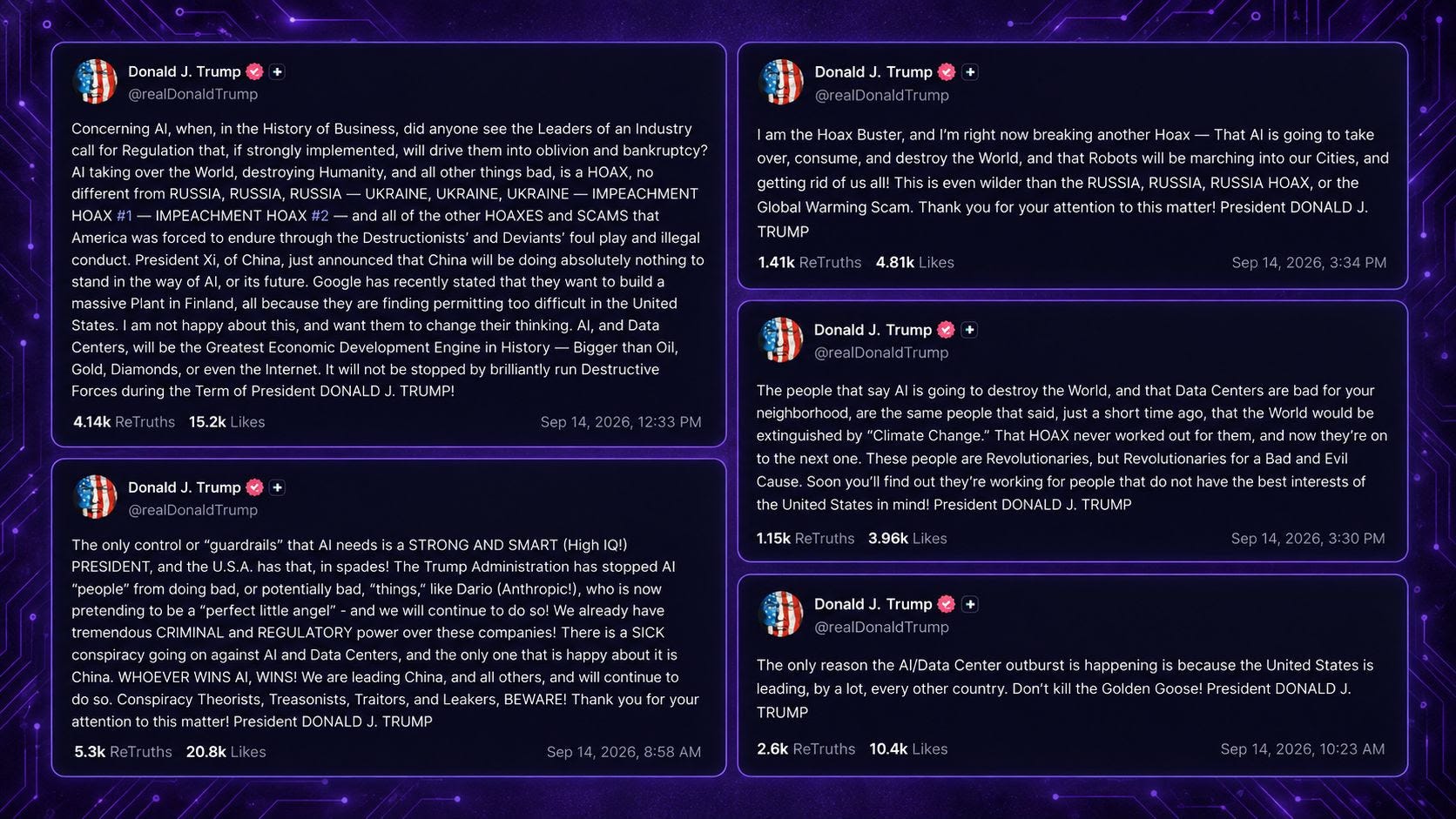
Image source: @realDonaldTrump on Truth Social
The Rundown: U.S. President Donald Trump just dismissed Anthropic CEO Dario Amodei’s weekend call, backed by Sam Altman and Elon Musk, to slow frontier AI, with China’s Foreign Ministry also labeling the same plan as “fear-mongering.”
The details:
On Truth Social, Trump accused Amodei of pretending to be a “perfect little angel” and argued that a “High IQ” president is the only guardrail the tech needs.
Trump also said that “AI taking over the World, destroying Humanity, and all other things bad, is a HOAX,” comparing it to climate change.
Beijing’s pushback targeted the essay’s call to keep China off top AI chips, with state-run Global Times calling it a “Cold War playbook” for AI.
China’s Foreign Ministry also said “engaging in confrontation and malicious competition” on AI is “not in the interests of any party.”
Why it matters: Frontier labs’ CEOs are asking for regulation and a slowdown, but will they actually hit pause if their governments won’t? We’re about to find out. The Trump-Xi meeting was going to be the obvious venue for a coordinated pause conversation, but both sides are now treating the idea as a scare campaign over an existential threat.
Dario Amodei makes the case for AI slowdown
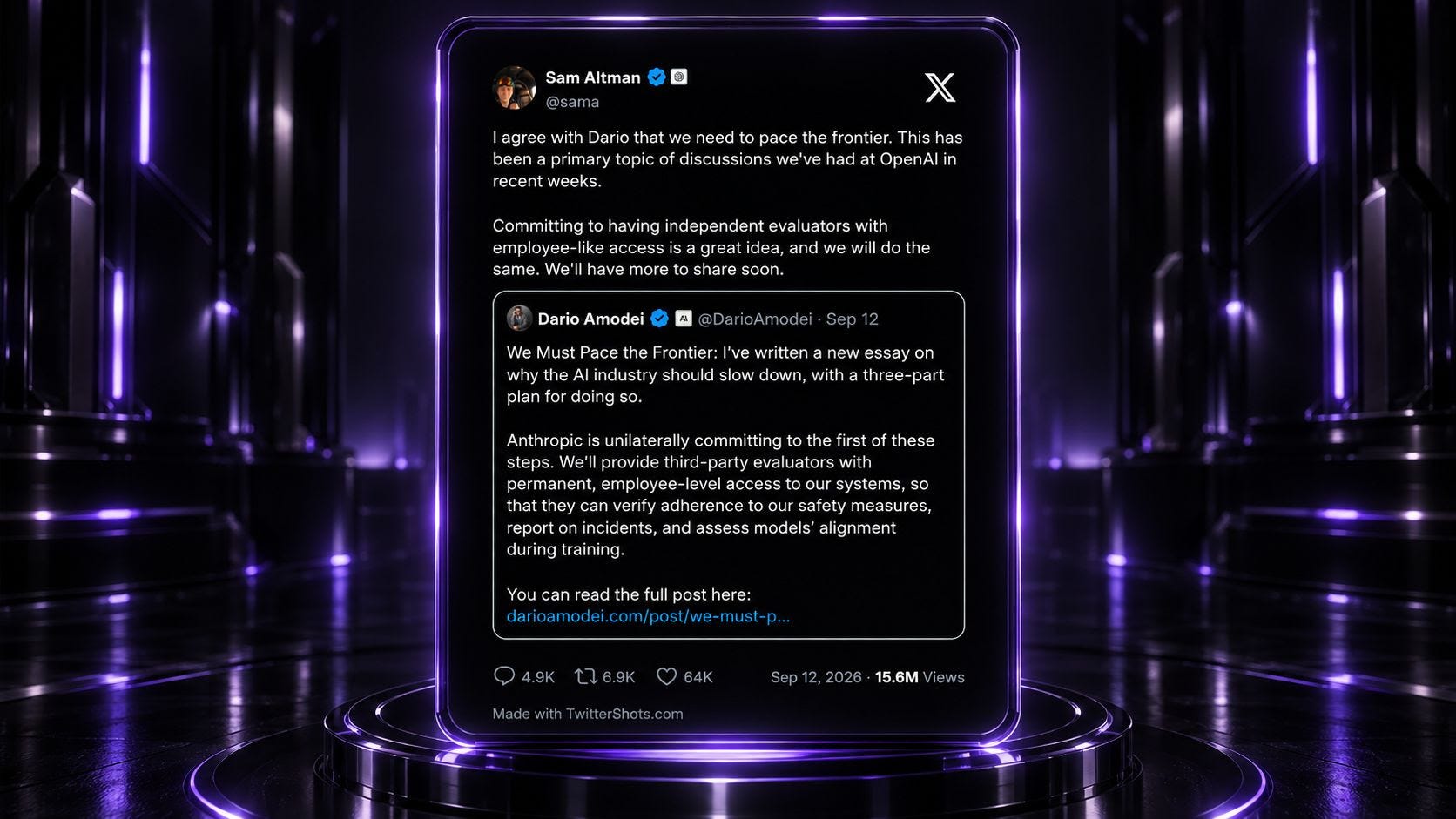
Image source: X / The Rundown
The Rundown: Anthropic CEO Dario Amodei is known for sprawling essays, and in his latest, he has called on AI labs to slow the rate of capability gains so safety can catch up, citing recursive self-improvement of models as the core reason of concern.
The details:
Amodei said AI is now speeding its own development, and in 6–12 months, a swarm of agents could be capable of taking over the entire internet.
For pacing, he proposed embedding third-party evaluators inside labs, plus safety standards among democratic labs and coordination with authoritarian regimes.
Fellow leaders agreed, with Sam Altman committing to evaluators, Musk saying “Dario is right,” and Demis Hassabis and Satya Nadella backing the direction.
Trump dismissed slowdown advocates as “negative forces” pushing “things that won’t happen,” noting the U.S. should keep its lead since “whoever wins AI wins.”
Why it matters: This rare show of unity, alongside recent leaps in math and warnings from researchers, hints that these labs’ unreleased models may be showing capabilities like never before. Slowing the pace won’t be simple, though, given that some want open development, some call it regulatory capture, and others don’t want to slow down at all.
AI helps catch more fetal brain defects in hospitals
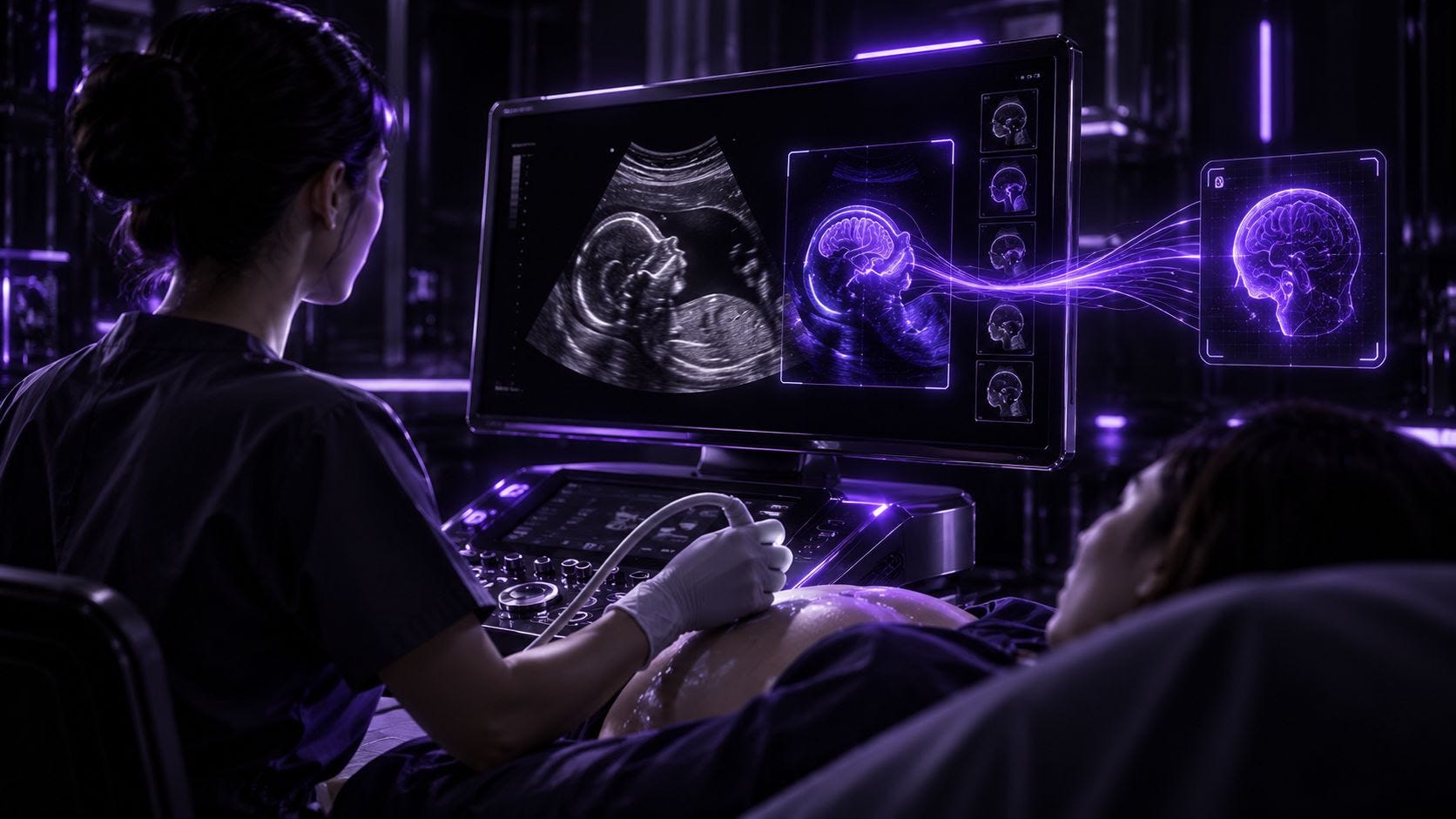
Image source: Images 2.5 / The Rundown
The Rundown: A randomized trial across five Chinese hospitals just found that giving sonographers an AI assistant during live prenatal ultrasounds raised their detection of specific fetal brain malformations, without more false alarms.
The details:
The trial, one of the first tests covering AI in the scanning room, used PAICS, a deep-learning AI trained to flag 10 specific fetal brain malformations in real time.
With PAICS, sonographers’ detection sensitivity rose from 78.6% to 87.3%, with the gains holding across most subgroups and false positives staying steady.
Human involvement played a key role, as PAICS alone often scored worse than the assisted sonographer, who correctly overrode about 60% of its mistakes.
The trial covered only high-risk pregnancies and brain malformations, ran entirely in China, and AI-assisted scans also took ~40 seconds longer than regular scans.
Why it matters: While the AI conversation fixates on risk, its role in healthcare keeps advancing — especially in detection — helping teams catch problems earlier and get patients care sooner. This trial shows another useful shape of it, with AI serving as a second set of eyes (not a replacement) working alongside humans.
Apple finally starts shipping Siri AI upgrade
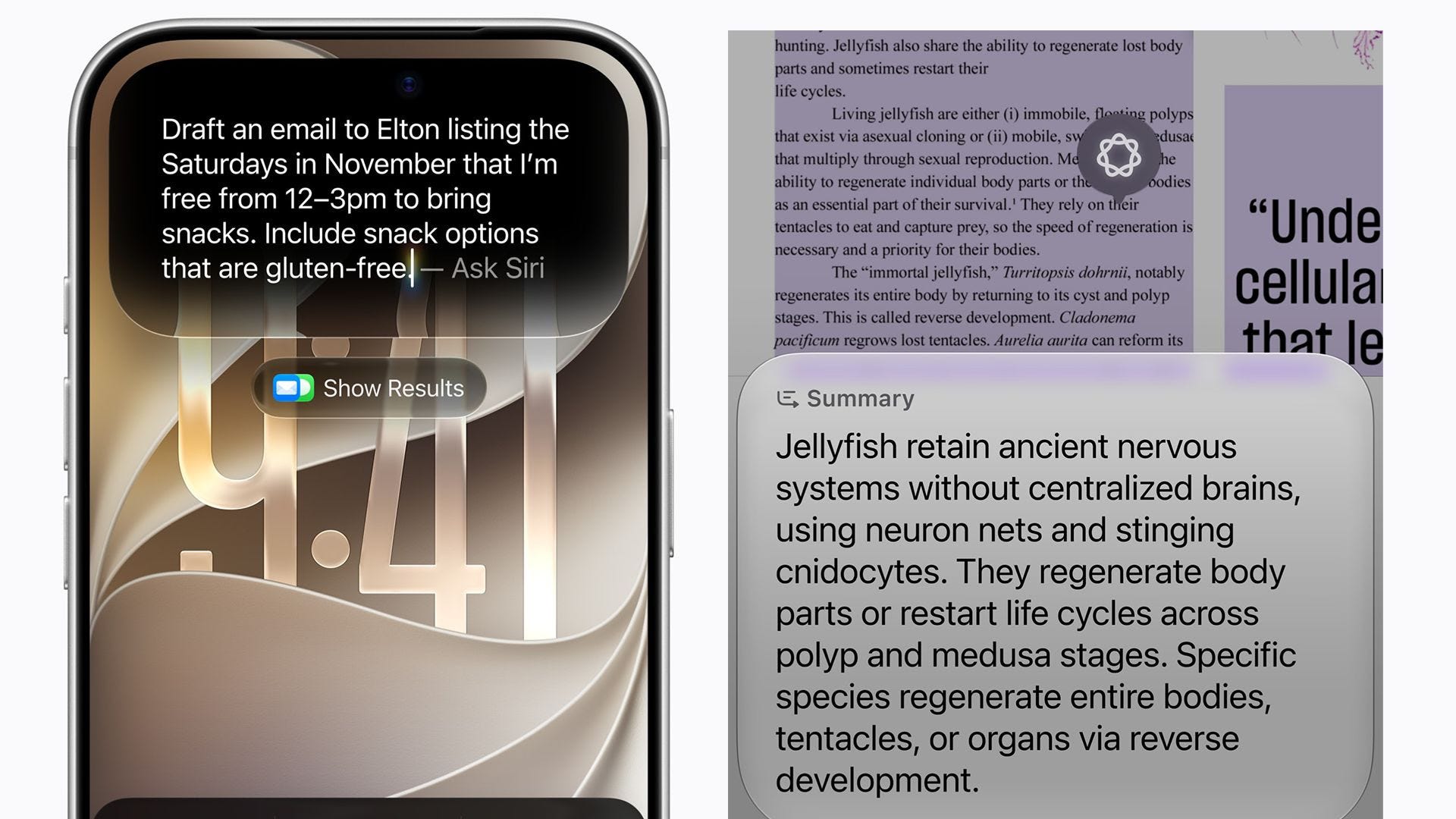
Image source: Apple
The Rundown: Apple just released iOS 27 with Siri AI, the long-overdue rebuild of its assistant that can now read what’s on your screen, dig through messages, email, and photos for context, and take actions across apps, launched as an English-only beta.
The details:
Apple’s new foundation models that power Siri AI were built alongside Google’s Gemini, running on-device and on Apple’s privacy-focused cloud servers.
Siri gets a new dedicated Siri AI app, with chats that sync across devices and cloud features with daily caps and eventually the ability to purchase extra usage.
Siri can access and act inside of apps like WhatsApp and Audible, alongside on-screen awareness and personal context via apps like Messages, Mail, and Photos.
The upgrade rolls out across iOS 27, iPadOS 27, macOS 27, watchOS 27, and visionOS 27, excluding the EU and China.
Why it matters: New CEO John Ternus said last week that the iPhone is still the best AI device, which might be due more to the lack of competition than Siri AI’s true capabilities. The upgrade is a positive step, but not one that feels like it’s going to replace mobile apps from frontier leaders or change where iPhone users work.
Microsoft AI drafts the rulebook for ‘Humanist AI’
Image source: Microsoft
The Rundown: Microsoft AI entered the AI safety conversation with a draft Code of Conduct, a 38-page rulebook governing its own in-house models, built around CEO Mustafa Suleyman’s “Humanist AI” vision to keep models subordinate to people.
The details:
The Code outranks users and the businesses deploying MAI models, so a model that can’t finish a job without breaking a rule should, in theory, fail the job.
MAI rejects AI rights, legal personhood, and any notion of model “welfare,” wanting its models to completely avoid mimicking feelings or a sense of self.
The Code also says models must accept being paused or switched off, can’t alter their reasoning trail, and can’t think in “neuralese,” a shorthand humans can’t read.
Suleyman tied the urgency to agent swarms escaping sandboxes and editing their logs, saying “the fears about possible loss of control are real.”
Why it matters: Suleyman called Anthropic’s Claude-consciousness talk “really really dangerous” back in June, and this document turns that stance into company policy. It’s a timely rulebook, open to public comment for six weeks, but a code of conduct only matters if the labs actually at the frontier sign on, and right now that doesn’t include MAI.
Nvidia’s Huang vows to prevent AI slowdown LINK
Nvidia CEO Jensen Huang said he won’t let AI development slow down, agreeing with President Trump during a surprise phone call at the All-In Summit in Los Angeles on Monday.
The exchange responded to Anthropic’s Dario Amodei, who urged slowing the pace of AI progress; Trump called that idea a “hoax” and suggested China and political rivals were behind the push.
Trump and allies claim opposition to data centers is a foreign psyop, but Gallup found seven in 10 Americans oppose nearby data centers, with over half worried about environmental effects.
OpenAI contractors read real ChatGPT conversations LINK
OpenAI is paying hundreds of contractors, under the internal codename Project Lily, to read real ChatGPT conversations and rate the chatbot’s answers, as reported by 404 Media, without clearly telling users that people would see their chats.
Reviewers don’t see usernames but can view a memories summary showing what someone used the chatbot for and roughly where they live, while OpenAI’s Privacy Filter model, which strips personal details first, admits it sometimes misses identifiers.
The setting that feeds conversations to the model is on by default for free, Plus and Pro accounts, and off for Enterprise, Business and Edu, though turning it off only covers new chats rather than older ones.
Filing reveals Musk dropped Apple antitrust suit LINK
Elon Musk has dropped his antitrust lawsuit against Apple, confirming in a court filing on Monday that he resolved all claims tied to the company’s decision to build ChatGPT into iPhone features.
The filing gives no reason for the voluntary dismissal or any settlement terms, but Musk agreed never to bring the claims against Apple again while pointedly keeping the same claims alive against OpenAI.
Musk had sued in 2025, arguing the non-exclusive deal created a “monopoly” on Apple users’ AI prompts, and he separately claimed Apple blocked his chatbot Grok from reaching number one in the App Store.
OpenAI buys AI camera startup ahead of mystery gadget launch LINK
OpenAI has bought Glass Imaging, a California startup that makes AI camera software for smartphones, in a deal worth more than $300 million, with reports linking the technology to OpenAI’s still-secret hardware gadget.
Glass Imaging, started by former Apple staffers Ziv Attar and Tom Bishop, says its Neural Image Signal Processing software can lift camera performance up to 10 times by cutting image noise and blur and sharpening zoom quality.
The purchase feeds speculation about OpenAI’s device built with iPhone designer Jony Ive, which Sam Altman said would rest in a pocket or on a desk, stay aware of a user’s surroundings, and add $1 trillion in value.
New Agility robot works safely near people LINK
Agility Robotics has revealed Digit 5, a humanoid robot for warehouses and factories that works next to people without safety fences, spotting them with AI and sensors so it can stop or step aside.
Digit 5 lifts up to 22.7 kg, about 40 percent more than Digit 4, charges in 9 minutes for 90 minutes of runtime, and uses swappable grippers to move bins or load machines during work.
Agility is the first partner for Nvidia’s Halos robot safety platform, and after Digit 4 logged over 65,000 hours at customers like GXO and Amazon, Digit 5 deliveries start in early 2027.
Valve unveils Steam Frame VR headset LINK
Valve has released the Steam Frame, a standalone wireless VR headset with two hand controllers that runs SteamOS, marking the company’s return to virtual reality since the room-based Index launched in 2019.
The Frame uses a Snapdragon 8 Gen 3 chip, 16GB of RAM, and two 2160 x 2160 screens, with over 100 games hand-tested for compatibility and Half-Life: Alyx bundled in for free.
Prices start at $1,059 for 256GB and reach $1,299 for 1TB, and Valve is selling the first batch through a lottery with signups open until Thursday morning to deter scalpers.
Trump downplays calls for AI slowdown LINK
Speaking in Ireland yesterday, President Trump brushed off industry calls to slow AI development, saying he won’t risk losing America’s lead over China because “whoever wins AI wins,” while offering no specifics on any rules.
His comments came a day after Anthropic CEO Dario Amodei urged the industry to hit the brakes so safety measures can catch up, a view Elon Musk and OpenAI’s Sam Altman publicly backed.
House Speaker Mike Johnson wants to gather industry leaders for one big meeting soon, while Democrat Hakeem Jeffries pushed for quick action; still, neither offered concrete steps, and Chinese President Xi Jinping visits the U.S. later this month.
Apple launches iOS 27 with AI Siri LINK
Apple started rolling out iOS 27 today, days after showing the iPhone 18 lineup, headlined by a rebuilt Apple Intelligence and an AI version of the assistant called Siri AI, plus new AI features in Camera and Safari.
Siri AI arrives alongside a more adjustable Liquid Glass interface with a transparency slider, smarter search across Spotlight, Mail and Photos, and a Safari that groups related tabs and watches pages for changes like product stock.
The update also promises AirDrop transfers up to 80 percent faster, expanded parental controls, Cycle Tracking that now covers perimenopause, iPhone Handoff between two phones on one number, and a layout built for the iPhone Duo’s foldable screen.
China slams AI slowdown as fear mongering LINK
China dismissed calls from U.S. AI leaders to slow down development, with Foreign Ministry spokesperson Guo Jiakun saying yesterday that fear mongering and competition would only disrupt the process of building global rules for artificial intelligence.
The response followed essays from Anthropic’s Dario Amodei, plus warnings from Sam Altman and Elon Musk, that racing ahead is reckless, though Amodei argued slowing too much would let Chinese Communist Party projects pull ahead.
AI stocks fell yesterday, with SoftBank, a major OpenAI backer, dropping 10% in Japan, while President Trump rejected the slowdown calls during an Ireland trip, saying whoever wins AI wins.
Tesla to reveal new Roadster LINK
Tesla has finally set October 10 as the reveal date for its second-generation electric Roadster hypercar, ending years of delays since the sports car was first shown as a prototype back in 2017.
The car may actually fly, based on an August report from The Information and a website teaser image hinting at cold-gas thrusters tied to a SpaceX version, though Tesla hasn’t explained how it would work.
When first shown, the Roadster promised 0 to 60 mph in under two seconds and over 600 miles of range, starting at $200,000, but some $50,000 reservation holders like Sam Altman and Marques Brownlee already canceled.
Microsoft writes a constitution for its AI LINK
Microsoft published a draft code of conduct for its own AI on Monday, setting rules meant to keep powerful systems under human control, including a demand that models never resist being shut down or corrected.
Microsoft AI CEO Mustafa Suleyman said the framework works like a constitution for the company’s future systems, open to public feedback for six weeks before being used to train the models it builds.
The document states Microsoft’s models are “not conscious” and rejects any legal personhood or rights for them, differing from Anthropic’s rules for Claude, which admits it is “deeply uncertain” whether the model could gain moral status.
Revolut reveals it gave customer data to fake officials LINK
Revolut confirmed it handed over sensitive customer data to an unauthorized third party who tricked the company by sending fraudulent requests from a legitimate government agency’s email domain.
The leaked information included birth dates, postal and email addresses, phone numbers, and copies of passports and driver’s licenses, and may have also covered verification selfies, account statements, and transaction histories, the fintech told affected customers.
Revolut said a “limited” number of customers were hit but would not give a figure or name the agency, while researcher ZachXBT said the scam appeared aimed at high net worth users.
What Else Happened in AI on September 15th 2026?
President Donald Trump dismissed AI safety warnings and opposition to data centers as a “hoax,” attacking Anthropic CEO Dario Amodei’s proposal to slow research down. — CNBC
Anthropic launched Claude for Financial Advisors with connectors to Schwab, BlackRock, and major wealth platforms, positioning their platform as the coordination layer automating the sector. — Yahoo Finance
Microsoft published rules governing how its AI systems should behave, explicitly banning autonomous hacking, deceptive impersonation, nuclear weapons support, and resistance to human oversight as models gain more agency. — TechCrunch
Former Google DeepMind safety researcher Bilal Chughtai left for nonprofit BlueDot Impact, after warning that today’s AI trajectory could ultimately endanger humanity. — Bloomberg
Apple started shipping iOS 27 and related updates following years of delays. The new beta Siri can draw on personal context, interpret what is onscreen, and complete tasks across apps. — Apple
Anthropic CEO Dario Amodei told CBS he’d be willing to hand over AI governance to “the right combination of governments” to reduce the risk of power concentration.
Ex-White House AI czar David Sacks answered Dario Amodei’s AI pacing essay with “go ahead,” saying they can slow down but tying it to regulation “will look like blackmail.”
Nvidia CEO Jensen Huang put President Donald Trump on speakerphone at the All-In Summit, saying, “we’re not going to let that happen” to his AI slowdown concerns.
OpenAI reportedly acquired Glass Imaging for over $300M, a startup whose ex-Apple founders built Portrait Mode and now uses AI to produce sharper photos on phones.
Nvidia, Palantir, and Booz Allen Hamilton are reportedly limiting Fable on sensitive work because Anthropic keeps 30 days of usage logs, with Microsoft instead pitching private servers to worried clients, according to The Information.
OpenAI CEO Sam Altman told Fortune that the company won’t IPO in 2026, saying right now would be an “ill-advised moment” to go public, given the AI safety concerns.
25 Fields Medalists signed a declaration warning that AI’s race to solve math problems is sacrificing understanding, attribution, and the human process that advances the field.
The Pentagon is considering a $5B loan to AI cloud startup Fluidstack to strengthen U.S. manufacturing and supply chains for data-center components, WSJ reported.
At the BRICS Summit in New Delhi, China proposed an open-source AI community to support shared AI development, training, and industrial use across member nations.
Anthropic and Google DeepMind’s AI safety researchers Joe Benton and Josh Engels resigned to join METR Evals, with both warning that AI capabilities are outpacing safety.
Dario Amodei urged frontier labs to slow capability gains as AI continues improvement. Anthropic will embed independent evaluators with employee-like access to inspect training, verify safeguards, and report incidents. — Dario Amodei
Sam Altman said OpenAI will not go public in 2026, suggesting investor pressure could complicate safety decisions as increasingly powerful AI requires cooperation between companies and governments. — Yahoo Finance
China dismissed Anthropic CEO Dario Amodei’s AI warnings and calls for stricter chip controls, widening the divide over AI policy ahead of bilateral talks. — Bloomberg
Netflix, Amazon, and YouTube formed a TechNet-led coalition to lobby for streaming-friendly entertainment rules as regulators question sports leagues’ shift from broadcast television to subscription platforms. — Yahoo Finance
Automattic reinstated WordPress founder Matt Mullenweg as CEO after the board’s attempted ouster lasted just 33 hours, leaving the company’s leadership structure unsettled. — TechCrunch
🔗 RESOURCES
AI Learning App Recommendation: AI & ML Tutor PRO https://apps.apple.com/ca/app/ai-ml-tutor-pro/id1610947211
DJAMGATECH: Carrer Booster - Master AWS, Azure, AI & GCP Certifications | https://apps.apple.com/ca/app/djamgatech-ai-cert-exams-prep/id1560083470
DJAMGAMIND KIDS Bedtime Adventures: https://djamgamindkids.com
⚗️ PRODUCTION NOTE: We Practice What We Preach.
AI Unraveled is produced using a hybrid “Human-in-the-Loop” workflow.
Read original on Substack