
[AI DAILY NEWS RUNDOWN] Tim Cook Warns AI Will Raise Prices, OpenAI Targets Palantir, Midjourney Reinvents Medical Imaging, and AI Trust Continues to Fall | June 18, 2026

🎧 Listen ADS-FREE: https://podcasts.apple.com/us/channel/djamgamind/id6760446113
Visit our Research Hub at https://djamgamind.com/pdfs
#DJAMGAMIND
Summary:
Artificial intelligence is beginning to reshape entire industries far beyond software. Apple CEO Tim Cook warned that soaring AI demand has created a semiconductor shortage severe enough to force higher prices across future products. Meanwhile, OpenAI is borrowing from Palantir’s playbook, launching a massive consulting and certification network to capture the lucrative AI deployment market.
Midjourney stunned observers by unveiling Midjourney Medical and a revolutionary whole-body ultrasonic scanner capable of generating detailed 3D images in sixty seconds, potentially challenging traditional MRI and CT scanning technologies.
At the G7 summit, Sam Altman, Dario Amodei, and Demis Hassabis met with world leaders to discuss a U.S.-led AI coalition while tensions over Anthropic’s Mythos and Fable restrictions continue. OpenAI strengthened its talent lead by recruiting transformer co-inventor Noam Shazeer, and Pew Research found that AI usage continues to rise even as trust in the technology declines.
Today’s developments suggest that the value in AI is rapidly shifting away from models and toward deployment, expertise, and real-world applications.
📌 Topics Covered
-
Tim Cook warns AI chip shortages will raise prices
-
Midjourney launches Midjourney Medical and Scanner
-
OpenAI launches a consulting ecosystem inspired by Palantir
-
G7 leaders discuss a U.S.-led AI coalition
-
Anthropic and the Mythos/Fable standoff continue
-
Noam Shazeer joins OpenAI
-
Pew finds AI usage rising while trust declines
-
Anthropic research shows expertise beats coding skill
-
OpenAI cash burn reaches $3.7B in Q1
-
AI diagnostics surpass doctors in some tests
-
Estonia prepares digital IDs for AI agents
-
Uber expands robotaxi services
-
Odyssey raises $310M for world models
-
Snap bets on life after smartphones
-
Firefox launches a bold turnaround strategy
🔗 RESOURCES
Stop scrolling through generic “Top 10” lists and head over to the AI Executive Toolkit at https://djamgamind.com/toolkit
-
AI Learning App Recommendation: AI & ML Tutor PRO https://apps.apple.com/ca/app/ai-ml-tutor-pro/id1610947211
-
DJAMGATECH: Carrer Booster - Master AWS, Azure, AI & GCP Certifications | Djamgatech App for iPhone, iPad & Mac: https://apps.apple.com/ca/app/djamgatech-ai-cert-exams-prep/id1560083470
-
Read Aloud wonderland bedtime Adventures:
https://wonderland-bedtime-stories.web.app/
⚗️ PRODUCTION NOTE: We Practice What We Preach.
AI Unraveled is produced using a hybrid “Human-in-the-Loop” workflow.
Tim Cook says higher prices are “unavoidable” because of AI LINK
-
Apple CEO Tim Cook told The Wall Street Journal that the company will raise prices because the cost of memory and storage chips has surged, driven by demand from artificial intelligence companies.
-
Cook would not say when the increases will start, how large they will be, or which products they will hit, but he said the prices for these chips have quadrupled over the past year.
-
Apple, one of the world’s largest chip buyers, now has to “wait in line” behind AI companies, and Cook called the situation a “hundred-year flood” he has never seen in over 40 years.
Midjourney is developing a full-body ultrasonic scanner LINK
-
Midjourney, the company behind the text-to-image AI tool, has announced the Midjourney Scanner, a medical machine designed to scan a person’s entire body in just 60 seconds using ultrasonic waves.
-
After stepping onto a platform, you are lowered into water at 2 inches per second through a ring of half a million tiny squares, each emitting ultrasonic waves and recording the ripples that bounce back.
-
The scanner produces a 3D map of your body down to a fraction of a millimeter, resembling an MRI but nearly 100 times faster, with Midjourney building spas in San Francisco to house the machines next year.
Google Gemini co-lead leaves for OpenAI LINK
-
Noam Shazeer, who served as co-lead of Google’s Gemini and is regarded as one of AI’s top researchers, is leaving the company to join OpenAI.
-
Shazeer’s move comes just two years after Google paid $2.7 billion to bring him and part of his CharacterAI team aboard, showing how acqui-hires can lose their value once retention periods end.
-
His hiring counts as a major win for OpenAI in the AI talent wars, as the company races to catch up with rival Anthropic’s most advanced models ahead of both firms’ anticipated IPOs.
Top AI CEOs want America to lead the world LINK
-
At the G7 summit in France, Anthropic’s Dario Amodei and Google DeepMind’s Demis Hassabis pushed for a U.S.-led coalition to set global rules and standards for artificial intelligence, with President Trump and other heads of state present.
-
Amodei told the group that cooperation should cover structured access to frontier models and trade of chips and critical components that excludes China, plus joint work on risks in cyber, bioterrorism, and intelligence.
-
OpenAI CEO Sam Altman, who also attended, called for an international forum to set globally accepted testing standards, while Canadian Prime Minister Mark Carney agreed the U.S. could lead such an AI coalition.
Trump says Apple will build chips with Intel LINK
-
President Trump announced on Truth Social that Apple has agreed to work with Intel to design and make chips inside the United States, though Apple itself said nothing and confirmed none of the details.
-
Trump’s post gave no volumes, timeline, dollar figure, or which chips were involved, and it followed a preliminary deal the two firms reportedly reached in May after more than a year of talks.
-
The Trump administration owns a roughly 10 percent stake in Intel and committed about $10bn to its factories, while Apple seeks a second source beyond TSMC, possibly using Intel’s 18A process.
Firefox’s bold new plan as users flee by the millions LINK
-
Mozilla has published a new roadmap of major Firefox changes, hoping to slow the browser’s steady loss of users as its desktop market share keeps falling.
-
The roadmap promises a Nova design refresh, mobile tab groups, customizable keyboard shortcuts, better PDF editing, a built-in VPN on mobile, and ad and tracker blocking for iOS without add-ons.
-
Firefox 152 already added a redesigned Settings page, experimental JPEG XL support, and HDR video on Windows and Linux, while a “Quick Answers” voice feature for chatbots is coming soon.
Why Midjourney Can Make Medical Machines
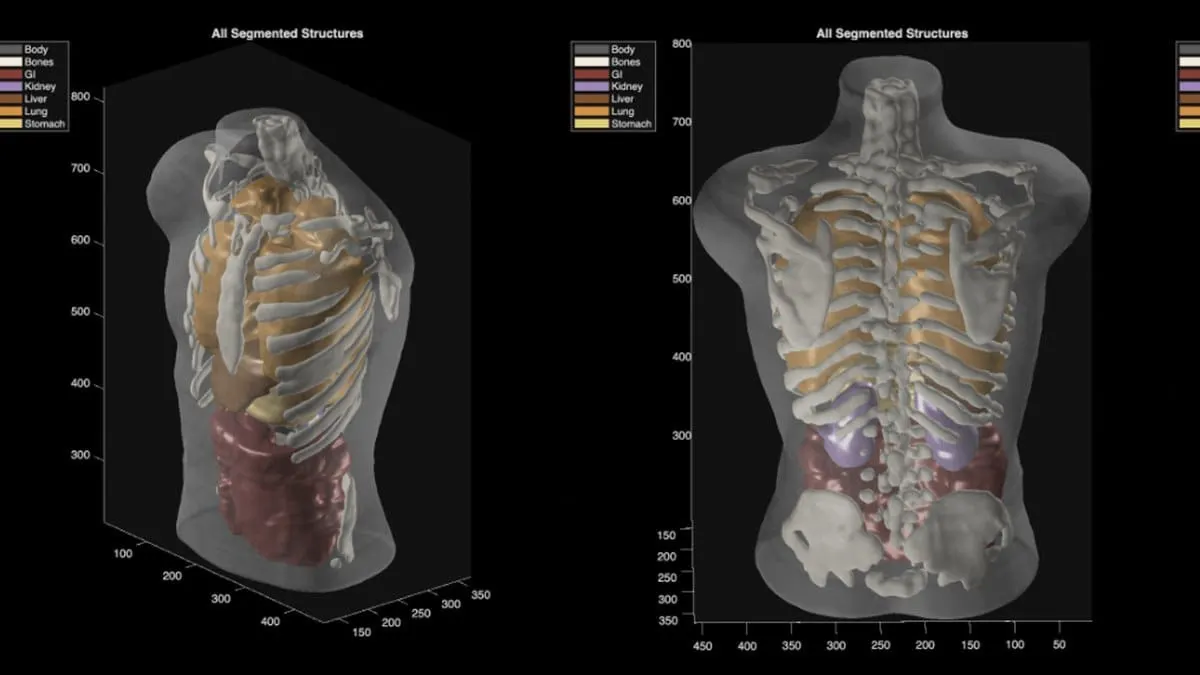
What happened: Midjourney released not one but two videos yesterday that got more than 13 million combined views in something like 14 hours. The videos were the company’s introduction to Midjourney Medical and the Midjourney Scanner, a full-body ultrasound tomography machine that uses a water bath for 60-second full-body scans without any radiation.
The details of how this machine works are pretty technical, but basically it competes with traditional MRI, CT, and conventional ultrasound, and in principle can produce close to the same or better results faster, more cheaply, and more safely than its competitors. You can look at a gallery of the machine’s early scans here.
And here’s a table that compares ultrasound tomography to conventional medical scanning, courtesy of Grok:
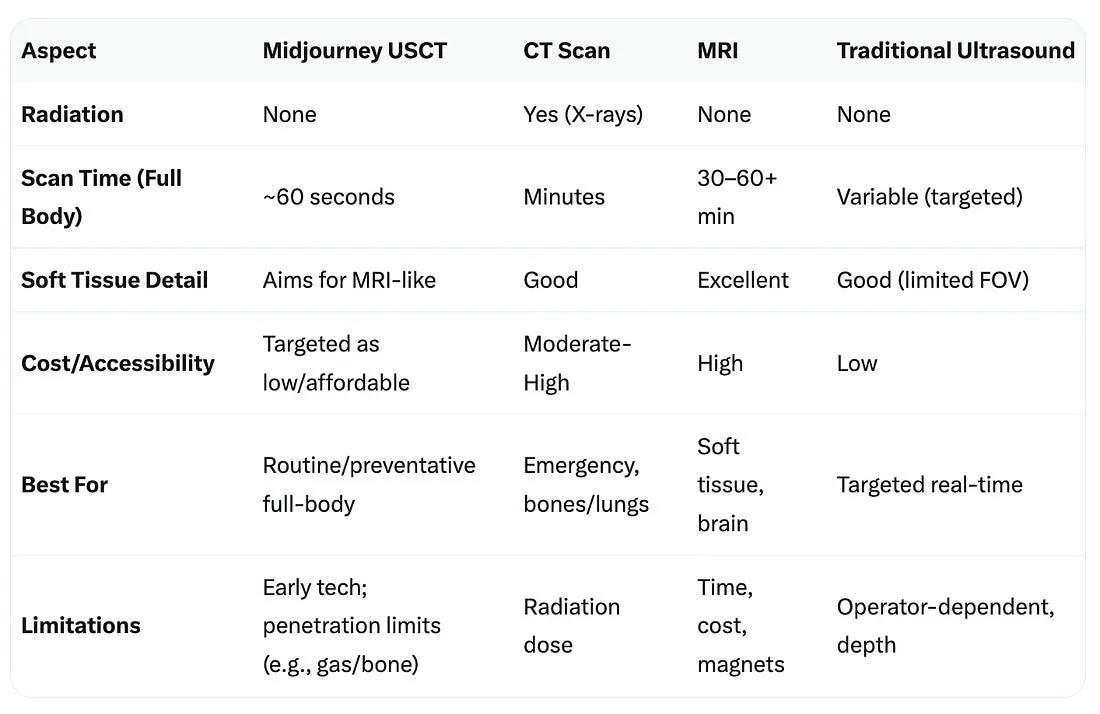
The machines are meant to provide preventive scans, and (again in theory) would be used for detecting tumors, cardiovascular issues that lead to heart attacks, strokes, etc., organ diseases, and musculoskeletal issues (e.g. muscle tears in athletes, osteoporosis complications). From Grok, again:
In summary, it targets silent, progressive conditions where repeated safe imaging provides the biggest edge: cancers, heart/vascular disease, metabolic organ issues, and body composition risks. This shifts healthcare toward true prevention through accessible, data-rich monitoring.
Hank Green added some nuance to (and poured a little water on) the discourse that’s worth reading, as well.
It looks like Midjourney will roll the first of these machines out at its newly planned Midjourney Spa, the first of which will open in SF’s Union Square toward the end of next year. Midjourney wrote all of these announcements up in a blogpost yesterday, including its roadmap to mass-scale medical scanning, which you can read here. - Brandon
How did Midjourney get here? The story of David Holz is pretty fascinating and inspiring. He grew up in Florida, the son of a dentist. Like most kids, he played video games, but quickly graduated to hacking on them for fun.
Clearly, David is very intelligent. PhD in math track, worked at NASA, but eventually branched out into entrepreneurship. Leap Motion was a pretty traditional venture-backed startup, and by all accounts it was a grind. Its first product brought hand tracking to VR. Big hardware challenges, complex market dynamics with bigger companies (Meta bought Oculus, Apple investing heavily, etc). Eventually Apple actually tried to buy David’s company, but the deal fell through at the eleventh hour. It was really rough for the company, they had to do layoffs, but they kept building. The devices sold to hackers, but broader VR adoption just never took off enough to sustain the business.
After about a decade, David was able to take a step back and start hacking on the next thing: AI image generation. Midjourney was a huge viral success that broke a lot of the traditional rules. No venture funding, no web front-end or app for years. The entire experience was contained to a massive Discord. A very odd product decision to be so dependent on another platform, but it had a bunch of knock on benefits. First, Midjourney basically had an extremely polished desktop and mobile experience from day one. This let the team focus on the core innovation - opinionated image generation that actually looked tasteful (to fans, myself included). Second, Discord allowed for a multiplayer AI interaction experience. New users could take inspiration from other users, see what prompts they were having the most luck with, and easily remix images. By generating four candidate images for each prompt, Midjourney got a bunch of really valuable data on what a “correct” image looked like for a specific prompt. A really solid data / RL flywheel.
The company still hasn’t taken venture funding, and after the big Meta deal to power Vibes, there’s clearly enough cash flow to fund other projects. I was personally hoping for a VR headset, but this seems way more impactful and unique. Very excited to see where it goes next. - John
Evan Spiegel’s bet on life after the smartphone
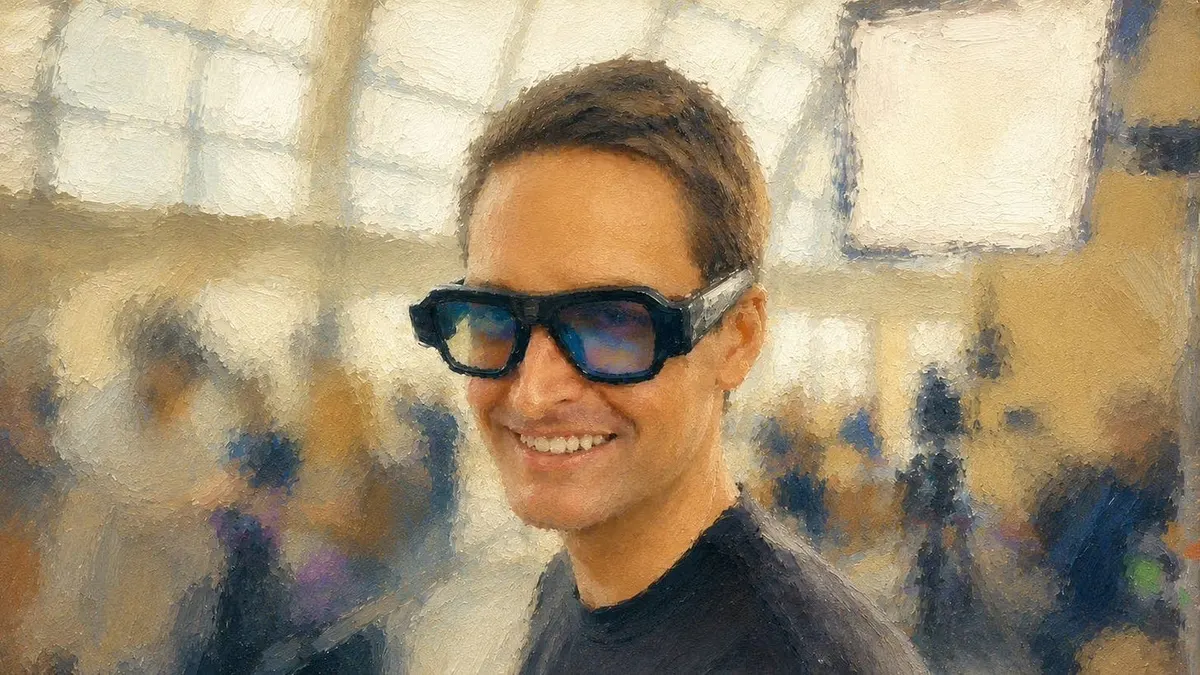
Snap CEO Evan Spiegel joins The Deep View Conversations to discuss SPECS, Snap’s long-awaited augmented reality glasses and why he believes they represent a new era of computing.
Senior reporter Sabrina Ortiz interviewed Evan at Augmented World Expo immediately after the SPECS unveiling and Spiegel explained why Snap spent more than a decade building toward this moment, how SPECS differ from AI smart glasses and mixed reality headsets, and why he sees AR glasses as the future beyond smartphones.
Evan Spiegel’s bet on life after the smartphone
Other topics covered include:
-
Why Snap calls SPECS a “computer” instead of AI glasses
-
How SPECS combine wearability with advanced spatial computing
-
The role AI played in making consumer AR glasses viable
-
Why shared experiences could become AR’s killer app
-
The challenge of competing with Apple, Meta, and other tech giants
-
Snap’s 12-year investment in augmented reality hardware and software
-
The importance of developers in building the AR ecosystem
-
Why Spiegel believes people are ready for an alternative to smartphones
-
How AR glasses could make computing more human
Spiegel argues that after nearly two decades of smartphone dominance, consumers are increasingly looking for a more natural way to interact with technology. Snap’s bet is that augmented reality glasses can bring computing into the world around us instead of pulling us away from it.
AI, world leaders meet at G7 as Mythos standoff continues

Image source: Images 2.0 / The Rundown
The Rundown: The U.S. government and Anthropic have remained at an impasse over the export restrictions that took the lab’s top models offline. But new details are emerging: a letter to Anthropic from Washington, employee reactions, and France’s G7.
The details:
-
Bloomberg released a letter from U.S. Commerce Sec. Howard Lutnick, who warned Anthropic against distributing Mythos/Fable to “foreign persons.”
-
Internal messages obtained by the NYT show concern from employees that the lab is being “unfairly targeted” and “bullied based on bad vibes.”
-
The Washington Post reported that the list of companies with Mythos access had “ballooned,” including a S. Korea firm with suspected ties to China.
-
Dario Amodei, Sam Altman, Demis Hassabis, and others are at the G7 summit in France, expected to discuss AI regulation and safety with world leaders.
Why it matters: Anthropic employees are coming to the same conclusion we initially did - that this is a relationship issue more than a safety one. But details like WaPo’s expanded Mythos list point to a clear situation that would draw the ire of the USG, though its stance on jailbreaks sounds like an impossible ask to comply with.
Pew: Americans using AI more but trust it less
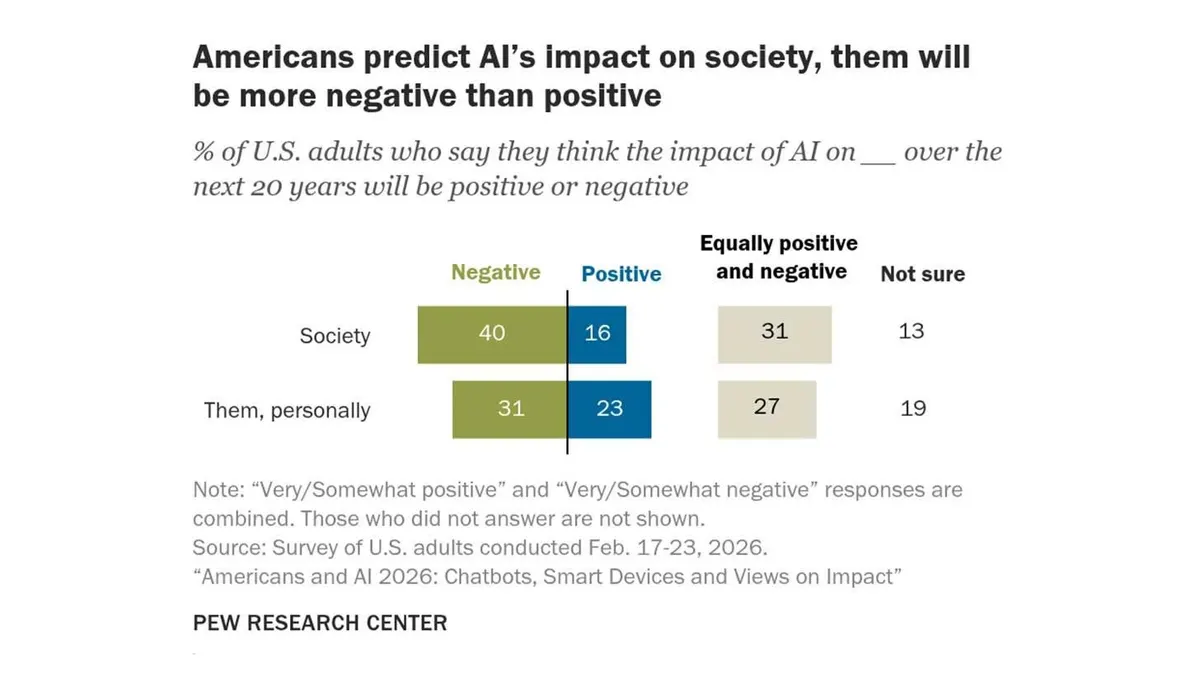
Image source: Pew Research Center
The Rundown: Pew Research just released its 2026 data on more than 5K U.S. adults, measuring both how people use AI and how they feel about it - with the two lines running in opposite directions as adoption climbs while optimism continues to slide.
The details:
-
Chatbots just crossed a milestone, with about half of U.S. adults now using one, and a quarter do so daily - a leap from just 1/3 of the public in 2024.
-
Pessimism reigns, with nearly 40% expecting AI to make society worse over the next 20 years and just 16% believing it will change things for the better.
-
The under-30 crowd leans on AI the hardest but trusts it the least, with only 14% seeing a positive payoff for society.
-
ChatGPT still dominates the field at 44% of adults, double its 2023 reach, with Gemini at 24% and Claude at just 6%.
Why it matters: This data aligns with our own gut check of AI’s sentiment outside of our narrow bubble, with adoption rising alongside fears for the future. The adoption numbers behind specific platforms are particularly wild, with Anthropic being the constant talk of the industry despite barely registering with the average American.
Study: Expertise beats skill in Claude Code
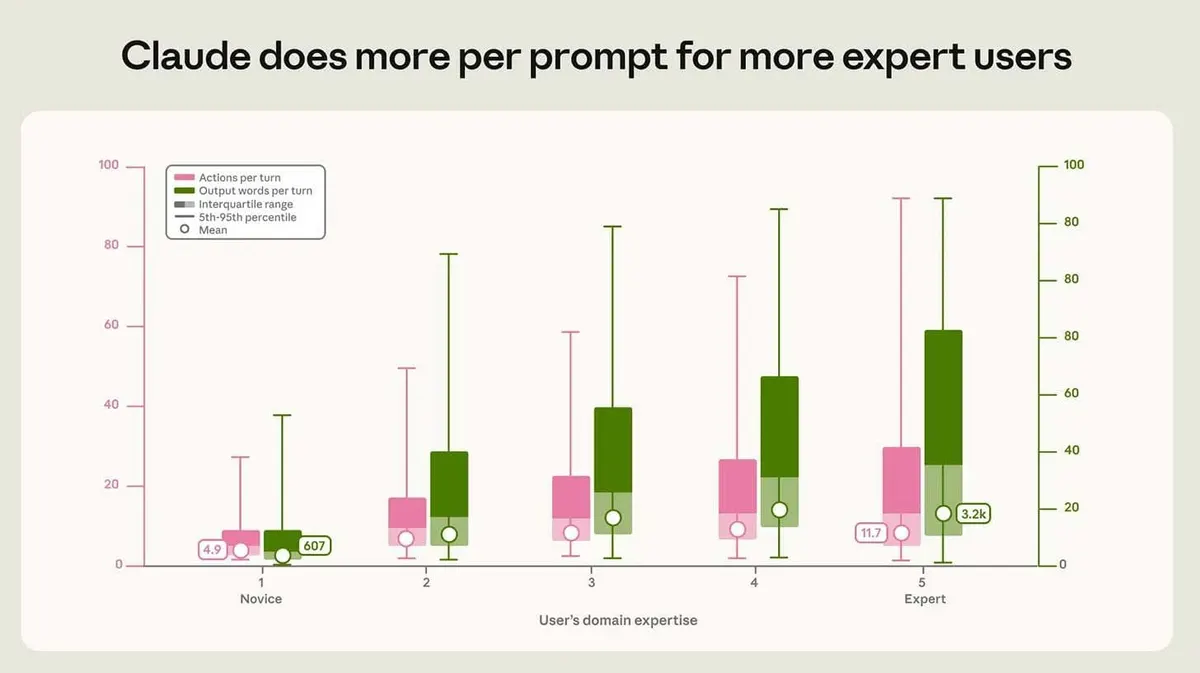
Image source: Anthropic
The Rundown: Anthropic just analyzed 400K Claude Code sessions, studying how work splits between human vs. agent and what drives success - finding that a user’s own expertise in their field matters more than their overall coding expertise.
The details:
-
Users made roughly 70% of planning decisions in a typical session, while Claude handled around 80% of execution choices.
-
Skill changed the yield per prompt, with beginners drawing about five actions and 600 words from Claude versus an expert’s 12 actions and 3,200 words.
-
Verified success rates confirmed by passing tests or saved work climbed to 28–33% for intermediate-and-above users, over double the 15% rate for novices.
-
Lawyers, managers, and scientists with no coding job title nearly matched software engineers on coding tasks, finishing within just seven points of them.
Why it matters: This data rhymes with the Perplexity-Harvard study we covered last week, where agents pushed people toward harder, cross-field work rather than just faster work. Both point in the same direction, with the value of agents being capped less by the model itself and more by how much its user actually understands the job.
OpenAI Wants Palantir’s Money

What’s happening: On June 14, OpenAI launched a Partner Network, pledging $150 million to certify 300,000 consultants by end-2026, enlisting McKinsey, BCG, Bain, Accenture, and PwC to wedge its AI into corporate workflows. It already runs a $4 billion Deployment Company and bought consultancy Tomoro for its forward-deployed engineers. Anthropic moved first in March with a $100 million network now at 40,000 applications and 10,000 certified consultants.
How this hits reality: For years the AI labs built the models and Palantir quietly pocketed the deployment money, embedding forward-deployed engineers in enterprises until the contract became the moat, not the software. Palantir is printing cash doing the unglamorous integration work OpenAI thought was beneath a frontier lab. Now OpenAI wants that revenue, so it is renting Palantir’s playbook and Salesforce’s certification racket, because the model alone stopped paying.
Key takeaway: The smartest model in the world turned out to be a commodity, and OpenAI just admitted the real money was in the consultants it once thought it was replacing.
What Else Happened in AI on June 18th 2026?
Dario Amodei and Demis Hassabis reportedly proposed a “U.S.-led AI coalition” at G7, with international cooperation on model access, chip exports, and safety risks.
OpenAI reported $3.7B in Q1 cash burn against $5.7B in revenue in 2026, with both tripling from a year earlier, according to documents seen by The Information.
Jensen Huang told the AP the AI age demands “new social norms,” comparing the shift to how cars pushed society to add sidewalks and crosswalks.
Odyssey raised $310M at a $1.45B valuation, fueling its push to build general AI world models that simulate physics and human behavior in real time.
ByteDance released Seedance 2.0 mini, a new lower-cost variant of the company’s powerful AI video model.
Midjourney announces Midjourney Medical, Midjourney Scanner, and Midjourney Spa
Hank Green: Let’s Talk about Whole-Body Ultrasounds
Noam Shazeer, co-inventor of the transformer, joins OpenAI
Dean Ball joins OpenAI “to help the company’s leadership shape frontier AI policy”
CNBC: CEOs of Anthropic and Google DeepMind call for U.S.-led AI coalition in meeting at G7
The Pragmatic Engineer: Why is Meta destroying its engineering organization?
WSJ: Apple to Raise Prices Due to Memory Chip Crunch, Tim Cook Says
Shoe company Allbirds rebrands as Smartbird amid AI pivot
AI medical tool Mira, Google’s Amie surpassed doctors at diagnostics
Estonia will grant digital ID numbers to AI agents to control access
Uber to expand premium robotaxi service to Houston next year
AI military startup Twenty raised $100 million at $1 billion valuation
World models startup Odyssey raises $310 million Series B