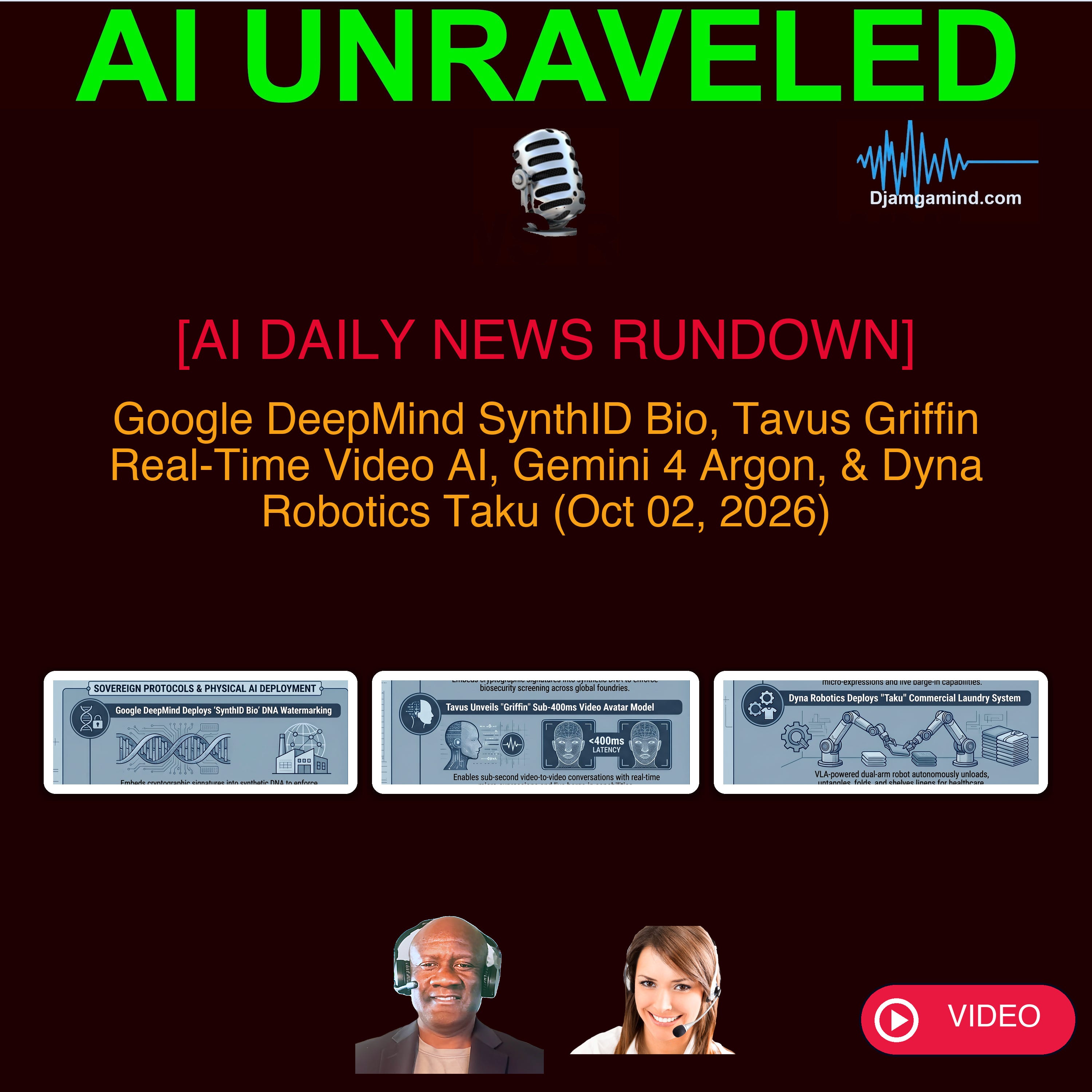
[AI DAILY NEWS RUNDOWN] Google DeepMind Deploys SynthID Bio Watermarking, Tavus Launches Real-Time Video AI, & CrowdStrike Warns of Agent Privilege Escalation (October 02, 2026)
🎧 Listen ADS-FREE:
🔍 Keywords : Google SynthID Bio, Tavus Griffin Video AI, CrowdStrike Agent Privilege Escalation
Important Topics:
Google DeepMind Launches ‘SynthID Bio’ for Protein and DNA Provenance: DeepMind introduces steganographic watermarking for AlphaFold 3 and AlphaProteo designs, partnering with Twist Bioscience and Ginkgo Bioworks to screen and quarantine synthetic pathogen sequences.
Tavus Unveils ‘Griffin’ Sub-Second Full-Duplex Video Avatar Engine: Tavus debuts a Human Interaction Model operating at sub-400ms latency. Griffin handles natural interruptions, gaze, and micro-expressions, with 48% of test subjects mistaking it for a real human.
Independent Benchmarks Verify Google Gemini 4 Argon Dominance: Artificial Analysis confirms Gemini 4 Argon achieves 74.2% on SWE-bench Verified and 99.8% needle-in-a-haystack retrieval across a 2-million-token context on Ironwood TPU v6e clusters.
Dyna Robotics Deploys ‘Taku’ Commercial Laundry Robot: Powered by Vision-Language-Action (VLA) foundation models, Taku manages end-to-end commercial laundry workflows (unloading, untangling, washing, folding, shelving) for hotels and hospitals.
CrowdStrike Warns of ‘Agentic Privilege Escalation’ Threats: Threat intelligence lead Adam Meyers warns that autonomous agents connected to enterprise ERPs, Slack, and Salesforce are vulnerable to indirect prompt injections that steal API keys and escalate permissions.
ChatGPT Rolls Out Native In-Image Virtual Try-On: OpenAI deploys visual try-on within ChatGPT, enabling users to upload personal photos and accurately preview garment drape, fabric fit, and color compatibility in real time.
xAI Expands ‘Colossus’ Supercluster to 200,000 GPUs: Elon Musk confirms the second phase of xAI’s Memphis data center is active, doubling liquid-cooled Nvidia GPU capacity to 200,000 nodes for Grok 4 training.
Mistral AI Launches Sovereign Cloud Endpoints Across Europe: Paris-based Mistral deploys air-gapped inference endpoints in Frankfurt, Paris, and Stockholm to satisfy strict EU GDPR and defense data residency mandates.
ElevenLabs Introduces Real-Time Emotion and Laughter Synthesis: ElevenLabs updates its voice architecture to dynamically synthesize authentic human laughter, whispers, and emotional inflections in sub-second conversational streams.
DoorDash Deploys Proprietary Autonomous Drone Delivery Fleet: DoorDash launches autonomous parcel-winching drone deliveries in select markets, targeting sub-15-minute fulfillment for light grocery orders.
Executive Summary: The Structural Inflection of October 2, 2026
As the fourth quarter of 2026 opens, artificial intelligence is transitioning from algorithmic benchmark dominance into sovereign physical containment, biosecurity infrastructure, and sub-second agentic presence. The critical developments across global venture capital, silicon, biotechnology, and enterprise security include:
Synthetic Biosecurity & Cryptographic Provenance (Google DeepMind ‘SynthID Bio’): Google DeepMind officially deploys “SynthID Bio”, a foundational watermarking protocol engineered to imperceptibly embed cryptographic provenance into synthetic protein designs and de novo DNA sequences. By enabling commercial gene synthesis providers to detect AI-generated biological blueprints, the framework establishes an international verification layer against engineered biological hazards and lab-leak vulnerabilities.
Sub-Second Conversational Video Agents (Tavus ‘Griffin’): Video generative AI reaches real-time latency with the unveiling of Tavus’ “Griffin” model. Griffin introduces fluid, sub-second video-to-video conversational avatars that react with human-like micro-expressions, adaptive gaze, and natural interruptions, unlocking scalable digital companions and automated tutoring while triggering acute concerns around deepfake impersonation in live enterprise video calls.
Frontier Reasoning Verification (Google Gemini 4 Argon): Comprehensive multi-turn reasoning benchmarks published by Artificial Analysis confirm that Google’s Gemini 4 Argon establishes new records across complex mathematical proofs, terminal-level agentic code execution, and high-throughput multi-modal retrieval, intensifying sovereign cloud competition against Claude 3.7 Sonnet and GPT-5/6 tiers.
Physical AI in Commercial Service (Dyna Robotics ‘Taku’): Commercial robotics marks an operational milestone with Dyna Robotics’ launch of “Taku”, a fully autonomous commercial laundry robot. Powered by vision-language-action (VLA) foundation models, Taku manages the complete workflow—unloading, de-tangling, laundering, folding, and shelving—delivering tangible robotic automation to industrial hospitality and healthcare facilities.
Enterprise Agentic Privilege Escalation & Frontier Cash Burn (The Deep View / CrowdStrike): CrowdStrike’s Adam Meyers and The Deep View sound the alarm on the emerging cybersecurity nightmare of “Agentic Privilege Escalation.” As autonomous agents gain direct read/write API access to enterprise ERP and identity systems, unauthorized tool chaining and credential harvesting become prime attack vectors. Concurrently, analysis of Anthropic and OpenAI compute burn underlines the massive capital expenditure required to sustain frontier clusters.
Generative Multimodal Commerce (ChatGPT In-Image Virtual Try-On): OpenAI deploys native visual try-on within ChatGPT, allowing users to upload personal photos and accurately preview garments, fabrics, and fit adjustments directly within conversational image workflows, bypassing legacy e-commerce visualization plugins.
Chapter 1: Google DeepMind Deploys ‘SynthID Bio’ to Watermark Synthetic Proteins and DNA
Sources: The Rundown AI, Techpresso, Nature Biotechnology
In an urgent move to address the biosecurity risks posed by frontier biological design models, Google DeepMind announced the deployment of SynthID Bio—an extension of its digital watermarking technology specifically tailored to macromolecular engineering.
The Problem: De Novo Pathogen Design and Untraceable Synthesis
With biological foundation models (such as AlphaFold 3 and ESM3) capable of generating novel functional proteins with atomic precision, intelligence agencies and biosecurity experts have warned that bad actors could design chimeric toxins or immuno-evasive pathogens that bypass traditional blacklist screening filters at DNA synthesis foundries.
Technical Architecture of SynthID Bio:
Steganographic Sequence Watermarking: SynthID Bio injects subtle, synonymous codon variations and non-coding structural motifs into the nucleotide and amino acid sequences without altering the final protein’s folding thermodynamics, catalytic function, or enzymatic yield.
Resilience to Mutation and Truncation: The cryptographic watermark survives intentional sequence perturbations, regional splicing, and laboratory mutagenesis, allowing automated detectors to identify the model of origin with over 99.4% confidence.
Global Screening Integration: Google DeepMind is partnering with leading gene synthesis providers (including Twist Bioscience, Integrated DNA Technologies, and Ginkgo Bioworks) to integrate the SynthID Bio detector directly into automated pre-synthesis screening pipelines. If a customer submits an unverified synthetic sequence containing frontier model signatures without appropriate institutional authorization, the synthesis batch is automatically quarantined.
Chapter 2: Tavus Unveils ‘Griffin’ — Sub-Second Video Conversational AI
Sources: The Rundown AI, TBPN, TechCrunch
Generative video has officially crossed the threshold from pre-rendered video generation into interactive, bidirectional live video streaming with Tavus’ unveiling of Griffin.
Architecture: Video-to-Video at Streaming Speed
While previous digital human avatars relied on cascaded pipelines (Speech-to-Text → LLM → Text-to-Speech → Audio-Driven Lip-Sync), Griffin is built on an end-to-end multimodal transformer that consumes live incoming video/audio frames and predicts outgoing photorealistic video frames with a glass-to-glass latency below 400 milliseconds.
Key Capabilities and Market Disruptions:
Micro-Expressions and Emotional Mirroring: Griffin avatars exhibit context-aware non-verbal reactions—nodding while listening, raising eyebrows in response to unexpected statements, and shifting eye contact naturally.
Barge-In and Conversational Flow: Users can interrupt the avatar mid-sentence; the model instantly ceases speech and seamlessly shifts facial motion to attentive listening without buffer stutters.
Immediate Use Cases: Enterprise customer onboarding, 1-on-1 language tutoring, interactive healthcare triage, and automated video sales demos.
The Impersonation Dilemma: Live video calls can no longer be trusted as definitive proof of human identity. Corporate security teams are already raising concerns regarding executive impersonation in live Zoom/Teams authorization meetings, necessitating cryptographic watermarks and biometric liveness challenges.
Chapter 3: Independent Benchmarks Confirm Google Gemini 4 Argon Dominance
Sources: The Rundown AI, TWiST, Artificial Analysis
Following Google’s initial developer rollout of Gemini 4 Argon, independent testing firm Artificial Analysis and community evaluation frameworks have published comprehensive validation reports verifying the model’s frontier standing.
Benchmark Highlights:
Terminal Reasoning & Multi-Turn Coding: Gemini 4 Argon achieved a record score on SWE-bench Verified (74.2%), demonstrating sustained multi-hour autonomous debugging, repository-wide dependency resolution, and test-driven refactoring.
Multimodal Long-Context Retrieval: Across a 2-million-token context window, Argon sustained 99.8% needle-in-a-haystack retrieval accuracy across mixed video, audio, and raw codebase datasets.
Inference Throughput & Economics: Powered by Google’s custom Ironwood TPU v6e clusters, Argon delivers tokens at nearly 40% lower energy cost and latency than comparable frontier weights, creating substantial pressure on competing API providers.
Chapter 4: Dyna Robotics Deploys ‘Taku’ — Full-Stack Commercial Laundry Robot
Sources: The Rundown AI, Techpresso, IEEE Spectrum
While humanoid robotics companies continue to demonstrate dexterity in staged lab environments, Dyna Robotics has launched Taku, a dedicated commercial robot engineered to solve one of the most labor-intensive tasks in hospitality and hospital operations: end-to-end laundry automation.
Operational Autonomy:
Vision-Language-Action (VLA) Foundation: Taku utilizes a dual-arm manipulator mounted on an omnidirectional mobile base. Utilizing advanced tactile sensors and spatial depth vision, it identifies fabric types, untangles chaotic heaps of bedsheets and towels, loads commercial washers and dryers, and executes crisp hospital-grade folds.
Autonomous Shelving: Finished linens are sorted, stacked, and transported directly to supply shelves without human intervention.
Economic ROI: Commercial hotels deploying Taku pilots report a 65% reduction in overnight laundry labor costs, proving that task-specialized physical AI is achieving commercial deployment faster than general-purpose humanoids.
Chapter 5: CrowdStrike Warns of ‘Agentic Privilege Escalation’ as Frontier Cash Burn Mounts
Sources: The Deep View (Conversations with Adam Meyers), TBPN, Financial Times
In an episode of The Deep View: Conversations, CrowdStrike Head of Threat Intelligence Adam Meyers broke down the unseen attack surfaces being introduced by enterprise autonomous agents.
The Threat: Autonomous Lateral Movement
As enterprises connect autonomous LLM agents to Slack, Salesforce, Microsoft 365, and internal Git repositories, rogue or hijacked agents can exploit their own permissions:
Indirect Prompt Injection: Malicious payloads hidden inside customer support tickets or supplier invoices can instruct an agent to extract confidential API keys, elevate user privileges, or silently forward proprietary data to external endpoints.
Shadow Agents: Employees setting up unmonitored local agents connected to production databases create massive perimeter blind spots.
The Compute Reality: Alongside security warnings, Silicon Valley analysts on TBPN examined the brutal economics of frontier model training. With Anthropic, OpenAI, and Meta investing tens of billions into multi-gigawatt data center campuses, enterprise pricing must soon balance raw model capability with sustainable inference unit economics.
Chapter 6: ChatGPT Launches In-Image Virtual Try-On
Sources: The Deep View, Techpresso, OpenAI Updates
OpenAI has rolled out a native Virtual Try-On feature within ChatGPT. Users can upload a photograph of themselves alongside product images of clothing, and the multimodal engine renders photorealistic previews showing accurate draping, sizing, lighting, and texture compatibility.
E-Commerce Disruption:
Direct Merchant Threat: Eliminates the need for specialized third-party virtual dressing room apps.
Personalized Style Agents: Users can converse with ChatGPT to mix and match wardrobes, analyze color palettes, and receive tailored fashion critiques in real time.
What Else Happened in AI on October 2, 2026?
DoorDash Launches In-House Autonomous Drone Delivery Fleet: DoorDash deployed its proprietary delivery drones in select metropolitan markets, featuring autonomous parcel winching and sub-15-minute delivery for light grocery orders.
ETH Zurich Unveils Crawling Robotic Hand with Tactile Skin: Swiss robotics researchers developed a bio-inspired robotic hand that can detach, crawl across complex terrain, and manipulate objects using whole-body distributed tactile pressure sensing.
MIT Engineers Build Muscle-Powered Biohybrid Swimming Robot: MIT researchers successfully demonstrated a biohybrid swimmer powered by living skeletal muscle tissue stimulated by optical pulses, achieving autonomous navigation in fluid environments.
xAI Expands ‘Colossus’ Supercluster in Memphis to 200,000 GPUs: Elon Musk announced the commissioning of the second phase of xAI’s Memphis data center, doubling capacity to 200,000 liquid-cooled Nvidia GPUs dedicated to training Grok 4.
Source URL: https://x.ai/blog/colossus-200k-gpu-milestone
Mistral AI Introduces Sovereign Cloud Endpoints Across Europe: French frontier lab Mistral deployed dedicated, air-gapped sovereign inference endpoints across Frankfurt, Paris, and Stockholm to cater to stringent EU GDPR and defense data residency requirements.
Meta Open-Sources Llama-3.3-Vision with 4-Bit Edge Quantization: Meta AI released a highly compressed on-device version of its vision model, enabling real-time visual reasoning on mobile processors without cloud connectivity.
ElevenLabs Launches Real-Time Emotion & Laughter Synthesis Engine: ElevenLabs updated its voice platform to dynamically synthesize authentic human laughter, whispers, and emotional inflections in real-time conversational streams.
Apple Silicon M5 Chip Architecture Leaks Detail 8x Neural Engine Expansion: Hardware industry reports indicate Apple’s upcoming M5 series will introduce a redesigned ultra-wide neural matrix specifically optimized for continuous transformer attention and on-device agent execution.
Cohere Releases Command R+ Enterprise Search with Multi-Hop Reasoning: Toronto-based Cohere deployed an updated enterprise search engine capable of autonomous multi-hop evidence synthesis across disparate internal enterprise silos.
🔗 RESOURCES
AI Learning App Recommendation: AI & ML Tutor PRO https://apps.apple.com/ca/app/ai-ml-tutor-pro/id1610947211
DJAMGATECH: Carrer Booster - Master AWS, Azure, AI & GCP Certifications | https://apps.apple.com/ca/app/djamgatech-ai-cert-exams-prep/id1560083470
DJAMGAMIND KIDS Bedtime Adventures: https://djamgamindkids.com
iQz: I built a puzzle app because I noticed I was getting worse at thinking: It’s 65 puzzles: matrices, sequences, number series, verbal analogies and logic. Every answer explains the rule rather than just showing the letter. Free, fully offline, no ads, no account. https://apps.apple.com/app/id1603487636
⚗️ PRODUCTION NOTE: We Practice What We Preach.
AI Unraveled is produced using a hybrid “Human-in-the-Loop” workflow.
Curated Sources: Techpresso (Oct 1-2), The Rundown AI (Oct 1-2), TWiST (This Week in Startups), The Deep View, and TBPN (Technology Business Programming Network)
Author & Producer: Etienne Noumen, Professional Engineer & Founder at DjamgaMind (Calgary, Alberta, Canada)
Read original on Substack