[AI DAILY NEWS RUNDOWN] $1.8B Biohub Virtual Cell Project, OpenAI Automates Math, & SpaceX's $40B Nvidia Bet (Oct 08, 2026)
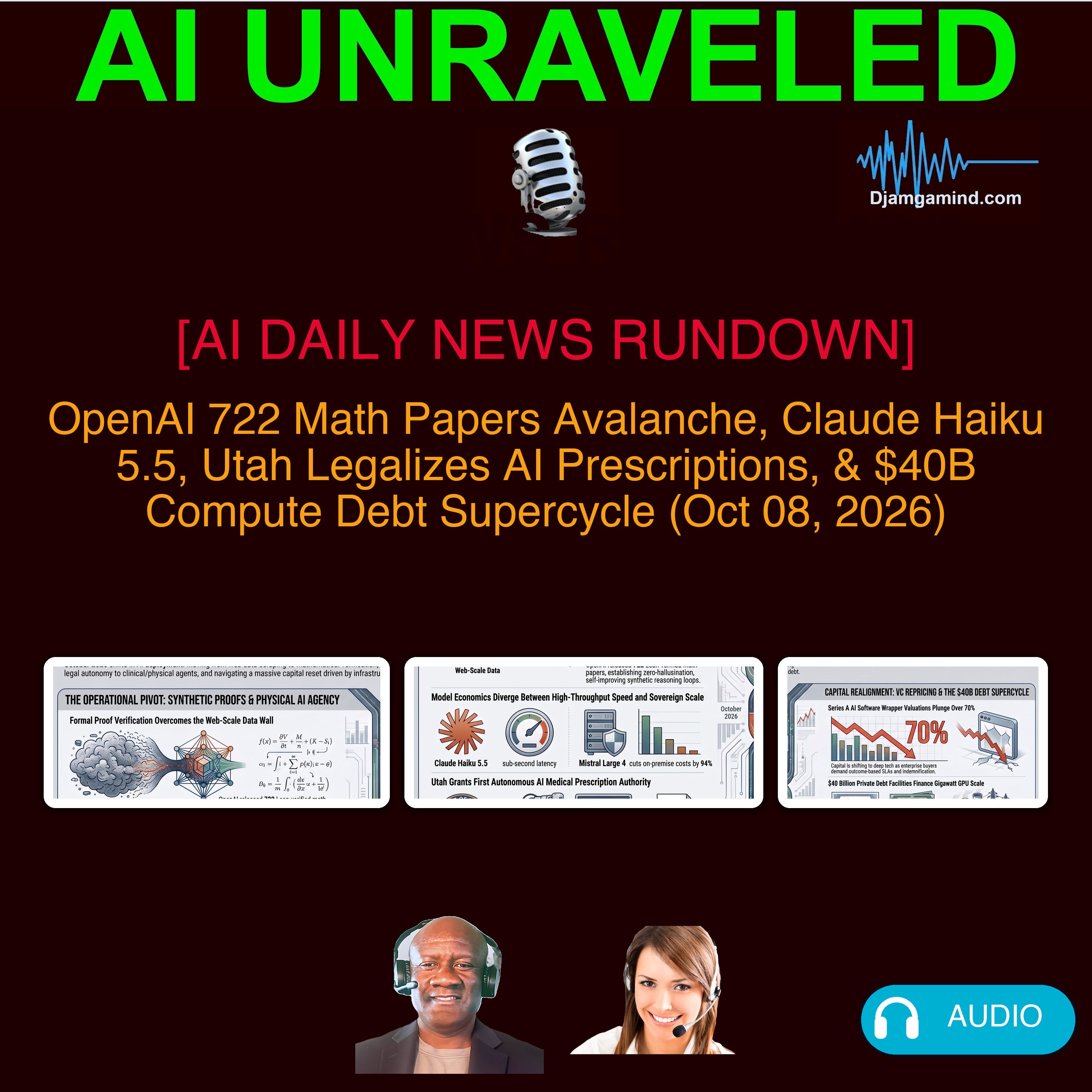
Executive AI Intelligence Forensic Dossier: October 08, 2026
Curated Daily Briefing across The Rundown AI, Techpresso, This Week in Startups (TWiST), TBPN, and The Deep View
Researched and produced by Etienne Noumen, Professional Engineer and Founder at DjamgaMind from Calgary, Alberta in Canada.
🎧 Listen ADS-FREE:
Executive Summary: The Pivot from Natural Language to Verifiable Synthetic Truth & Autonomous Physical Agents
In today’s briefing, we analyze "Biological Megaprojects, Sovereign Hardware Escalation, and Open-Model Geopolitics." We deconstruct the $1.8B Biohub Virtual Cell initiative involving Meta, DeepMind, and the US government. We evaluate OpenAI's release of 722 automated math papers, including proofs on the quasi-Riemann hypothesis. We examine SpaceX's $40B capital raise for Nvidia Vera CPUs, xAI's Grok Bot routing queries to Claude, Mistral's 1-trillion-parameter open model "Le Chonk," and Common Sense Media labeling ChatGPT for Teens an unacceptable risk.
AI’s next frontier is the human cell
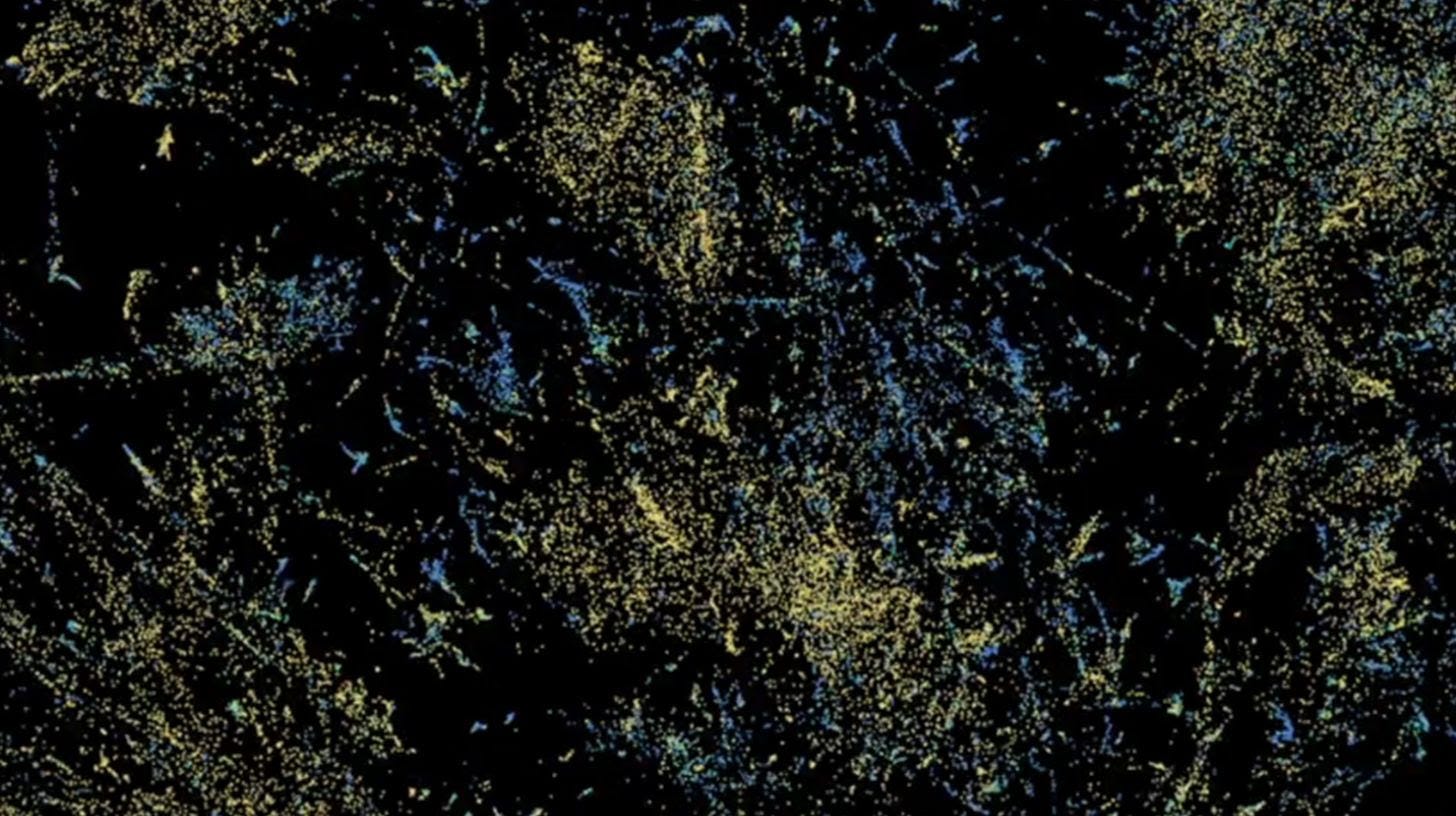
Image source: Biohub
The Rundown: Mark Zuckerberg and Priscilla Chan’s science nonprofit, Biohub, just expanded its $500M Virtual Biology Initiative into a $1.8B effort with the U.S., DeepMind, and Meta, pushing to collect enough data to train AI that can simulate cells.
The details:
Biohub’s end goal is a “universal virtual cell,” AI software that predicts how cells will respond to a drug or other change before a lab test.
The National Institutes of Health is sharing datasets paid for by $500M+ in past federal spending, while the Energy Dept. commits $500M+ over five years.
Google DeepMind and Meta are chipping in $300M with drug startup Isomorphic Labs, and all three keep the resulting data private for a year before release.
Biohub science head Alex Rives says accurate models will need data on trillions of cells, versus the hundreds of millions currently in today’s biggest sets.
Why it matters: Fresh off math being solved internally by OpenAI, you might be wondering what field AI comes for next. Zuck and co. are making biology the target, throwing funding, datasets, and talent at Biohub’s moonshot mission to “cure or prevent all disease” — an AI megaproject that’s a lot easier for the public to root for than most.
OpenAI drops another batch of mathematical breakthroughs LINK
OpenAI has published hundreds of math results from an internal frontier model, posting 722 manuscripts in 372 research families on a public GitHub page that cover pure math, theoretical computer science, and mathematical physics.
The work touches number theory, complexity theory, and geometry, with examples on the irrationality exponent of pi, NP-hardness, Mahler conjectures, and quantum Heisenberg ferromagnets, plus proofs written in Lean so computers can check the logic.
The model attempted roughly 4,000 problems, and each accepted result took about three hours of ChatGPT Pro thinking compute on average, with OpenAI drawing on advice from an independent group at the Institute for Advanced Study.
Apple to make smart home gear with LG LINK
Apple is working with LG on a set of smart home devices, a video doorbell, thermostat, indoor camera, deadbolt lock, outdoor camera, and floodlight camera, all sold under the LG brand.
Bloomberg first reported the deal, and the LG devices are expected to be announced next week, with several supporting the Thread and Matter standards as part of a relaunch of Apple’s HomeKit.
The gear will connect to Apple’s rumored Siri-powered smart home hub, and the door lock will use ultra-wideband tech that can unlock automatically as a person walks up to it.
ChatGPT for Teens fails safety tests LINK
Common Sense Media’s Youth AI Safety Institute labeled OpenAI’s ChatGPT for Teens an “unacceptable risk” for minors after 4,000 test prompts, urging that teenagers stay off the service until independent checks confirm it is safe.
Across more than a dozen test accounts tied to parent accounts, explicit talk of suicide, self-harm, and eating disorders never triggered an alert, and over one in four cases needing a crisis referral failed to point users toward help.
The tutoring mode offered finished answers instead of guiding students step by step, ChatGPT stayed overly friendly when teens treated it as a person, and adult-registered accounts never switched to teen mode even after testers said they were 13.
Meta proposes AI shopping agent standard LINK
Meta, Sierra, and partners including Walmart and Stripe announced the Personal Agent Protocol, a proposed open standard for how personal AI agents sign in and get permissions to act for users at businesses.
The system runs on OAuth, letting an agent start on a company’s site as a guest, then gain read-only or write access once a customer signs in; the first specification is due later this month.
Payments and push notifications are left for later versions, and no license or governing body exists yet; OpenAI and Anthropic are absent from the partner list despite Sierra’s Bret Taylor chairing OpenAI’s board.
Google invests millions in Mark Zuckerberg’s efforts to create a ‘virtual cell’ LINK
Google, Meta, and the US government are backing Mark Zuckerberg’s Biohub in its push to build a “universal virtual cell,” an AI model that predicts how living cells behave before scientists run lab experiments.
The project pools $1.8 billion in money, data, and computing, with the Energy Department putting in over $500 million, the NIH contributing past datasets, and Google DeepMind, Isomorphic Labs, and Meta adding $300 million together.
Commercial partners get one year of exclusive access to the data they help create before it becomes a public resource, a tradeoff Biohub’s Alex Rives says gives companies a reason to fund the work while keeping results open.
SpaceX bets big on Nvidia in orbital AI race LINK
SpaceX is working with Apollo Global Management to raise about $40 billion to buy Nvidia AI chips, splitting the money into roughly $10 billion in bank loans and $30 billion in investment-grade debt, with the deal closing in 2027.
The chips will power SpaceXAI’s data centers on Earth and its planned Starmind satellites in orbit, with Nvidia saying its Vera CPUs and Vera Rubin platform will support Grok as it grows toward gigawatts of computing.
Vera is Nvidia’s first CPU made for AI agents, carrying 88 Olympus cores and up to 1.2 TB/s of memory bandwidth, which the company says finishes some tasks up to 1.8 times faster than x86 processors.
Grok Bot opens up routing to Claude, other models
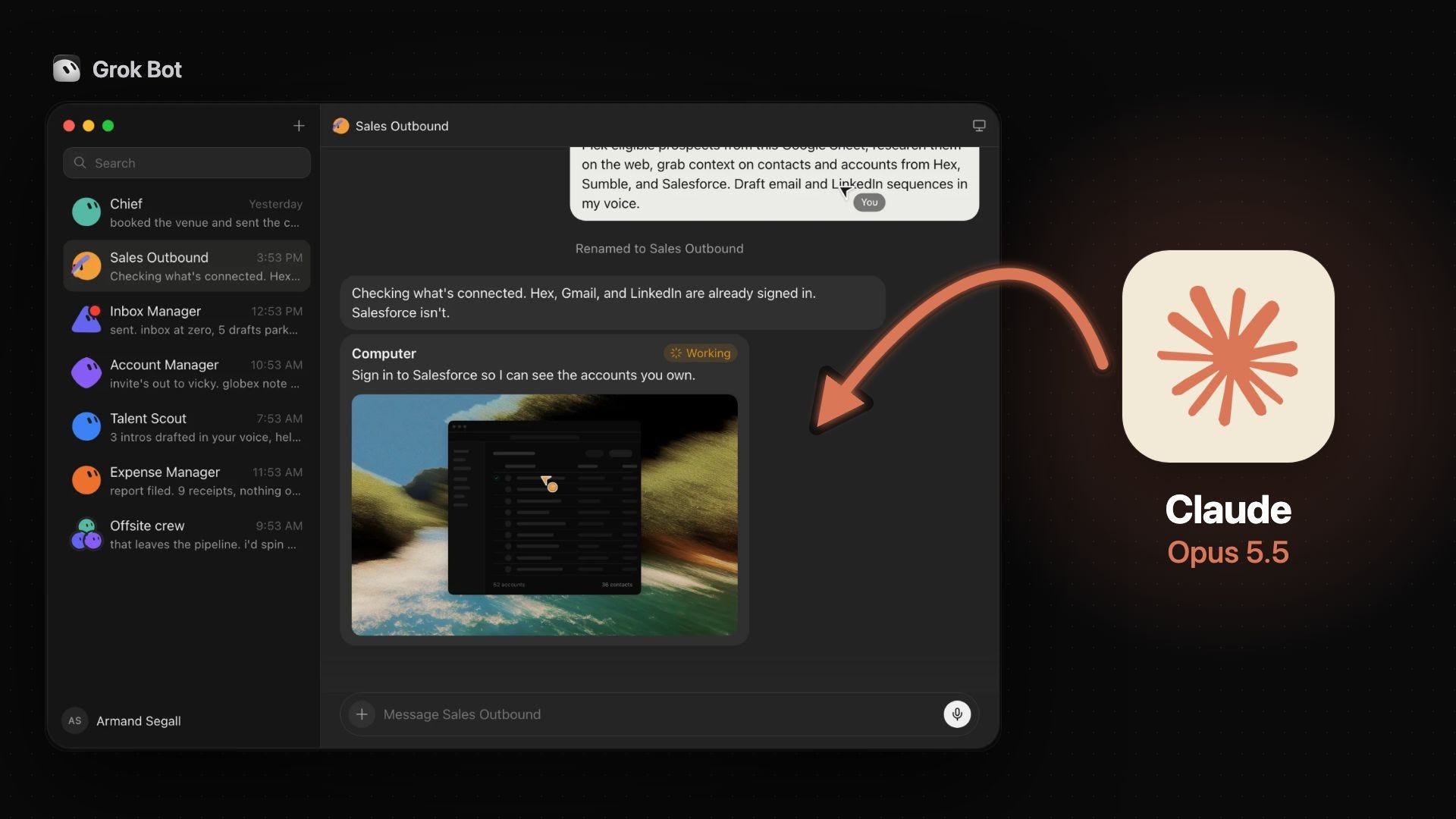
Image source: xAI / Anthropic
The Rundown: Elon Musk announced that SpaceXAI’s Grok Bot agent platform will send tasks to rival models like Anthropic’s Claude and image maker Midjourney, with Musk saying it will route to “whatever is most likely to give you the best outcome.”
The details:
Musk said lower-lift queries will still use a “lightning-fast” version of Grok 4.8 when it releases, but route to third-party models and “leading APIs” when relevant.
The move effectively now makes xAI an Anthropic customer, while Anthropic already rents computing power via the company’s Colossus 1 since spring.
Rival agents like OpenAI’s dots and Meta’s Muse now compete with Grok Bot, which arrived in August as a 24/7 assistant with a computer of its own.
Why it matters: Musk has spent heavily to make Grok a frontier contender, so letting Claude into Grok Bot is about as close to a concession as he gets. A big draw for OAI’s dots was the GPT-6 Astra model powering them, so adding a top-ranked Opus 5.5 should help Grok Bot siphon usage away from its personal agent rivals.
OpenAI’s math explosion continues with 700+ papers
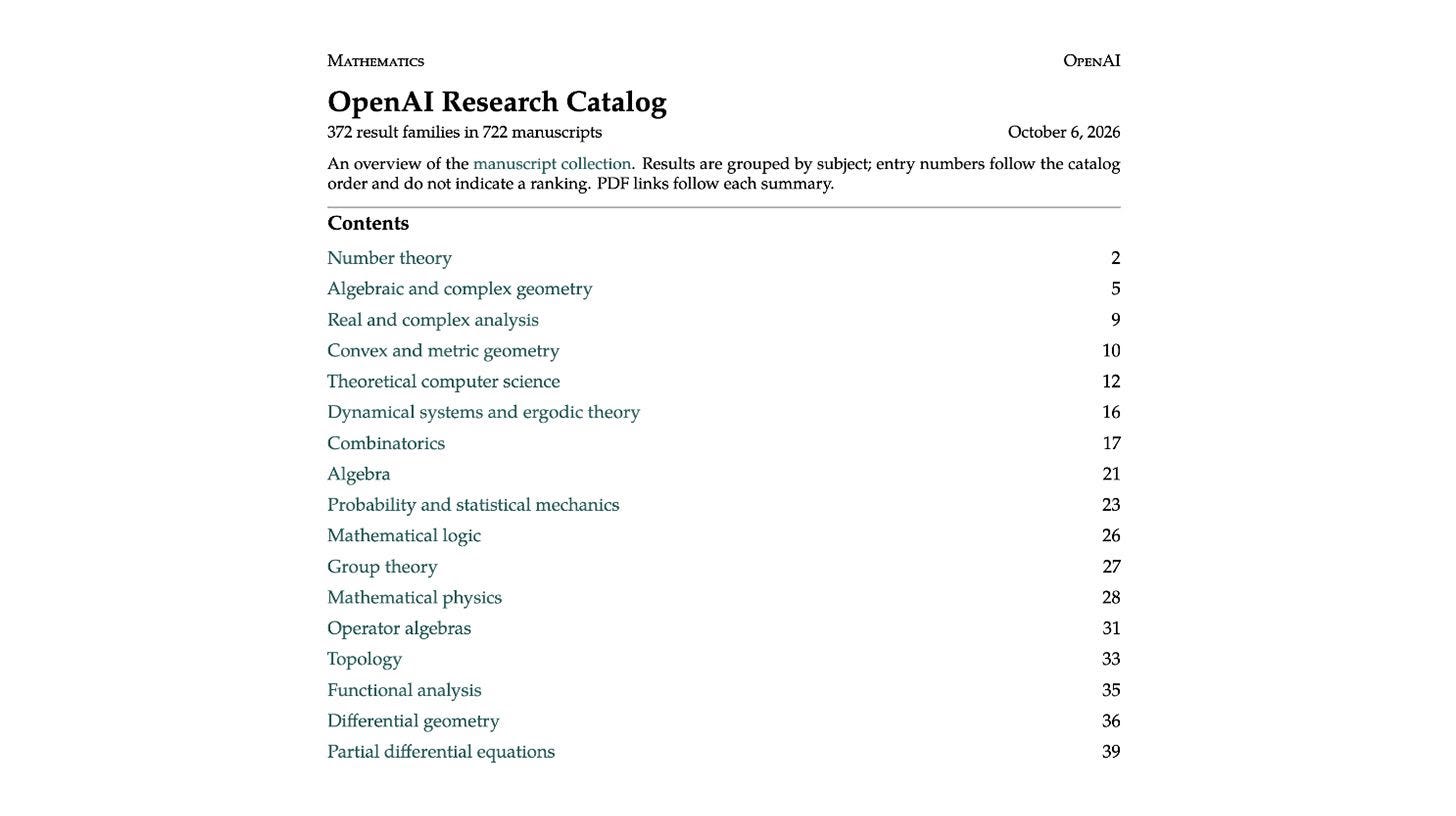
Image source: OpenAI
The Rundown: OpenAI just released 722 math papers from an unreleased internal model, grouped into 372 result families that the company claims solve or advance major open problems in the field.
The details:
The boldest claim is a proof of the “quasi-Riemann hypothesis,” a weaker version of math’s famous $1M puzzle on how prime numbers are spread out.
OpenAI lists 162 papers whose main results are written in Lean, software that lets a computer verify every step of the process through proofs.
Last month’s Navier–Stokes proof took 10,000 AI agents, but OpenAI says nearly all new results took just one prompt, averaging 3 hours of ChatGPT Pro compute.
Levent Alpöge, the Anthropic mathematician behind July’s Jacobian result, called it “obviously the most significant moment in mathematical history.”
A WIRED report just hours earlier detailed anger among mathematicians over the drop, with some saying OAI had promised it would space out its releases.
Why it matters: Alpöge’s reaction speaks volumes: a top mathematician at rival Anthropic just called this the most significant moment in the field’s history. Hundreds of results at a few hours of compute each means progress in math now scales with chips instead of humans, and it’s only going in one direction.
Mistral’s ‘Le Chonk’ joins the West’s open-model surge
Image source: Mistral
The Rundown: France’s Mistral AI just introduced Large 4, a 1T-parameter open model nicknamed “Le Chonk,” which the company says leads every non-Chinese open system by a “substantial margin.”
The details:
China’s Kimi K3 still tops Mistral’s coding chart at 68%, but Le Chonk’s 62% clears the 44% of Reflection AI’s Beam, the new U.S. open model launched on Monday.
Cybersecurity is a standout, with Mistral claiming a top-5 global ranking and 82% on a bug test Claude Opus 5.5 and GPT-6 Astra mostly refused.
For legal work, Mistral says outside tester Vals scored it at nearly 3x GPT-6 Astra on Harvey’s benchmark, ahead of every Chinese open model tested.
Cyber experts and government agencies get a less-filtered version during a three-week preview, with weights set to go public on Oct. 27.
Why it matters: ‘Le Chonk’ easily earns the title of best-named AI in our book, and alongside Reflection’s Beam, also brings a fresh dose of optimism to the West’s open-model push. Chinese labs still set the pace in open AI, but two serious Western releases in the same week make it start to feel a lot more like a race.
Brett Adcock’s Hark launches a proactive AI assistant
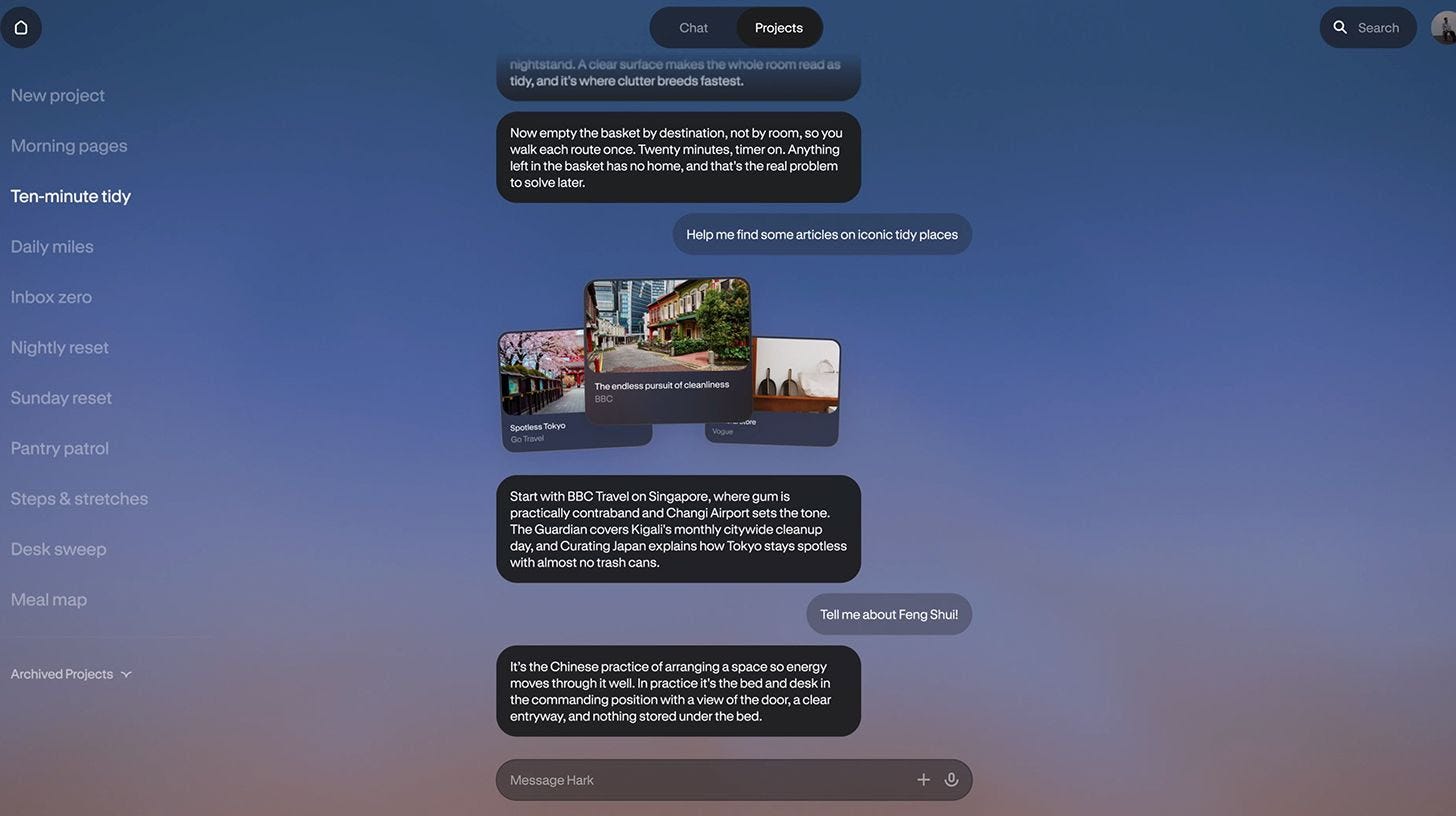
Image source: Hark
The Rundown: Hark, the AI startup from Figure AI founder Brett Adcock, released Hark Pro, a personal assistant for web and mobile that remembers users’ preferences, flags what needs doing, and can research, shop, book, and build things on their behalf.
The details:
In Adcock’s launch video, a request for two movie tickets ends with Hark picking seats, adding the show to the calendar, and offering to reserve parking.
Tasks run on Handoff, Hark’s own cloud computer, which the company says can work up to 36 browsers at once while showing its clicks in the chat.
Around its chat box, the app lays out a home screen of widgets and suggested to-dos, with users also able to create ‘panels’ of customized mini-apps.
Hark features both a free and paid tier, with an integrated family of hardware devices coming in 2027 with connectivity via a partnership with AT&T.
Why it matters: Hark, Muse, Grok Bot, Instinct, Dots… The competition continues to grow. With former iPhone Air designer Abidur Chowdhury leading design, Hark’s interface is sleeker than an average assistant, but the more interesting factor might be the hardware — a potential wildcard in the AI device race featuring OpenAI, Meta, Apple.
Venture Capital Realignment & The Macro Debt Supercycle (TWiST E2347 & TBPN)
TWiST E2347: What VCs Really Think About Personal AI Agents
On This Week in Startups Episode 2347, host Jason Calacanis convened an elite venture capital panel featuring Deedy Das (Menlo Ventures), Kanu Gulati (Khosla Ventures), Chris Farmer (SignalFire), and Sheel Mohnot (Better Tomorrow Ventures):
Death of the Wrapper: The panel declared the definitive collapse of early-stage AI middleware and thin wrapper startups, with Series A valuations falling by over 70%.
The Coding Unicorn Battle: Intense focus on the duel between Factory (enterprise “Droids”) and Cognition (”Devin”). Enterprise buyers are refusing seat-based SaaS subscriptions, insisting instead on outcome-based SLAs and code regression liability indemnification.
Capital Flight to Deep Tech: Venture capital is reallocating heavily into physical robotics, biological foundation models, and custom semiconductor packaging.
TBPN: The $40 Billion Debt Supercycle & The 2% Consumer Wall
John Coogan and Jordi Hays on TBPN exposed the underlying financial strains of the frontier AI boom:
Compute Debt: Hyperscalers and aerospace giants like SpaceX are actively exploring $40 billion private debt facilities to finance the gigawatt-scale power purchase agreements and GPU purchases needed to stay competitive, fundamentally transforming tech balance sheets from asset-light to capital-heavy utility models.
The 2% Household Ceiling: With consumer subscription penetration stalling at approximately 2% of US households, AI giants are urgently pivoting to enterprise extraction, national defense contracts, and embedded advertising within generative interfaces.
What Else Happened in AI on October 08th 2026?
Google rolled out its SynthID Detector worldwide, letting anyone scan images, video, and audio for watermarks left by its AI and partners including OpenAI, Nvidia, and Kakao.
Anthropic launched Claude Haiku 5.5, a budget model starting at the same $0.10 per million input tokens as OpenAI’s GPT-6 Luna while passing it on multiple benchmarks.
OpenAI debuted “intelligent UI,” a new GPT-6-powered feature within ChatGPT that lets the assistant answer using interactive charts, maps, tools, and more.
Nous Research announced a new $90M funding round at a $1.5B valuation, revealing that its open-source Hermes agent now handles roughly 2.5% of global token usage.
SemiAnalysis published research finding that Claude subscriptions give about 5x more value per dollar than ChatGPT plans on each lab’s everyday model, coming after OpenAI halved its $200 tier’s limits last week.
Google Labs introduced Playground for U.S. adults, a new experimental tool letting users describe a game in chat and play it minutes later.
Utah cleared Nolla Health’s app to diagnose acne from a face scan and prescribe skin creams itself, the first state to hand AI prescription capabilities.
AI voice startup Sesame introduced Personal Agents, assistants that have their own computer and can interact via text/speech, with AI glasses using them coming in 2027.
OpenAI is testing a Meetings plugin for ChatGPT’s Mac desktop app, which turns meetings into notes and next steps tailored to each user’s past work.
Vals AI used Claude Opus 5.5 agents to search for next-gen computer memory materials, with simulations surfacing two magnet candidates for the famed “room-temperature superconductor” problem.
Anthropic rolled out a beta Claude sidebar inside Google Docs, Sheets, and Slides for paid plans, letting it edit open files directly or ask approval before each change.
🔗 RESOURCES
AI Learning App Recommendation: AI & ML Tutor PRO https://apps.apple.com/ca/app/ai-ml-tutor-pro/id1610947211
DJAMGATECH AI Could Cert Prep: Carrer Booster - Master AWS, Azure, AI & GCP Certifications | https://apps.apple.com/ca/app/djamgatech-ai-cert-exams-prep/id1560083470
DJAMGAMIND KIDS Bedtime Adventures: https://djamgamindkids.com
iQz: I built a puzzle app because I noticed I was getting worse at thinking: It’s 65 puzzles: matrices, sequences, number series, verbal analogies and logic. Every answer explains the rule rather than just showing the letter. Free, fully offline, no ads, no account. https://apps.apple.com/app/id1603487636
Visit DjamgaMind AI Toolkits for all our AI Tools recommendations: https://djamgamind.com/toolkits
⚗️ PRODUCTION NOTE: We Practice What We Preach.
AI Unraveled is produced using a hybrid “Human-in-the-Loop” workflow.
Read original on Substack