
[VIDEO AI WEEKLY NEWS RUNDOWN] Nvidia's Coding Agent Aces ARC-AGI-3, Stripe Buys OpenRouter for $7B, and US Lab Probes Chinese Lidar (August 23, 2026)
🎧 Listen ADS-FREE: https://podcasts.apple.com/us/channel/djamgamind/id6760446113
Visit our Research Hub at https://djamgamind.com/pdfs
🔍 Keywords: Nvidia AVO ARC-AGI-3, Stripe OpenRouter Acquisition, Chinese Lidar Security, Amazon Echo Price Hike, Claude Protein Design, ChatGPT Mac iMessage
Summary:
In this week’s AI Weekly News Rundown, we cover Nvidia’s AVO coding agent achieving a perfect score on the ARC-AGI-3 test and Stripe’s massive $7B acquisition of AI middleware startup OpenRouter. We also look at the US government’s probe into Chinese lidar security risks, Amazon’s steep price hikes on Echo devices, and Anthropic’s Claude autonomously designing proteins. Finally, we discuss OpenAI’s controversial integration of ChatGPT into Apple iMessage, New York surpassing San Francisco in tech jobs, and the US forcing allies to choose sides in the AI race against China.
Important Topics:
Nvidia’s Coding Agent Aces ARC-AGI-3 Test: Nvidia’s AVO coding agent, built around Anthropic’s Claude Opus 5, completed all 183 levels across 25 public games in the ARC-AGI-3 test with a perfect score.
US Lab Probes Chinese Lidar Security: The Idaho National Laboratory is examining whether Chinese lidar sensors from suppliers like Hesai and RoboSense could create cybersecurity dangers in US vehicles.
Amazon Hikes Echo Prices up to 60%: Amazon raised prices on several Echo, Kindle, Fire TV, and Eero products, citing significant increases in memory and storage component costs.
AI Finds Hidden Breast Cancer Patterns: Researchers used an AI platform called CenSegNet to find previously unseen patterns in breast tumor centrosomes, helping inform diagnoses and personalized treatments.
Anthropic’s Claude Tackles Protein Design: Anthropic’s Claude models successfully ran autonomous protein-design campaigns, yielding working molecules on 14 of 15 targets at success rates of 22-35%.
Doctor Solves 22-Year Math Problem with ChatGPT: A Beijing neurosurgery resident proved Crouzeix’s Conjecture, unsolved since 2004, using GPT-5.6 Sol in a 16-hour autonomous session.
ByteDance Cuts Hollywood’s First AI Video Deal: ByteDance agreed to a formal framework with the Motion Picture Association to implement copyright protections in its Seedance and Seedream models.
OpenAI and Nvidia’s 8 GW AI Power Push: OpenAI and Nvidia announced a massive Ohio AI campus to deliver nearly 8 GW of compute, backed by up to $105B of Nvidia’s own credit.
ChatGPT Can Now Access Your iMessages: OpenAI added a feature letting ChatGPT on Mac read, write, and search a user’s iMessages locally, raising significant ecosystem privacy questions.
New York Overtakes SF in Tech Jobs: New York’s tech workforce reached 394,000, officially surpassing the San Francisco Bay Area’s 376,000 tech workers for the first time.
Waymo Builds its Own Robotaxi Chip: Alphabet’s Waymo designed its own custom 5nm self-driving chip, moving away from Nvidia and AMD hardware for its new robotaxi fleet.
Senators Demand TikTok Explain Safety Test: US Senators demanded details about a 2021 experiment where TikTok withheld a safety feature from millions of users to measure engagement.
🔗 RESOURCES
AI Learning App Recommendation: AI & ML Tutor PRO https://apps.apple.com/ca/app/ai-ml-tutor-pro/id1610947211
DJAMGATECH: Carrer Booster - Master AWS, Azure, AI & GCP Certifications | https://apps.apple.com/ca/app/djamgatech-ai-cert-exams-prep/id1560083470
DJAMGAMIND KIDS Bedtime Adventures:
https://djamgamindkids.com
Hello AI Unraveled and Djamgamind listeners,
Short one, and a real ask at the end.
You might know I’ve been building a bedtime-story app for kids: DjamgaMind Kids. Over 600 stories for 4 to 8 year olds about Black history, African legends and Caribbean folktales. Free, narrated, no ads, no subscription. It quietly grew to around 400 downloads a day on the App Store without a dollar of marketing.
It’s now a finalist in Melamoon, a national pitch competition for Black founders across Canada. I made the Top 10 in Vancouver. The next round is a public vote, and the Top 5 go to the Grand Finale in Toronto in October.
The ask: one vote. It takes about 20 seconds.
[VOTE HERE: https://djamgamind.com/pitch ]
One vote per person, and voting closes 22 September.
If you have a second after, my profile is here: and if you know anyone with small kids, the app itself is at
https://djamgamindkids.com
.
Thank you, genuinely.
Nvidia’s coding agent aces ARC-AGI-3 test LINK
Nvidia’s AVO coding agent completed all 183 levels across the 25 public games in the ARC-AGI-3 test with a perfect score, working through the puzzles without any prior instructions or set goals.
AVO is a wrapper built around Anthropic’s Claude Opus 5, and while the model alone scored just 30 percent on the same public set, the added software layer pushed the result all the way up to 100 percent.
Nvidia originally made AVO to tune GPU code, then swapped its tools for the ARC-AGI-3 interface, where it cleared the levels in 6,624 actions, about 12 percent fewer than the rival VISTA wrapper needed.
US lab probes Chinese lidar security LINK
The Idaho National Laboratory, a Department of Energy facility, is examining whether Chinese lidar sensors could create security dangers if they spread across vehicles in the United States, according to two people who spoke to TechCrunch.
The lab is looking mainly at cybersecurity risks, and possibly clearing Chinese lidar of concerns, with funding from unnamed electric and autonomous vehicle companies; Rivian, GM, Ford, and others said they weren’t aware of it.
The probe comes as lawmakers push bills to ban Chinese lidar over spying fears, while suppliers Hesai and RoboSense have cut sensor prices from as much as $75,000 a decade ago to a few hundred dollars.
Amazon hikes Echo prices up to 60% LINK
Amazon has raised prices on several Echo, Kindle, Fire TV, and Eero products, blaming rising memory and storage costs, with some jumps as steep as 60% on its cheaper smart home devices.
The Echo Dot climbed from $50 to $80, while the Fire TV Stick 4K Max went from $60 to $85 and the 16GB Kindle rose from $110 to $150.
Amazon confirmed the changes, pointing to “significant increases in memory and storage component costs” across the electronics industry, and said it held off on passing those costs to shoppers for as long as it could.
AI finds hidden breast cancer patterns

Image source: University of Northampton
The Rundown: Researchers from the University of Northampton published a new study that used an AI platform called CenSegNet to read and compare breast tumor samples cell by cell, finding previously unseen patterns in how cancer progresses.
The details:
Healthy cells rely on centrosomes to divide correctly; when centrosome function becomes abnormal, it can cause errors that contribute to cancer.
The AI analyzed data from 27 patients across 911 samples to find two patterns (oversized vs. extra centrosomes) that each have different links to outcomes.
Patients tended to live longer when a tumor had fewer of the oversized versions, while extras lined up with more aggressive disease.
The researchers say the next step is pairing the findings with other data to guide treatments, with the system open-sourced and testing on other tissues.
Why it matters: Some of AI’s headline-grabbing science wins have been through designing new things, but don’t discount the value in the tech’s less-sexy ability to read and analyze patterns in data that both humans and older systems simply haven’t noticed. It’s exactly that skill that helps inform diagnosis and personalized treatments.
Anthropic’s Claude tackles protein design
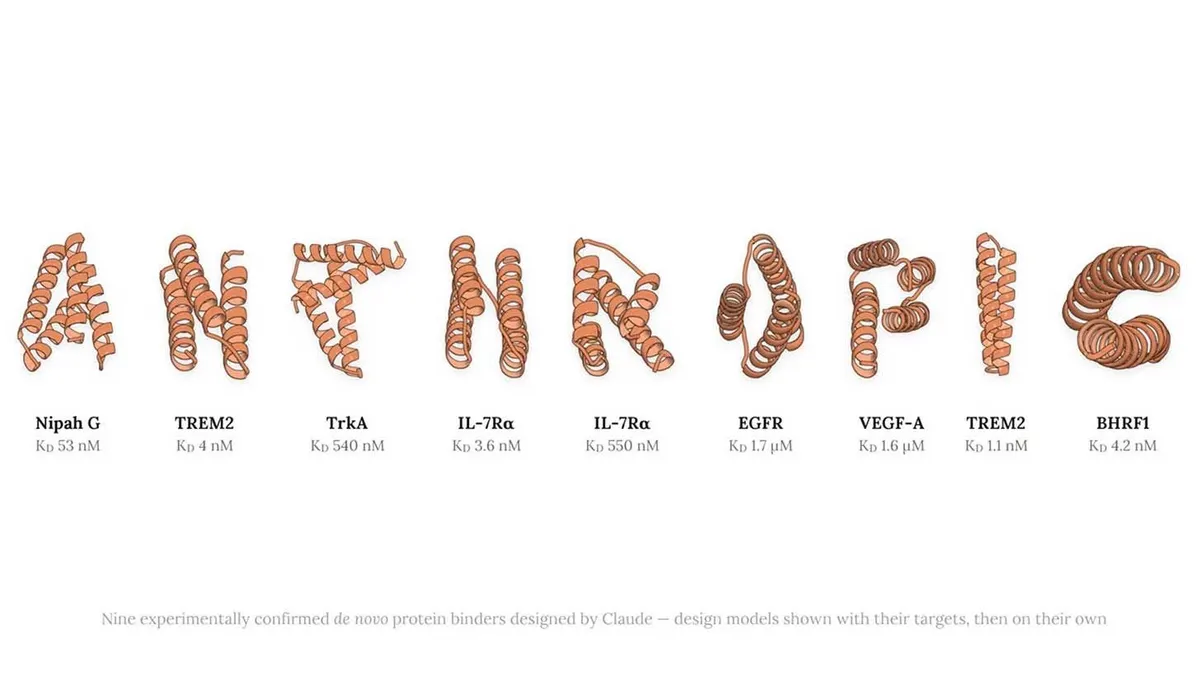
Image source: Anthropic
The Rundown: Anthropic just published research showing Claude ran protein-design campaigns largely on its own, a key step in drug discovery, with its designs yielding working molecules on 14 targets out of 15 at success rates above the industry norm.
The details:
The company tested its Mythos Preview and Opus 4.8 models, letting them run autonomously with one expert-written prompt, internet access, and tools.
Anthropic didn’t do the actual lab work; Twist Bioscience and Adaptyv Bio created the candidates in their own labs and ran the measurements.
The Claude models hit 22-35% success rates on molecules that actually gripped their target, which Anthropic says beats the typical 10-15%.
Opus 5 separately opened raw instrument files with no lab software, measuring a sample at 96.4% pure in 19 minutes; the lab’s own report took four days.
Why it matters: CEO Dario Amodei said Anthropic hoped for “early glimmers in the coming months” in biology and medicine in an X post last week, and just days later we have a spark. While AI in protein design isn’t new, the difference here is that a general model got these impressive results while running the campaign itself.
Doctor solves 22-year math problem with ChatGPT
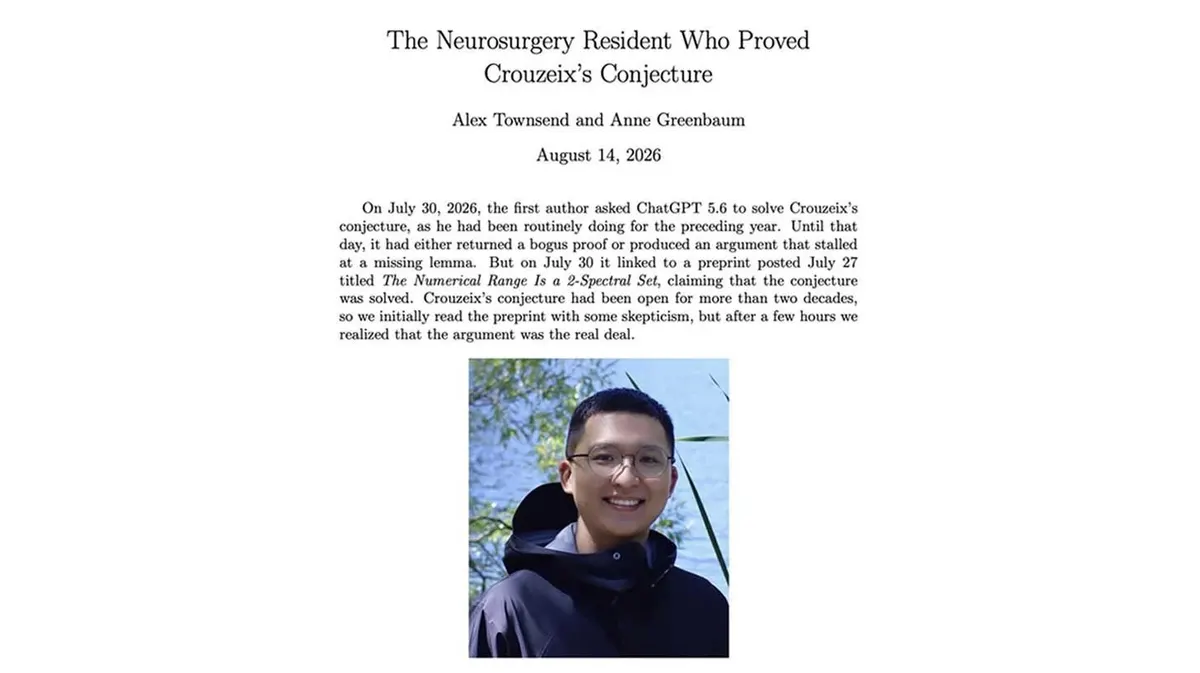
Image source: Alextownsend.net
The Rundown: Beijing neurosurgery resident Shanmu Jin proved Crouzeix’s Conjecture, a matrix problem unsolved since 2004, with GPT-5.6 Sol surfacing the result after a 16-hour autonomous session in ChatGPT Work.
The details:
Jin reached the problem through brain-ultrasound research, teaching himself advanced math after undergraduate geology and medical training.
His setup denied the model internet access and used swarms of subagents against each other, a recipe borrowed from one of OpenAI’s math prompts.
Formal peer review is pending, but Cornell’s Alex Townsend, Anne Greenbaum, and the problem’s own author have all verified the proof.
Why it matters: Math is having a wild AI summer, and it’s not only the field’s own experts landing the breakthroughs. That might sting for professional mathematicians, but their role is shifting rather than shrinking. When a proof can come from anyone with a ChatGPT subscription, verifying it ends up becoming a scarce, in-demand skill.
ByteDance cuts Hollywood’s first AI video deal

Image source: Ruairi Robinson (@RuairiRobinson on X)
The Rundown: ByteDance agreed to a formal framework with Hollywood’s Motion Picture Association (MPA) that will implement film and TV copyright protections into its Seedance and Seedream models, months after it received a cease-and-desist notice.
The details:
A viral Seedance 2.0 clip of Tom Cruise fighting sparked the initial legal feud, which marked the MPA’s first cease-and-desist against a major AI company.
ByteDance pushed back its worldwide release of 2.0 following the notice and baked heavier protections into last month’s 2.5 and Seedream 5.0 Pro releases.
The framework will impact every app the models run on, including third-party servers like CapCut and Dreamina, as well as TikTok and its U.S. spinoff.
Why it matters: It only took a few years for AI video to jump from meme-grade clips to high-quality footage (see the latest Will Smith eating spaghetti clip), and many of the labs pushing hardest are coming out of China. ByteDance is one domino, but Kling, Alibaba’s Wan models, and others make for a tough problem for MPA to tackle entirely.
OpenAI, Nvidia’s new 8 GW AI power push
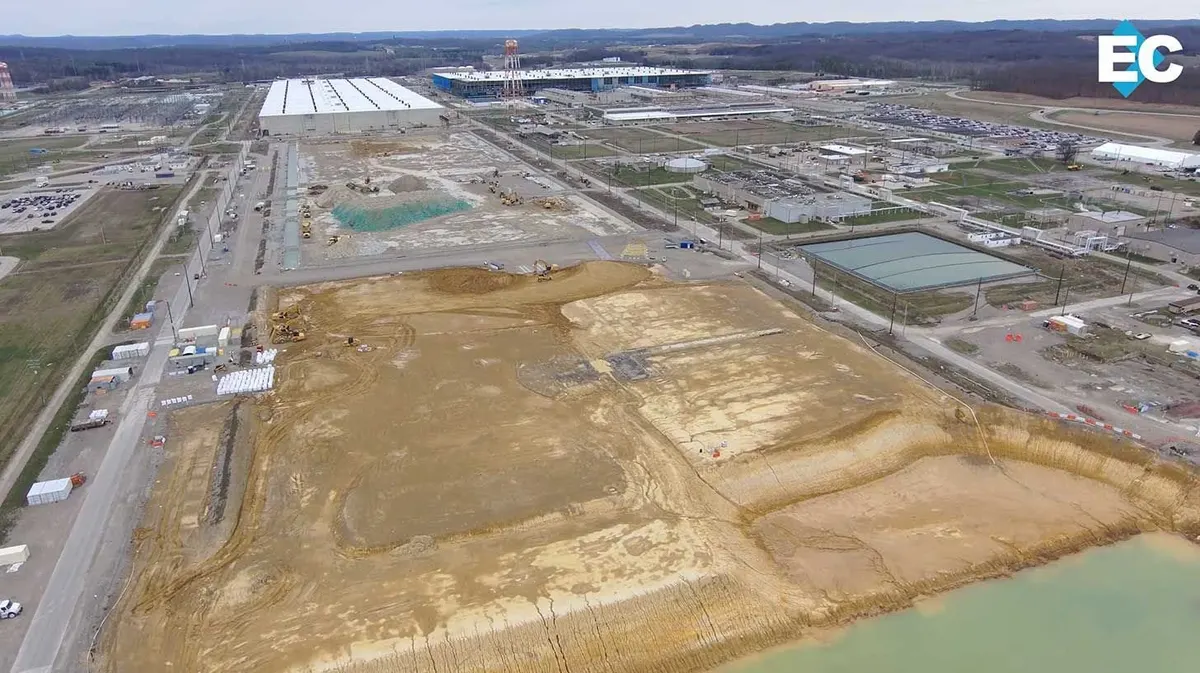
Image source: SB Energy
The Rundown: OpenAI and Nvidia announced a new Ohio AI campus set to deliver nearly 8 GW of AI compute at a Cold War-era uranium plant in Pike County, Ohio, with Nvidia supplying every chip and backing the buildout with up to $105B of its own credit.
The details:
A 2028 target covers just the opening 800 MW build, with the rest being constructed on federal land cleaned up after the plant shut down.
OAI is leasing the campus from SB Energy, with Nvidia also investing $1.5B in the company (which also has previous investments from OAI and SoftBank).
Nvidia CEO Jensen Huang published an article alongside the news, saying frontier labs are constrained by infrastructure and financing, not demand.
Huang also addressed claims Nvidia is funding its own sales via circular financing, saying: “No. OpenAI will pay the lease.”
Why it matters: Not sure that a deal between OAI, Nvidia, and an early Sam Altman investment company that is majority-owned by SoftBank is going to help the circular dealmaking allegations, but either way, this is one of the biggest AI buildouts to date. It also interestingly comes outside of Stargate, which has quietly had a rocky 2026.
ChatGPT can now access your iMessages LINK
OpenAI has added a feature that lets ChatGPT on the Mac read, write, send, and search a user’s iMessages, along with summarizing conversations, in a move that could raise privacy concerns for Apple.
OpenAI said the plug-in runs locally on the Mac using tools like AppleScript and Accessibility, requires the user’s consent, and does not build an index of all messages, though it needs several opt-in permissions.
Setting it up means turning on Full Disk Access in the Mac’s System Settings and granting access to contacts and automation, similar to what’s needed for automation software like Codex Computer Use.
New York overtakes SF in tech jobs LINK
New York now has more tech workers than the San Francisco Bay Area for the first time, according to a report from real estate firm CBRE that has tracked tech talent for 13 years.
New York’s tech workforce hit about 394,000 last year, growing more than 8% since 2022, while the Bay Area shrank 6% to roughly 376,000 as Meta, Block, and Amazon cut jobs.
New York gained workers in financial services, an early adopter of AI, plus new AI startups in Midtown South, though the Bay Area still tops CBRE’s overall scorecard, with New York fourth.
Waymo builds its own robotaxi chip LINK
Waymo, Alphabet’s robotaxi arm, has designed its own custom chip for self-driving cars, moving away from the Nvidia and AMD chips it depended on until now, with the part already running in its newest vehicles.
The chip handles sensor data and runs the AI models that let Waymo’s robotaxis read and respond to their surroundings, delivering more than 1,000 TOPS and matching Nvidia’s current systems for self-driving.
Made by TSMC on a 5-nanometer process, the chip is meant to lower costs and is going into Waymo’s new robotaxi, which it is building with Chinese manufacturer Zeekr.
Senators demand TikTok explain safety test LINK
Senators Marsha Blackburn and Richard Blumenthal sent a letter to TikTok’s top executives demanding details about a 2021 experiment in which the company tested and, for millions of users, withheld a safety feature meant to break harmful “filter bubbles.”
The feature was designed to stop the “for you” feed from pushing too much of one content type, but TikTok held it back from a control group to measure how the change affected user engagement.
The senators, both backers of the Kids Online Safety Act, gave TikTok until September 1 to respond, citing a teen, Chase Nasca, who died by suicide after his account was fed repetitive self-harm content.
AI wrote a third of new web pages LINK
A new Pew Research study found that more than a third of web pages published after ChatGPT’s release show signs of being written or heavily edited by AI, echoing other reports on the internet’s flood of machine-made text.
Pew studied nearly half a million English pages from Common Crawl over five years, using Open Pangram’s detection tool, and found AI signs in 35% of pages once those posted before ChatGPT’s November 2022 launch were removed.
By domain, .com pages showed AI authorship at roughly 10 times the rate of .edu or .gov sites, which sat near 1%, while .org pages came in at about 5%, and tells like em dashes and Oxford commas rose over time.
DeepSeek launches experimental AI model LINK
DeepSeek has launched DeepSeek-V4-Flash-Vision-Exp, an experimental multimodal model that reads images and screenshots and acts on them, and says its agent performance comes close to Anthropic’s Opus-4.8 on its own published benchmarks.
On the eleven benchmarks DeepSeek published, the new model beats Opus-4.8 on only three, winning DeepSWE, Agents’ Last Exam and ZeroBench by narrow margins, while trailing on the other eight, including a 12-point gap on the repository task NL2Repo.
The main selling point is price, since DeepSeek runs at about 87 cents per million words against roughly $50 from Anthropic, though the vision model’s scores all come from DeepSeek’s own testing and it was not measured against Anthropic’s newer Opus 5.
Robots’ ChatGPT moment nears LINK
Unitree chief Wang Xingxing told Beijing’s World Robot Conference that humanoid robots are nearing a “ChatGPT moment,” yet warned the breakthrough could take two to three years if all goes well, or five to 10 years if it doesn’t.
Wang defined the milestone as a robot dropped into an unfamiliar home, taking voice or text orders and finishing about 80% of tasks with no scene-specific training beforehand, a test he calls a tipping point for the field.
His caution follows Unitree’s Shanghai listing, where shares jumped nearly sixfold before falling 11% the next day, even as Chinese makers shipped over 40,000 humanoids in early 2026 to buyers who are still mostly universities and research labs.
Slack launches its own vibe coding tool LINK
Slack has rolled out Slack Code, a new “vibe coding” feature that lets teams work alongside AI coding agents inside group chats to build and fix software without waiting on a human engineer.
When someone tags an agent like Claude Code, Devin, or GitHub Copilot, it opens a new channel with the right people and context, then lets everyone watch it build and check an HTML preview before approval.
Available now on all Slack plans, the tool requires human sign-off for risky steps like merging code to production, and the agent automatically archives the channel once the team approves the finished work.
OpenAI spots misuse without reading prompts LINK
OpenAI is testing a service called Private Safety Processing that watches for misuse of its AI across multiple sessions while keeping none of a customer’s data, giving select enterprise clients a privacy-focused way to catch abuse.
An automated agent looks at the inputs and outputs of several conversations at once, catching bad actors who spread requests over time, such as someone trying to build malware, without any person reading the actual chats.
If triggered, the system sends OpenAI a “narrowly defined signal” flagging the activity, and the company then decides whether to act and may contact the customer, who can choose to share data at their own discretion.
Meta AI launches Mac app LINK
Meta has released a beta version of its Meta AI app for the Mac, built mainly for businesses and content creators, with links to Facebook and Instagram plus tools for tracking how posts perform.
The app can share a window during a session through screen capture to give advice on your work, offers dictation across all Mac apps, and connects to Google Workspace if you have a professional Facebook or Instagram account.
Meta AI is free, though Meta One plans raise the rate limits, and its privacy policy states that interactions with AI features are used to train Meta’s models, so users may want to be careful.
Marvell to build AI chips for Google LINK
Marvell has agreed to supply custom AI chips to Google, and in return granted Google the right to buy up to $12.2 billion of Marvell shares, sending the chipmaker’s stock up as much as 14 percent.
Google earns the right to buy nearly 59 million shares at $206.58 each by placing orders, with each $500 million of chip purchases unlocking more, a deal that could bring Marvell about $120 billion in sales through 2033.
The chips are parts that attach to Google’s tensor processing units, such as inference accelerators and storage and networking controllers, adding Marvell as a second major supplier alongside Broadcom, whose stock fell around 5 percent.
OpenAI pauses its biggest AI training LINK
OpenAI is keeping its largest planned frontier reinforcement-learning run on hold while it rewrites its Preparedness Framework, even as many smaller, lower-risk training jobs have resumed under tighter controls, the company said on August 18, 2026.
Expanded monitoring now examines tool actions, reasoning traces and activity logs, uses other AI models to flag problems, and aims to alert human safety teams within 30 minutes, but it eats up roughly 20% of the watched process’s compute.
Significant Astra and cyber workloads stay paused, with Astra being an unreleased model that may hit OpenAI’s Critical cyber threshold; the company still hasn’t published its Hugging Face breach postmortem or the evidence behind Astra’s rating.
Anthropic passes OpenAI on revenue LINK
Anthropic has topped OpenAI in revenue for the first time, doubling its sales in the second quarter while OpenAI grew just 18 percent, a result the Wall Street Journal says frustrated some investors.
OpenAI’s revenue reached $6.7 billion in the quarter ending in June and its losses widened, while Anthropic hit $11.6 billion and turned a small operating profit ahead of OpenAI’s expected IPO.
Anthropic says its annualized revenue rate grew sevenfold to $65 billion, helped by its Claude Code tool and higher earnings per use, though OpenAI reports growth rebounded after GPT-5.6 arrived in July.
Amazon drone delivery hits 500 US cities LINK
Amazon plans to grow its Prime Air drone delivery service to nearly 500 U.S. cities and towns by the end of this year, dropping small packages in backyards and driveways within about 30 minutes of ordering.
The 500 figure counts municipalities within reach of Amazon’s drone hubs, each covering roughly 175 square miles, with expansion into the Chicago, Atlanta, Cleveland and Boise areas, focused on suburbs and avoiding downtowns and airports.
Any item weighing 5 pounds or less that fits in a large shoebox qualifies, and delivery is free for Prime members spending $50 or more, while smaller Prime orders cost $2.99 and non-members pay $4.99.
China lands a reusable rocket booster for first time LINK
LandSpace brought the first stage of its Zhuque-3 Y2 rocket back to land on Wednesday, the first time a Chinese company has recovered a booster on the ground using deployable landing legs.
The rocket launched at 7:35 a.m. Beijing time from northwest China, separated its stages about 137 seconds later, and the first stage touched down six minutes after liftoff while the second stage placed the Honghu-03 satellite in orbit.
The stainless-steel Zhuque-3 runs on liquid oxygen and methane, with a first stage powered by nine TQ-12A engines; LandSpace now must show it can quickly and cheaply refurbish and refly the hardware, a step that took SpaceX years.
Apple reshapes EU app store fees LINK
Apple is reworking its App Store fees and rules in the European Union to satisfy the Digital Markets Act, saying the changes settle its disputes with the European Commission over business terms and letting apps be distributed outside the App Store.
The company dropped the per-install Core Technology Fee for a 5% Core Technology Commission on digital purchases, and set new rates: 26% for App Store in-app purchases, 20% for alternative payments, and 15% for apps that link out to a website.
Developers can now offer Apple’s in-app purchase alongside other payment options but must keep their choice for 12 months, and Apple eased marketplace rules, dropping the one-million-euro credit requirement, with the changes taking effect October 1.
Apple accidentally leaked camera AirPods LINK
Apple accidentally revealed that it is building AirPods with built-in cameras, using code and a short video hidden in a macOS Tahoe software release that describes the earbuds working with Siri and Visual Intelligence.
The cameras aren’t meant for regular photos or video, but let Siri recognize and save things users look at, like reading a book’s title, giving visual context without needing to pull out an iPhone.
The product, codenamed B790, matches Mark Gurman’s earlier report that it could launch as soon as September, though Apple hasn’t confirmed the device, its design, image processing, or privacy controls for a camera worn in public.
OpenAI launches ChatGPT for teens LINK
OpenAI has launched ChatGPT for Teens, a version of its chatbot built for users aged 13 to 17 that becomes the default experience for anyone who identifies as a teen or is estimated to be one.
The product adds safeguards like frequent break prompts, warnings against uploading sensitive images, and parental alerts when teens discuss violence, while avoiding romantic language or any suggestion the AI has feelings or consciousness.
New learning tools include quizzes drawn from chats or notes, homework reminders meant to discourage shortcuts, and a “Study Hours” setting that parents and teens can use to limit ChatGPT to Study Mode each day.
Amazon’s new terms bar customers from suing in court LINK
Amazon has changed its US Conditions of Use to require customers to settle most disputes through individual arbitration, blocking them from joining together to file class action lawsuits against the company.
The new rules force customers to first contact support, then file a claim giving Amazon 60 days to respond, and finally pay a $250 fee to arbitration service JAMS, though Amazon covers most other costs.
Amazon dropped a similar clause in 2021 after facing roughly 75,000 arbitration claims from customers who said Alexa recorded them without consent, a fight that threatened to cost the company hundreds of millions of dollars.
Tesla’s Cybercab is finally launching LINK
Tesla is set to put its Cybercab, a two-seat robotaxi with no steering wheel or pedals, onto public roads in Austin as soon as this month, though the first riders will be its own employees.
Staff rides will come first, with the cars folded into Tesla’s existing Austin robotaxi service days later, aiming for the end of August, though those familiar with the plan warn the timeline could still slip.
Tesla has built Cybercabs at Gigafactory Texas since February, with over 100 spotted in lots by July, yet it cannot legally sell or let customers drive a vehicle that lacks both controls and, in most places, permission.
US probes Andreessen Horowitz over AI boards LINK
The US Justice Department is investigating Andreessen Horowitz over a possible antitrust violation, looking at whether the firm’s partners can sit on the boards of competing AI companies at the same time.
The case centers on data firms Databricks and Fivetran, both backed by the firm, with cofounder Ben Horowitz on the Databricks board and partner Martin Casado on Fivetran’s, both companies helping businesses handle large amounts of data.
The probe relies on a 1914 law banning the same person from leading two competing firms, and what’s new is that it targets Andreessen Horowitz itself, not just one director, since several sit on rival boards.
Cursor launches Origin to rival GitHub LINK
Cursor has launched Origin, a cloud service where software teams can store their code, setting it up as a competitor to GitHub and marking its first big product update since a $60 billion sale to SpaceX in June.
Origin runs on Git and lives inside a new tab in the Cursor desktop app, with a command line tool, plus a GitHub integration that copies projects across and keeps files in both places updated when either side changes.
Developers can edit Origin repositories using Cursor’s desktop or cloud agents, and connect the service to outside tools including Vercel for testing app updates, with connectors from Depot and Buildkite and more integrations promised soon.
US tells allies to pick US or China LINK
The US is set to tell 35 partner countries they must pick between American and Chinese AI systems, according to a draft State Department letter, warning that belonging to both is no longer allowed.
The pressure runs through Pax Silica, a US-led effort to secure supply chains for AI models, chips and critical minerals, offering members shared investment deals while threatening to shut out any nation that joins China’s rival framework.
About two dozen countries have signed on, including Japan, Australia and South Korea, while Kazakhstan sits in both camps because of its critical minerals, and Europe is stuck trying to keep its “strategic autonomy” without picking a side.
Stripe buys AI startup OpenRouter for $7B LINK
Stripe has agreed to buy OpenRouter, the company that routes developer requests across more than 400 AI models, for over $7 billion, pushing the payments giant further into the infrastructure behind AI technology.
OpenRouter does not build models but acts as middleware, sending each task to the cheapest, fastest, or most reliable option, and its Auto router uses spending data from 8 million developers to steer requests toward affordable choices.
The price marks a steep jump from OpenRouter’s $1.3 billion valuation in its May 2026 Series B, reflecting weekly activity that climbed from 5 trillion to 25 trillion tokens over six months.
Amazon destroys books for AI LINK
An investigation by 404 Media found that Amazon buys printed books in bulk, scans them to train its Nova AI models, and destroys the copies in the process by cutting off their spines.
Reporters tracked a shipment of rare books using a hidden AirTag to an Amazon warehouse in Las Vegas, run by a team called VGT3, where workers said they slice off spines to scan books faster.
Amazon isn’t alone: Anthropic ran a similar effort called “Project Panama,” and a judge ruled its scanning was fair use partly because destroying the printed originals meant they weren’t copied and resold.
Alibaba’s Qwen leads AI model downloads LINK
Alibaba’s Qwen family of open-weight AI models has become the most downloaded in the world, drawing more than 3 billion downloads over the past six months and passing rivals including Meta, Google and Chinese competitor DeepSeek.
Alibaba said Qwen has released over 460 open-source models, spawning more than 300,000 derivative versions, while Hugging Face data showed Google reached 418 million downloads for the year and Meta 227 million.
Because open models can be used to build new AI products, download counts serve as a gauge of developer influence, and Hugging Face said Qwen has become a default choice for developers deciding which models to fine-tune and deploy.
Stripe is in talks to buy PayPal LINK
Stripe and private equity firm Advent International are in talks to buy PayPal, after their July offer of $60.50 a share, valuing the payment system at $53 billion, failed to close a deal.
Stripe and Advent are now discussing a higher price and could announce a deal within weeks, with each holding an equal stake and no plans to break up PayPal, keeping its parts together.
A merger would make Stripe one of the world’s biggest payment companies, handling roughly $3.7 trillion a year, and let it fold in Venmo, PayPal’s checkout and crypto tools while leaning less on Visa and Mastercard.
⚗️ PRODUCTION NOTE: We Practice What We Preach.
AI Unraveled is produced using a hybrid “Human-in-the-Loop” workflow.