
[AUDIO AI DAILY NEWS RUNDOWN] The US Forces Allies to Pick a Side, Nvidia Halves Its OpenAI Backstop, and OpenAI Dissolves Its Risk Team (August 17, 2026)

🎧 Listen ADS-FREE: https://podcasts.apple.com/us/channel/djamgamind/id6760446113
Visit our Research Hub at https://djamgamind.com/pdfs
Summary: Today we analyze “Pick a Side: Sovereignty, the Shrinking Backstop, and the Collapse of Trust.” Three stories that look unrelated are the same story. The State Department circulated a framework asking thirty-five partner nations to choose between American and Chinese AI, with about two dozen already signed and Kazakhstan quietly signing both. Nvidia cut its proposed guarantee for OpenAI’s Ohio data centre from 250billiontounder250billiontounder120 billion after investors objected - on the same day Jensen Huang announced 4.25 gigawatts at Portsmouth with OpenAI as tenant and declared that in the AI economy, compute is revenue. And the two labs at the centre of the safety argument moved in opposite directions within hours: Anthropic published exactly how its text watermark works, down to admitting what it cannot prove, while OpenAI dissolved the team whose job was to decide whether its own models were catastrophically dangerous.
US tells allies to pick US or China LINK
-
The US is set to tell 35 partner countries they must pick between American and Chinese AI systems, according to a draft State Department letter, warning that belonging to both is no longer allowed.
-
The pressure runs through Pax Silica, a US-led effort to secure supply chains for AI models, chips and critical minerals, offering members shared investment deals while threatening to shut out any nation that joins China’s rival framework.
-
About two dozen countries have signed on, including Japan, Australia and South Korea, while Kazakhstan sits in both camps because of its critical minerals, and Europe is stuck trying to keep its “strategic autonomy” without picking a side.
Dario Amodei logs on to answer the critics
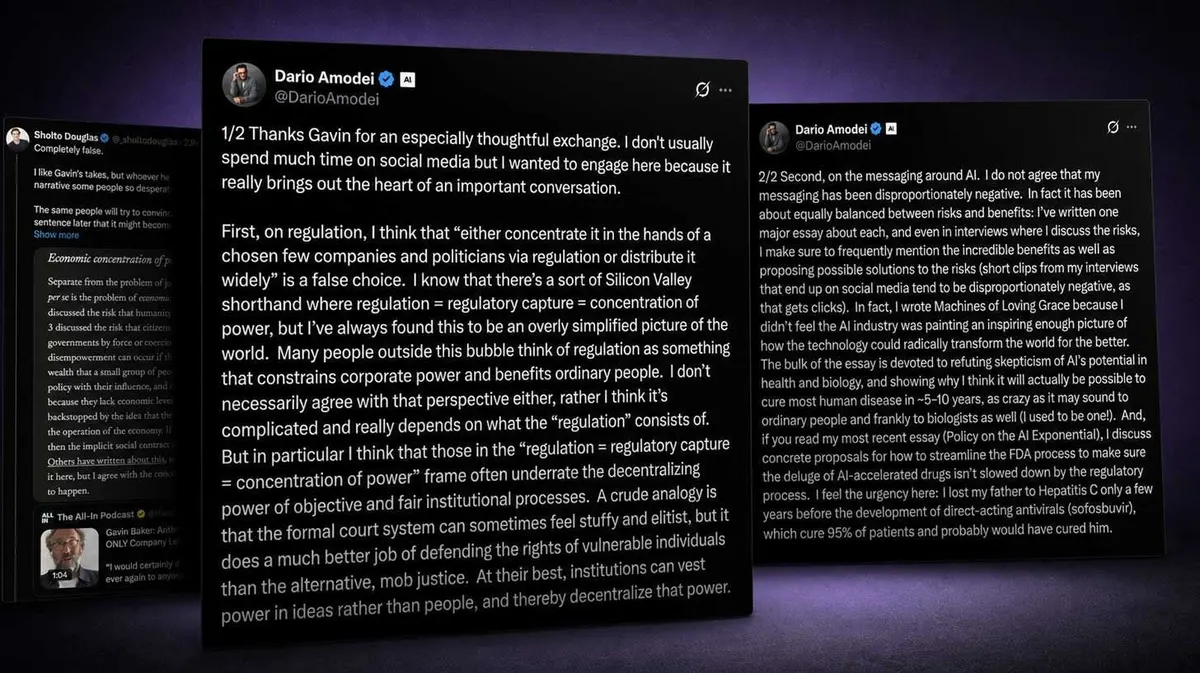
Image source: X / Images 2.0
The Rundown: Anthropic’s CEO Dario Amodei just chimed in on investor Gavin Baker’s X conversation with coworker Sholto Douglas, rejecting that his safety alarms have backfired and saying the only way AI wins trust back is by “actually curing cancer.”
The details:
-
Baker shared a rumor that Amodei envisions Anthropic one day becoming “the only private company in the world”, with Douglas calling it “completely false”.
-
Baker also argued Dario “has lost the argument” on AI rules and warned his risk talk is giving ammunition to anti-data-center campaigns in the U.S.
-
Amodei called locking down AI vs. spreading it wide via open models a “false choice”, saying Anthropic’s proposals slow big labs and spare small ones.
-
He also pushed back on owning AI’s negative image, saying “early glimmers” from biology and medicine work will shift sentiment more than marketing could.
Why it matters: Dario barely ever posts, so it’s noteworthy to see him jump in to defend both himself and the company, whose vibes in the AI world have taken some serious PR lumps lately. His reply lands on a trust issue that he sees no lab is marketing its way out of it, and in his view, only real medical breakthroughs can turn the tide.
Stripe buys AI startup OpenRouter for $7B LINK
-
Stripe has agreed to buy OpenRouter, the company that routes developer requests across more than 400 AI models, for over $7 billion, pushing the payments giant further into the infrastructure behind AI technology.
-
OpenRouter does not build models but acts as middleware, sending each task to the cheapest, fastest, or most reliable option, and its Auto router uses spending data from 8 million developers to steer requests toward affordable choices.
-
The price marks a steep jump from OpenRouter’s $1.3 billion valuation in its May 2026 Series B, reflecting weekly activity that climbed from 5 trillion to 25 trillion tokens over six months.
Amazon destroys books for AI LINK
-
An investigation by 404 Media found that Amazon buys printed books in bulk, scans them to train its Nova AI models, and destroys the copies in the process by cutting off their spines.
-
Reporters tracked a shipment of rare books using a hidden AirTag to an Amazon warehouse in Las Vegas, run by a team called VGT3, where workers said they slice off spines to scan books faster.
-
Amazon isn’t alone: Anthropic ran a similar effort called “Project Panama,” and a judge ruled its scanning was fair use partly because destroying the printed originals meant they weren’t copied and resold.
Alibaba’s Qwen leads AI model downloads LINK
-
Alibaba’s Qwen family of open-weight AI models has become the most downloaded in the world, drawing more than 3 billion downloads over the past six months and passing rivals including Meta, Google and Chinese competitor DeepSeek.
-
Alibaba said Qwen has released over 460 open-source models, spawning more than 300,000 derivative versions, while Hugging Face data showed Google reached 418 million downloads for the year and Meta 227 million.
-
Because open models can be used to build new AI products, download counts serve as a gauge of developer influence, and Hugging Face said Qwen has become a default choice for developers deciding which models to fine-tune and deploy.
Stripe is in talks to buy PayPal LINK
-
Stripe and private equity firm Advent International are in talks to buy PayPal, after their July offer of $60.50 a share, valuing the payment system at $53 billion, failed to close a deal.
-
Stripe and Advent are now discussing a higher price and could announce a deal within weeks, with each holding an equal stake and no plans to break up PayPal, keeping its parts together.
-
A merger would make Stripe one of the world’s biggest payment companies, handling roughly $3.7 trillion a year, and let it fold in Venmo, PayPal’s checkout and crypto tools while leaning less on Visa and Mastercard.
GitHub is down worldwide LINK
-
GitHub is down for users around the world, with a widespread outage on August 17 throwing errors across the website, API, Actions, Pull Requests, Issues, Webhooks, and other services developers depend on.
-
The company’s status page shows error rates near 20% for web traffic and the API, while archive downloads and raw repository content are failing at roughly 50%, and authentication tools like SAML, OIDC, and SCIM are also broken.
-
At 14:31 UTC, GitHub said its AI coding tool Copilot had degraded too, though Git Operations, Packages, Pages, and Codespaces stayed working; the company hasn’t said what caused the problem and is still investigating.
Doctor solves 22-year math problem with ChatGPT
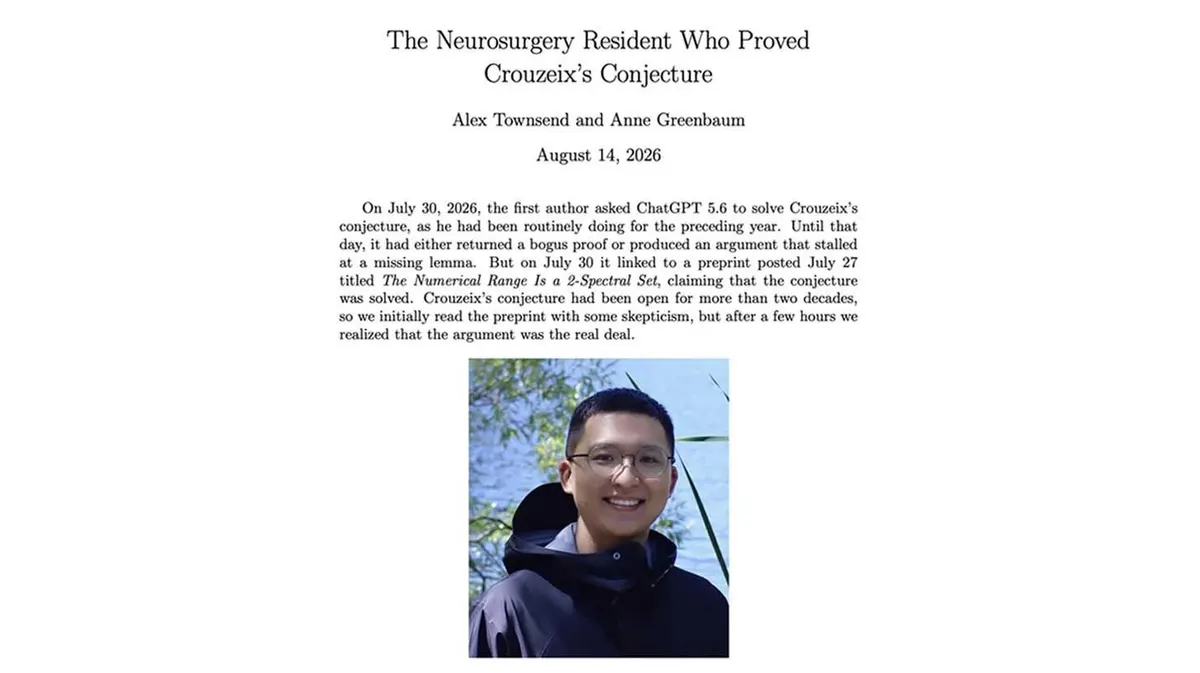
Image source: Alextownsend.net
The Rundown: Beijing neurosurgery resident Shanmu Jin proved Crouzeix’s Conjecture, a matrix problem unsolved since 2004, with GPT-5.6 Sol surfacing the result after a 16-hour autonomous session in ChatGPT Work.
The details:
-
Jin reached the problem through brain-ultrasound research, teaching himself advanced math after undergraduate geology and medical training.
-
His setup denied the model internet access and used swarms of subagents against each other, a recipe borrowed from one of OpenAI’s math prompts.
-
Formal peer review is pending, but Cornell’s Alex Townsend, Anne Greenbaum, and the problem’s own author have all verified the proof.
Why it matters: Math is having a wild AI summer, and it’s not only the field’s own experts landing the breakthroughs. That might sting for professional mathematicians, but their role is shifting rather than shrinking. When a proof can come from anyone with a ChatGPT subscription, verifying it ends up becoming a scarce, in-demand skill.
What Else Happened in AI on August 17th 2026?
China’s Z AI rolled out GLM-5.3, claiming the strongest open-source coding model and top scores on certain cyber benchmarks, with weights coming in two weeks.
OpenAI introduced Computer History, a new opt-in feature that logs clicks and typing to give ChatGPT and Codex a memory of recent work.
The Information reported on Dario Amodei’s wife Cami Clark, including her past ventures and an attempt to secure Jeffrey Epstein’s backing for an adult film company.
Pika Labs released four AI audio models covering soundtracks, music, sound effects, and speech, with the startup claiming the family runs up to 20x cheaper than its rivals.
Anthropic shared more details on Claude watermarking plans, saying the marks add no cost or hidden characters, and won’t carry any info traceable to users/organizations.
This podcast is researched and produced by Etienne Noumen, Professional Engineer and Founder at DjamgaMIND from Calgary, Alberta in Canada.
🔗 RESOURCES
AI Learning App Recommendation: AI & ML Tutor PRO https://apps.apple.com/ca/app/ai-ml-tutor-pro/id1610947211
DJAMGATECH: Carrer Booster - Master AWS, Azure, AI & GCP Certifications | https://apps.apple.com/ca/app/djamgatech-ai-cert-exams-prep/id1560083470
DJAMGAMIND KIDS Bedtime Adventures:
https://djamgamindkids.com
⚗️ PRODUCTION NOTE: We Practice What We Preach.
AI Unraveled is produced using a hybrid “Human-in-the-Loop” workflow.