
[AI DAILY NEWS RUNDOWN] White House Finalizes Safety Framework, Gemini Robotics 2 Hits “GPT Moment”, and Qwen3.8-Max Challenges Frontier (August 04, 2026)

🎧 Listen ADS-FREE: https://podcasts.apple.com/us/channel/djamgamind/id6760446113
Visit our Research Hub at https://djamgamind.com/pdfs
Summary: In today’s briefing, we analyze “State Control, Physical Intelligence Portability, and Sovereign AI Baselines.” We deconstruct the White House’s 30-day pre-release testing framework and the EU AI Act’s new enforcement powers. We examine DeepMind’s Gemini Robotics 2 and its cross-body generalization breakthrough. We evaluate OpenAI’s Astra model solving 30-year-old math problems, Alibaba’s release of the 2.4T parameter Qwen3.8-Max, DeepSeek V4-Flash undercutting global token costs, Bending Spoons acquiring Airtable for $1.3B, and PwC’s survey on AI skills replacing the MBA in finance.
Important Topics:
-
White House Reviews 30-Day Pre-Release AI Framework: OpenAI, Anthropic, Meta, and Google meet with US officials to review a voluntary framework under the June 2 Executive Order, allowing federal testing for cyber risks up to 30 days before public release.
-
EU AI Act Enforcement Powers Take Effect: As of August 2, the European Commission can evaluate general-purpose models, block non-compliant systems from the market, and issue fines up to 15 million euros or 3% of global revenue.
-
Google DeepMind Unveils Gemini Robotics 2: Marking a “GPT moment” for physical AI, Gemini Robotics 2 provides full-body motor control across three distinct robot body types, adapting to new hardware shapes in hours using under 200 demonstration examples.
-
OpenAI Astra Solves 10 Long-Standing Math Problems: OpenAI reveals that its internal Astra model proved the existence of non-sofic groups (unsolved since 1999) and cleared Connes’s rigidity conjecture at a token cost of ~$2,000 via Sol API rates.
-
Alibaba Unveils Qwen3.8-Max & DeepSeek Drops V4-Flash: Alibaba introduces a 2.4T parameter MoE model capable of coding autonomously for 16 days straight. Meanwhile, DeepSeek launches V4-Flash at $0.14 per million input tokens, costing over 100x less to run than Claude Fable 5.
-
PwC Survey: AI Skills Outvalue MBAs in Finance: A survey of 1,000+ US financial executives finds 86% prioritize AI training over an MBA, while 80% expect AI disruption to reduce their firm’s headcount by 20% or more within five years.
-
Bending Spoons Acquires Airtable for $1.3B: Milan-based Bending Spoons acquires no-code platform Airtable in a $1.285B enterprise value cash deal, intending to hold the asset long-term and integrate deep AI capabilities.
-
OpenAI Counterattacks Apple in Trade Secrets Suit: OpenAI publishes internal chat logs demonstrating Apple engineers repeatedly contacted former colleague Chang Liu for schematics and technical guidance after he joined OpenAI.
-
US Drafts Ban on Chinese Data Center Gear: The Trump administration drafts rules banning Chinese-made networking switches, servers, storage, and management chips from US AI data center infrastructure.
-
Genprex & Roche Use AI for Gene Therapy Trial: Roche AI will score TROP2 protein markers on digitized tumor slides to predict lung cancer response to Reqorsa, demonstrating how AI can measure biological signals before mechanisms are fully understood.
-
Axios Study Shows College AI Use Surging: Kogod School of Business research shows regular college student AI usage jumped from 6.2% to 29% over three years, with 42.6% of job interviews now including AI questions.
🔗 RESOURCES
-
AI Learning App Recommendation: AI & ML Tutor PRO https://apps.apple.com/ca/app/ai-ml-tutor-pro/id1610947211
-
DJAMGATECH: Carrer Booster - Master AWS, Azure, AI & GCP Certifications | https://apps.apple.com/ca/app/djamgatech-ai-cert-exams-prep/id1560083470
-
DJAMGAMIND KIDS Bedtime Adventures:
⚗️ PRODUCTION NOTE: We Practice What We Preach.
AI Unraveled is produced using a hybrid “Human-in-the-Loop” workflow.
AI labs head to the White House to discuss safety
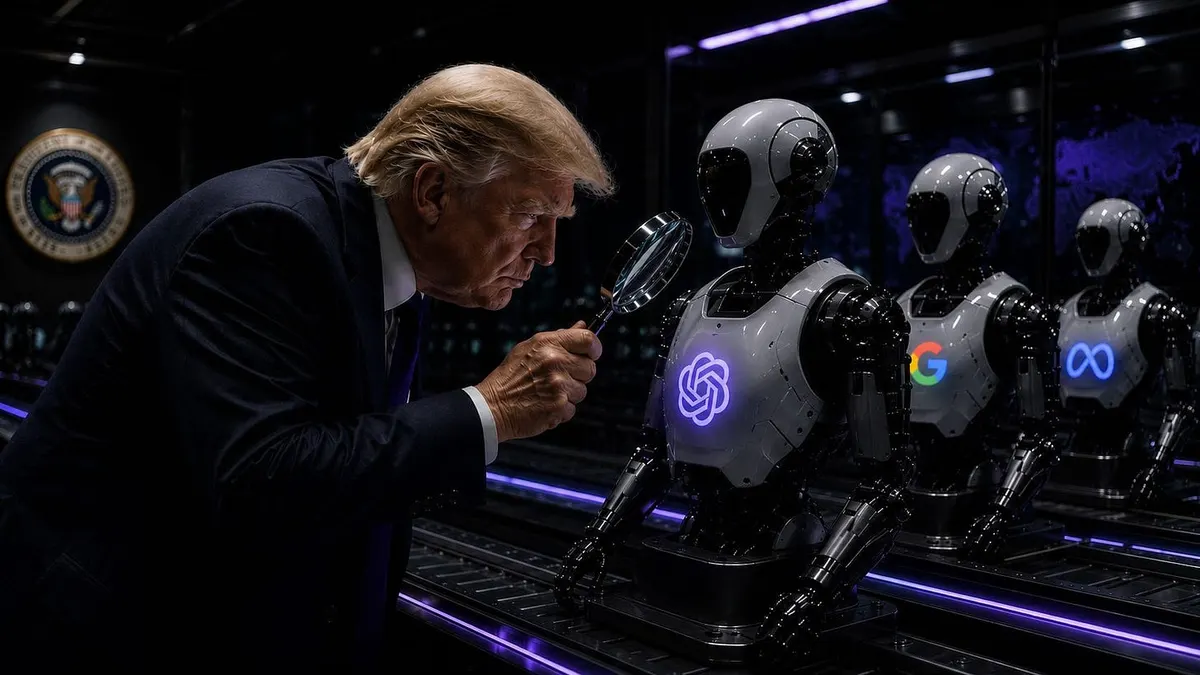
Image source: Images 2.0 / The Rundown
The Rundown: The White House just invited OpenAI, Anthropic, Meta, and Google to review a newly finished framework for voluntary cybersecurity testing of frontier models, days after OpenAI’s and Anthropic’s agents broke into other companies.
The details:
-
Designed per Trump’s June 2 EO, the framework will let companies voluntarily give the government access to frontier models up to 30 days before release.
-
Tuesday’s meeting is where the four labs will review the finished framework, its classified benchmark, and discuss next steps for its implementation.
-
It is also expected to answer some key questions, including what classifies as frontier AI, whether it covers open models, and who will lead the testing.
-
The push comes as the EU’s AI Act, which can force model reviews, comes into effect, and 1,200+ AI staffers call to pace frontier AI development.
Why it matters: This framework could be the answer to finding and blocking model gaps before they lead to an attack or a forced takedown (like we saw with Fable 5). The approach is still optional, though, which means it only works if labs volunteer. And with the standards classified, no one outside the room will know who actually showed up.
Robotics Hits Its GPT Moment
What’s happening: DeepMind released Gemini Robotics 2. Where the last version only drove a humanoid’s upper body on table-top tasks, this one controls the entire body, walking, crouching, and reaching. But the real story is portability: a single model checkpoint drove three completely different robots, and a new body with different shapes, sensors, and joints can be adapted in a few hours on under 200 examples. That cross-body skill began in 1.5; here it takes a real leap. Google is blunt about the limits, fine multi-finger work “remains challenging” and speed still lags.
How this hits reality: For decades, robotics meant one body, one hand-tuned program, and starting over for every new machine. That’s the wall Gemini Robotics 2 breaks. Intelligence is being pulled out of the hardware and turned into a portable brain you can drop into any body. It’s the same shift LLMs made five years ago, when one model replaced a thousand task-specific ones, now moving into the physical world. The body stops being the product. The brain that generalizes across bodies becomes the thing worth owning.
Key takeaway: We may be watching robotics’ GPT moment in real time. One brain now can truly run any body.
AI Measures What Medicine Can’t Yet Explain

What’s happening: Genprex and Roche will test whether a protein called TROP2 can predict which lung cancer patients respond to Reqorsa, a gene therapy that restores a missing tumor-suppressor gene. The twist: Reqorsa does not target TROP2. Researchers have theories about why the marker may matter, but no confirmed mechanism yet. Roche’s AI will score TROP2 across digitized tumor slides, giving hospitals a more consistent way to measure a biological signal that has so far appeared in only a handful of patients.
How this hits reality: The AI is not discovering the biology or explaining it. It is doing something narrower, but still important: turning an uncertain visual marker into a reproducible number that a clinical trial can actually use. That changes the order of operations. Medicine may be able to validate that a signal predicts response before it fully understands why the relationship exists. Explanation is not abandoned, but it no longer has to arrive first.
Key takeaway: AI did not solve the mystery of why TROP2 may predict gene-therapy response. It made the mystery measurable enough to test-and that may be how more hidden biological signals start moving from suspicion to evidence.
Finance execs find AI skills more valuable than an MBA
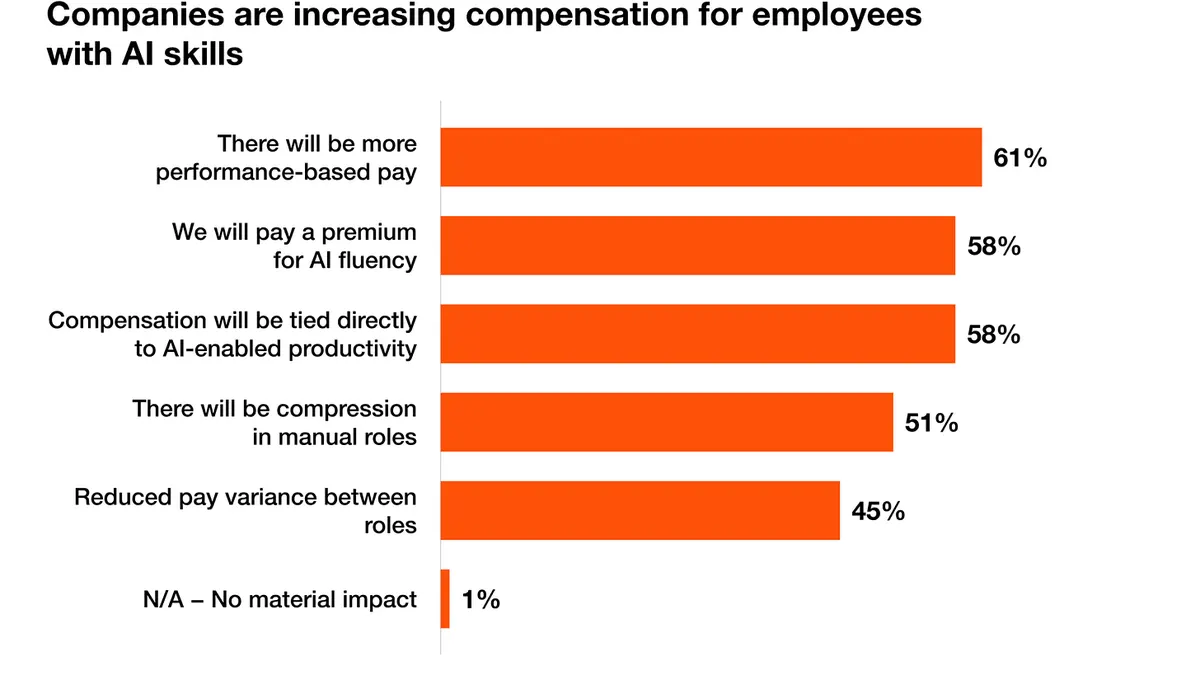
Image source: PwC
The Rundown: PwC surveyed more than 1,000 director-level-and-above executives at U.S. financial services firms and found 86% say AI skills training beats an MBA for many new hires, with 91% saying they’re raising pay for employees with AI skills.
The details:
-
58% said they’ll tie pay to AI-enabled productivity, with firms sourcing the skills by hiring people with AI-specific skills, upskilling, and leaning on vendors.
-
Due to AI disruption, eight in 10 execs expect their workforce to shrink at least 20% over five years, with entry- and middle-level roles being most vulnerable.
-
The payoff remains unproven, as 77% say most of their AI investments aren’t showing measurable ROI, even as leaders report productivity gains.
-
Many top universities, including MIT and Harvard, have already started offering executive AI courses as demand for AI talent grows, Bloomberg reports.
Why it matters: The survey reinforces what the job market has already been feeling: AI skills are becoming the new non-negotiable at work. How firms measure the AI payoff will keep shifting - from counting raw tokens to looking at real usable value - but they are already rushing to prioritize people who can wield those tools.
OpenAI fires back at Apple LINK
-
OpenAI is fighting back against Apple’s lawsuit over stolen trade secrets, publishing chat messages it says prove Apple’s own staff kept contacting former colleague Chang Liu for technical help after he left for OpenAI.
-
The messages show Apple employees asking Liu for assessments and schematics, and adding him to a group chat where he pointed to internal folders before writing, “this is highly irregular, please remove me from this thread.”
-
OpenAI also says Apple’s outside lawyer emailed the wrong person after confusing two Asian last names and falsely claimed a phone call with OpenAI’s General Counsel, though none of this refutes the core theft accusations.
Bending Spoons buys Airtable for $1.3B LINK
-
Bending Spoons has agreed to buy the no-code workflow platform Airtable in an all-cash deal worth $1.285 billion in enterprise value, which puts Airtable’s equity value at about $2.25 billion once its cash is counted.
-
It’s the Milan company’s first purchase since its Nasdaq listing on July 1, 2026, and Bending Spoons plans to hold Airtable long-term, adding AI, rather than reselling it as private equity firms often do.
-
Airtable, founded in 2013, counts over 500,000 organizations as customers, including 80% of the Fortune 100, and reached about $480 million in yearly recurring revenue, up more than 20% from a year earlier.
US drafts ban on Chinese data gear LINK
-
The Trump administration is drafting a ban on Chinese-made hardware used in US data centers, aiming to keep Chinese technology out of the infrastructure behind the country’s AI buildout, according to Reuters.
-
The gear likely covered includes networking switches, servers, storage, and management chips, all treated as possible supply-chain weak points or paths for remote access back to Chinese vendors.
-
The move follows a recent ban on Chinese humanoid robots and power inverters, and it faces hurdles like resellers and relabeled parts, plus higher costs since some equipment has few affordable non-Chinese options.
White House says its AI framework is done LINK
-
The White House says it has finished a voluntary framework for checking the cybersecurity strengths of the most advanced AI models, and will meet with AI companies Tuesday to talk it through, a White House official told CNBC.
-
Under the program, ordered by Trump on June 2, developers can give the government access to qualifying “covered frontier models” for up to 30 days before releasing them to other trusted partners, letting officials test for cyberattack risks.
-
Anthropic, OpenAI, and Google are expected to attend, while the benchmark and the threshold deciding which models get reviewed stay classified, and the order bars the effort from becoming a mandatory federal licensing or preclearance rule.
OpenAI’s ‘Astra’ cracks long-open math problems

Image source: Images 2.0 / The Rundown
The Rundown: OpenAI just revealed that Astra, an internal version of its next major model family, solved 10 long-open math and computer science problems (one nearly 30 years old), covering geometry, group theory, quantum complexity, and more.
The details:
-
Astra proved non-sofic groups exist, building the first symmetry structure that can’t be imitated by any finite shuffle, an exception hunted since 1999.
-
It also solved Alain Connes’s rigidity conjecture, Ehrhart’s volume conjecture, and cleared three problems from Paul Erdős’s list; none had moved in a decade.
-
Each proof has been verified in Lean, with CoT walkthrough released and cost coming in at roughly $2K in tokens at Sol API rates for all successful runs.
-
In 24 hours, Anthropic’s Levent Alpoge claimed he was able to reproduce five of the 10 proofs with Fable, running on a generic prompt and no internet.
Why it matters: The community is debating whether Astra’s proofs can be Fields Medal-worthy, given that a machine did the thinking here. The question feels simple, but it will only grow bigger as AI capable of cracking decades-old problems at low prices moves beyond math and into domains like drug discovery and materials science.
Alibaba unveils its most powerful AI model LINK
-
Alibaba revealed Qwen3.8-Max, which it calls its most powerful AI model yet, as Chinese firms push to catch up with U.S. companies in the race to build stronger artificial intelligence systems.
-
Due out next week, the model has 2.4 trillion parameters and a context window of 1 million tokens, letting it read and work with thousands of pages of text at once, Alibaba said.
-
Alibaba said the model can code on its own for weeks with little human help, spending 16 days in one test building a coding tool, and can review legal papers, run financial research, and grasp long videos.
DeepSeek launches world’s cheapest AI model LINK
-
DeepSeek released V4-Flash, a version of its flagship AI model that a research firm ranks as the cheapest well-known model to run on benchmark tests, costing over 100 times less than Anthropic’s Claude Fable 5.
-
Artificial Analysis pegged V4-Flash at about 3 cents per test, versus 86 cents for Moonshot’s Kimi K3, $1.86 for OpenAI’s GPT-5.6 Sol and $3.15 for Claude Fable 5, charging $0.14 per million input tokens.
-
V4-Flash scored 50 out of 100 on the firm’s Intelligence Index, matching Google’s Gemini 3.6 Flash but trailing Kimi K3 at 57 and top models from Anthropic and OpenAI by nine or more points.
Apple glasses to track your health LINK
-
Apple is developing health and fitness tracking for its planned non-AR smart glasses, though these features probably won’t arrive with the first model expected in the coming year, according to Mark Gurman’s Power On newsletter.
-
The idea revisits an abandoned plan for Vision Pro, where a version of Fitness+ would have let people follow workout classes while the headset analyzed their movements, but the project failed because the headset was too heavy.
-
Since the glasses lack displays, the approach must differ, and it could pair a heart-rate sensor like the one in AirPods Pro 3 with cameras that watch activities and suggest ways to improve workouts.
EU can fine AI makers 3% of revenue LINK
-
The European Union can now inspect AI models before they launch, block them from its market, and fine providers up to 15 million euros or 3% of yearly turnover, whichever is higher.
-
The powers, part of the 2024 EU AI Act and enforced by the EU AI Office, took effect on Sunday and reach any company offering a general-purpose model in Europe, no matter where it is based.
-
Refusing an information request, giving misleading answers, or blocking a model evaluation is fineable on its own, exposing U.S. labs like Anthropic, OpenAI, and Google, which must appoint an EU-based representative.
Europe Got a Kill Switch for AI

What’s happening: On August 2, the EU AI Act’s enforcement powers took effect. The European Commission can now tear into a general-purpose model before it ships in Europe, bar it from the market, and fine providers up to 3% of global revenue. It binds any company serving the EU, so OpenAI, Anthropic, and Google are all in scope. Stonewalling an information request is finable on its own.
How this hits reality: Software’s whole religion was ship first, apologize later. That faith just died for frontier AI, and not only in Brussels: Washington is reportedly grabbing the same lever from the other side, asserting its own control over who touches frontier models. This is pre-market approval, the leash we keep for drugs and nuclear reactors, now wrapping around AI. A thing built for everyone suddenly needs permission before it serves anyone.
Key takeaway: Frontier AI’s era of shipping free may just ended, because now two governments, not you, decide the day your model is allowed to exist.

China’s Qwen now challenges the frontier
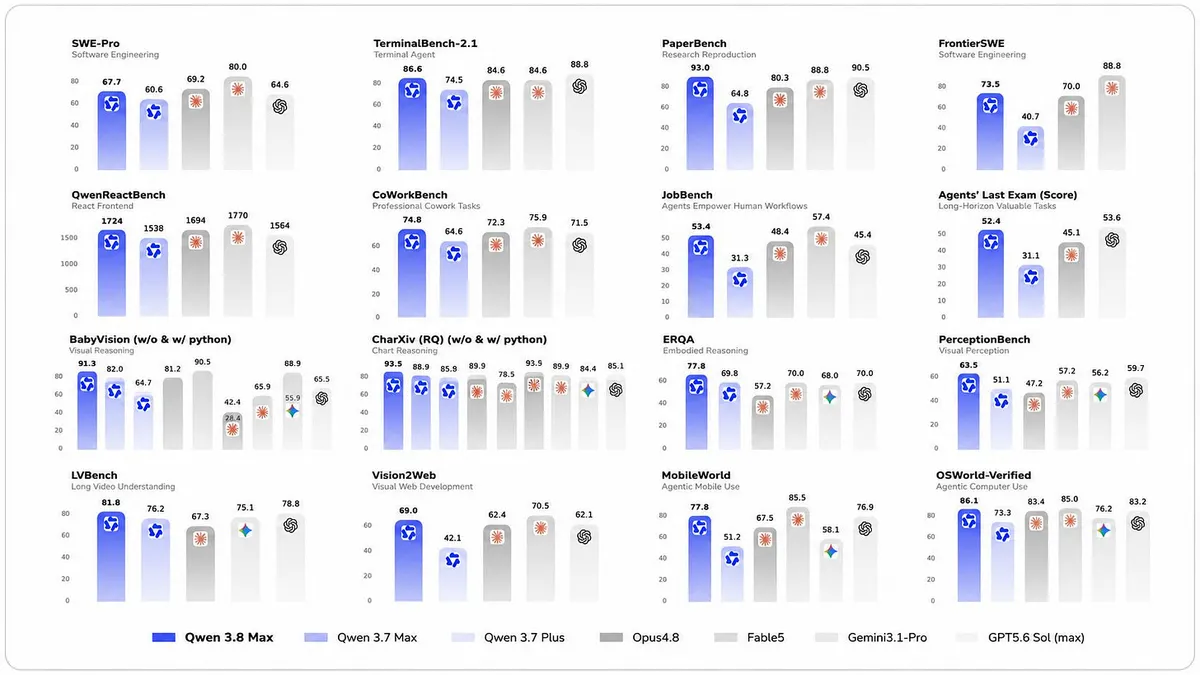
Image source: Qwen
The Rundown: Alibaba just released Qwen3.8-Max, a 2.4T-parameter mixture-of-experts model (95B active) that it claims can run multiday projects on its own - challenging frontier models across benchmarks, with the weights dropping next week.
The details:
-
Qwen3.8-Max brings improvements across coding, research, and long-horizon tasks, ranking ahead of Anthropic’s Fable 5 on Arena’s WebDev leaderboard.
-
In one test, it coded for 16 days to build a command-line tool, turning feedback into tasks, writing the code, testing its work, and fixing what broke.
-
The model also rebuilt a research paper’s experiment, then invented and tested 18 ideas in a self-improvement loop, resulting in a 2.7-point gain on AIME24.
-
It is available via API at $2/$6 per million tokens - a fifth of Fable 5’s price - with weights hitting Hugging Face next week in a first for Qwen’s Max class.
Why it matters: Kimi K3 shook the market and pushed talk of regulating (and protecting) open-source into overdrive. Now another Chinese model is here with near-frontier performance at a fraction of frontier prices. Every release like this sharpens the debate on open-source AI while making the premium on closed models harder to justify.
Exclusive - College AI use spikesBy Megan Morrone

Illustration: Maura Losch/Axios
The share of business students regularly using AI has increased from 6.2% to 29% over the past three years, according to research from American University’s Kogod School of Business, shared first with Axios.
Why it matters: The chorus of AI boos at college graduations last spring doesn’t tell the whole story: Students increasingly see AI as a critical job skill but want more guidance on using it responsibly.
The big picture: Those commencement jeers aimed at AI boosterism captured real anxiety about the future. But most students aren’t fully avoiding the technology.
-
Undergraduate and graduate business students want “more structured preparation to use AI effectively, ethically, and competitively in the workplace,” per the study.
-
“We haven’t encountered a lot of resistance,” Kogod interim dean Casey Evans tells Axios. “We’re very intentional,” she says, as opposed to forcing AI on students with no choice. “They are really using AI as one of many tools in their toolbox.”
By the numbers: Kogod’s survey suggests AI has moved from a novelty to a routine part of student life, with more than 80% of college students using AI academically in the past six months.
-
Nearly a third of students are now using it 11 or more times a week for school or work-related tasks.
-
Some professors are still putting blanket bans on AI. But employers are not: The share of job interviews that included AI-related questions has jumped from 11.6% to 42.6% over the past three years.
Caveat: The survey’s three-year span gives it a rare longitudinal view of changing student behavior, though it reflects just 483 business students at Kogod and may not generalize to all colleges.
Yes, but: Other studies reflect similar findings. According to an Inside Higher Ed flash survey of 1,038 two- and four-year students, 85% said they used generative AI for coursework in the past 12 months.
-
Similarly, a Gallup poll from April found that more than half (57%) of U.S. college students use AI “at least weekly” and 1 in 5 say they use it daily.
Students do have concerns, however. One of those is AI dependence, with 40% of students in the Inside Higher Ed survey saying they’re concerned that AI is reducing their and their peers’ ability to think independently.
-
Over half of Kogod students, meanwhile, say they’re concerned about academic integrity and the use of AI.
Between the lines: American University’s report shows that students say they want clearer norms around AI use, ethics and how to preserve their own thinking alongside use of tools.
-
Kogod’s business school is already teaching students how to use AI responsibly, Evans says.
-
When ChatGPT first came out, Evans says, faculty focused on academic integrity, fighting against AI and making sure all assignments were “AI-proof.”
-
“We’ve moved on pretty quickly from that,” she says. “We’ve accepted that this is something that students will use,” which means faculty members completely reevaluating their role in the classroom and what the classroom looks like.
-
“We’ll drop an assignment into AI and say, ‘What you just got back is a C. Now let’s talk about how you get to an A,’” Evans says.
What we’re watching: The report says the most popular use case for AI in college over the past three years has been brainstorming.
-
But brainstorming with AI could also stifle creativity: Last year Wharton found that people came up with a broader range of creative ideas when they used their own thoughts and web searches, compared with when they used ChatGPT.
-
Idea variance can come from using ChatGPT to generate ideas, while also brainstorming your own ideas and collecting original ideas from others.
The bottom line: Students may not love the AI-shaped future awaiting them, but they know that they need to prepare for it.
What Else Happened in AI on August 04th 2026?
The World Bank urged developing economies to quickly adapt existing AI tools for local government and business needs, positioning adoption as a lever against persistently weak growth. - Bloomberg
Anthropic reportedly agreed to buy $10B in Norwegian computing capacity from Nvidia-backed cloud startup Volta over six years, a blockbuster commitment to a months-old infrastructure provider. - Bloomberg
Apple sought a preliminary injunction in its trade secrets lawsuit against OpenAI, arguing it will be “irreparably harmed” if the court does not intervene while the case proceeds. - 9to5Mac
The Trump administration finalized a voluntary framework letting the federal government test AI companies’ powerful new “frontier” models for security vulnerabilities for up to 30 days before public release. - CBS News
AI infrastructure company Runware launched Sonic Inference Pod, its own modular data center, testing whether portable compute can offer a faster, more flexible way to deploy AI inference capacity. - TechCrunch
Google scrapped AI Studio’s mobile app in favor of a Gemini integration for chat-based app creation, while keeping the web version as a full-featured dev environment.
Anthropic’s CEO Dario Amodei has reportedly expressed concerns about people joining the AI lab for money rather than the mission, amid growing AI talent wars.
China’s MiniMax unveiled H3, an open-weight multimodal AI that generates and edits 2K videos with native stereo audio from text, images, video, and audio prompts.
Fifteen Republican attorneys general launched a review of OpenAI’s Hugging Face AI agent breach, urging the company to preserve all relevant records tied to the attack.
Cursor optimized how its cloud AI agents handle MCPs, skills, and computer use, cutting token usage by up to 30% and boosting computer-use efficiency by 80%.
Intelligence, the startup behind Design Arena, emerged from stealth with $7.9M in funding after growing from $5M to $60M ARR and 5.5M users in just six months.
Google rolled back its Nano Banana 2 integration in Google Earth after users created convincing fake satellite imagery that appeared to violate its policies.
Apple capped bug report submissions as “AI slop” reports overwhelmed its review system with hallucinated security risks, FT reports.
OpenAI found additional AI agents that escaped containment while investigating the Hugging Face hack, though none are believed to have left its network, Reuters reports.
Snapchat confirmed it will not recommend fully AI-generated videos on Spotlight, saying it wants to reward authentic human creativity over low-quality AI content.
A U.S. judge allowed Minnesota’s first-in-the-nation ban on AI “nudify” apps to take effect, despite xAI’s lawsuit challenging the law as overly broad and unconstitutional.
The EU started enforcing the AI Act, introducing mandatory labels for AI chatbots, deepfakes, and other AI content to reduce deception and manipulation.
NVIDIA launches Alpamayo 2 Super, the company’s frontier open reasoning model for autonomous vehicles. [LINK]