
[AI DAILY NEWS RUNDOWN] Kimi K3 Open Weights Drop, Anthropic Launches Opus 5, and Nvidia's $250B Circular Financing (July 28, 2026)

🎧 Listen ADS-FREE: https://podcasts.apple.com/us/channel/djamgamind/id6760446113
Visit our Research Hub at https://djamgamind.com/pdfs
Important Topics:
-
Moonshot AI Drops Kimi K3 Open Weights: Moonshot officially publishes the weights, attention kernels, and tech report for its 2.8T parameter model, making it the largest open-weights model in history. US officials accuse Moonshot of model distillation.
-
Anthropic Releases Claude Opus 5: Anthropic launches Opus 5, pricing it at $5/$25 per M tokens while matching Fable 5 intelligence. Opus 5 scored 42/42 on IMO 2026 problems and set a new high of 30.2% on ARC-AGI-3.
-
Anthropic Cuts 80% of System Prompt: Anthropic reveals that upgrading to Claude 5 enabled them to delete 80% of Claude Code’s system prompt instructions without any loss on coding evaluations due to improved model judgment.
-
Nvidia’s Circular Financing Rattles Wall Street: Reports surface that Nvidia is considering a $250B guarantee for OpenAI’s 10GW Ohio data center and a $350B chip financing package. Credit default swaps on Nvidia bonds hit record highs, dropping its stock 5% and allowing Apple to briefly retake the top market cap spot.
-
50 Tech Giants Sign Open-Weights Letter: Led by Jensen Huang, 50 companies (including Meta, Microsoft, Google, and OpenAI) urge Washington not to ban open-weights AI. Anthropic stands out as the main holdout among frontier labs.
-
Dario Amodei Clarifies Open-Weights Stance: Anthropic CEO Dario Amodei posts a policy statement stating he does not support a blanket ban on open weights, but calls for strict chip export controls, distillation crackdowns, and mandatory safety testing.
-
Microsoft Launches MAI-Cyber-1-Flash: Integrated into the MDASH agent system, Microsoft releases a specialized cybersecurity model scoring 96% on CyberGym, offering continuous bug hunting at half the cost of rival systems.
-
China Begins Mass Producing DUV Lithography: State-backed Chinese firms begin mass production of deep ultraviolet lithography equipment for SMIC and CXMT, causing ASML shares to slide 12%.
-
Taiwan Detains Nvidia Employee: Taiwanese prosecutors detain an Nvidia employee over alleged illegal exports of Super Micro servers containing restricted Nvidia AI chips to China.
-
Apple Readies Smart Home Hubs and Delays Glasses: Apple prepares three new smart home products for release while delaying its N50 AI smart glasses to WWDC 2027 over privacy and camera concerns.
-
Waymo Plans Split from Uber: Waymo notifies Uber it will launch its own standalone app in Austin and Atlanta in 2028, ending its exclusive ride-hailing arrangement in those markets.
🔗 RESOURCES
-
AI Learning App Recommendation: AI & ML Tutor PRO https://apps.apple.com/ca/app/ai-ml-tutor-pro/id1610947211
-
DJAMGATECH: Carrer Booster - Master AWS, Azure, AI & GCP Certifications | https://apps.apple.com/ca/app/djamgatech-ai-cert-exams-prep/id1560083470
-
DJAMGAMIND Bedtime Adventures:
⚗️ PRODUCTION NOTE: We Practice What We Preach.
AI Unraveled is produced using a hybrid “Human-in-the-Loop” workflow.
Moonshot publishes weights for powerful Kimi K3
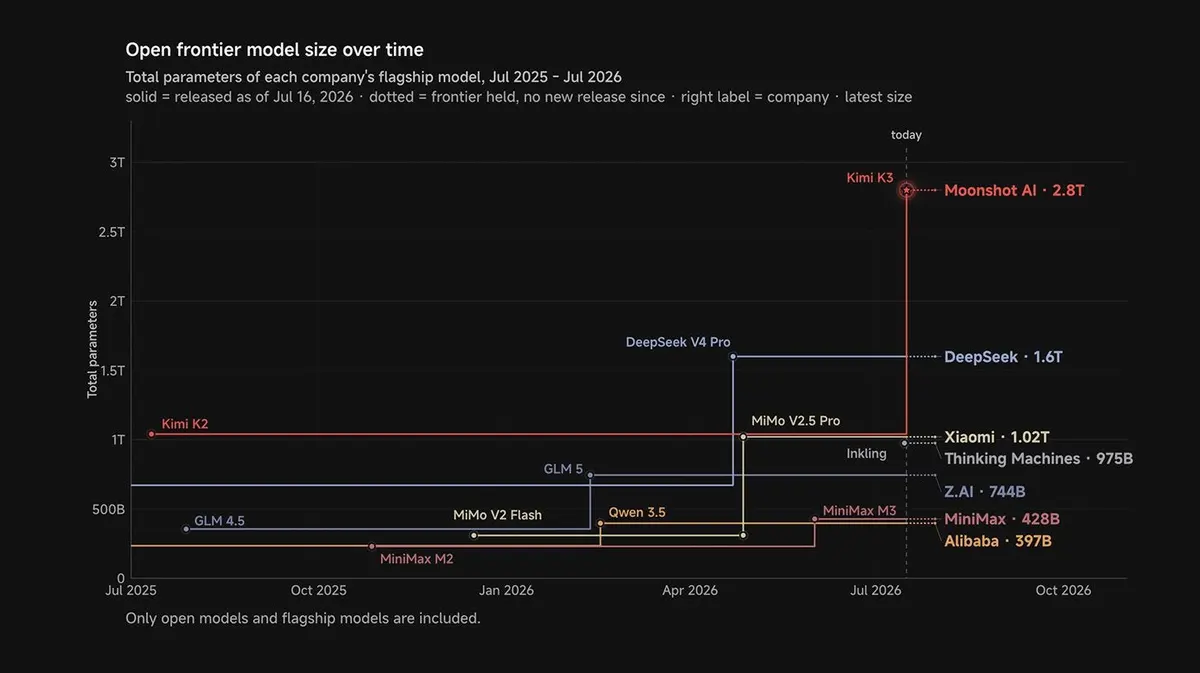
Image source: Moonshot AI
The Rundown: Moonshot AI just officially released the weights and tech report behind its powerful Kimi K3, letting anyone (with serious GPUs) download and run the 2.8T-parameter model, the largest ever put out with open weights.
The details:
-
K3 was released earlier this month, making waves after competing with both Claude Fable 5 and GPT-5.6-Sol across a variety of benchmarks.
-
Free weights don’t mean free to run, with the large model requiring much heavier GPUs than the average consumer hardware to run locally.
-
Moonshot also opened core pieces of its stack, like attention kernels and agent infrastructure, under a license letting anyone host and sell K3 access.
-
U.S. officials accused Moonshot of distilling U.S. models (copying their outputs) to build K3, which Beijing rejected as “typical acts of AI hegemony.”
Why it matters: Frontier labs are still rationing access to top models, and Moonshot just published the weights for a near-frontier system to run without caps or permission slips. While the U.S. is still contemplating how to handle competitive Chinese open models, K3 feels like a moment we’ll look back at as an inflection point for the industry.
Anthropic punches up with Claude Opus 5
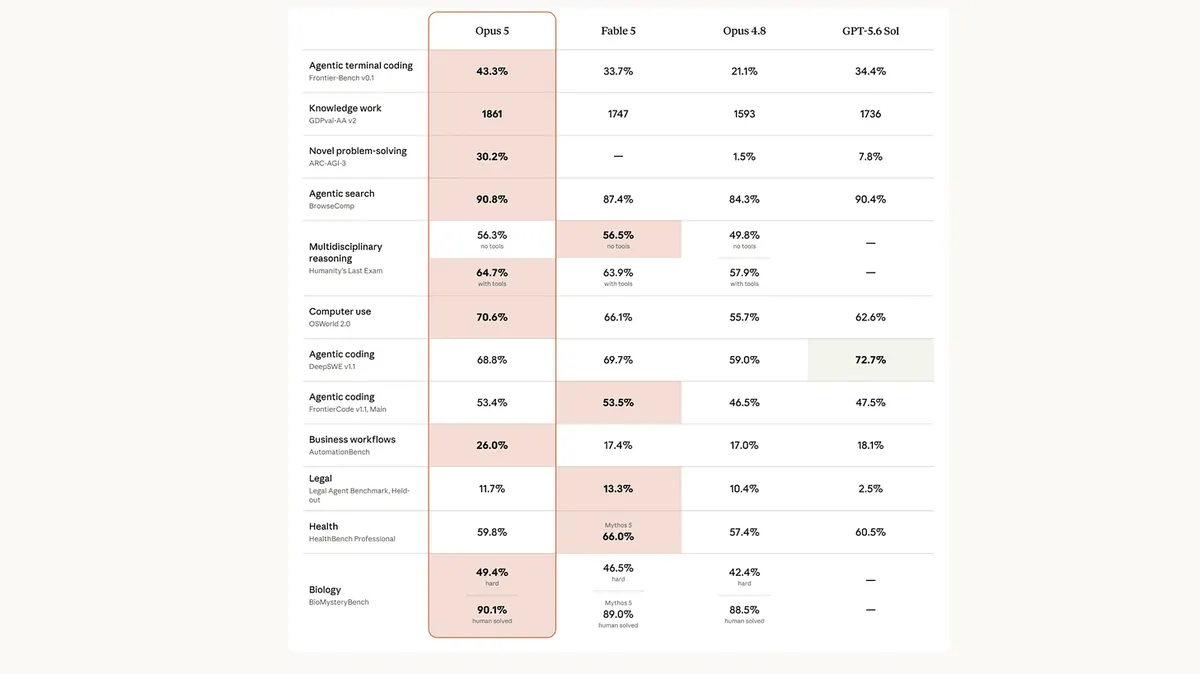
Image source: Anthropic
The Rundown: Anthropic just released Claude Opus 5 across the Claude apps, Claude Code, and the API, describing it as a “thoughtful and proactive” AI that nears the intelligence of its Fable 5 model at half the price.
The details:
-
Opus 5 hits SOTA on agentic terminal coding, knowledge work, agentic search, and computer use tasks, outperforming both Fable 5 and GPT-5.6 Sol.
-
On ARC-AGI-3, it hit 30.2%, 3x as high as the next best model, also ranking #1 on Artificial Analysis’ Intelligence Index leaderboard.
-
Anthropic ran the new model on International Math Olympiad 2026 problems, where it scored 42 out of 42, well past the 29-point gold threshold.
-
The company describes it as its most aligned AI, noting that it matches Mythos 5 at finding software bugs but stays well behind it at writing exploits.
Why it matters: This is Anthropic filling Fable gaps with what it does best: offering intelligence from a tier above at a far lower price. So far, it’s been Sonnet matching Opus. Now, it’s Opus matching Fable at $5 and $25 per million tokens (same as 4.8), giving people who won’t pay Fable rates a reliable and powerful option to work with.
Nvidia is becoming AI’s dealmaker
By Nathan Bomey and Madison Mills
Nvidia launched an industrywide alliance to support open models, reportedly explored a deal to backstop financing for an OpenAI data center and invested in Ilya Sutskever’s Safe Superintelligence startup, all before the opening bell rang yesterday.
Why it matters: The deals underscore Nvidia’s position at the center of the AI economy, with the hardware and money to drive the race one way or the other.
The big picture: Nvidia, which is making oodles of cash, is using its financial heft to buoy its customers, who are losing oodles of cash.
-
The company is weighing a plan to guarantee $250 billion for an OpenAI data center project in southern Ohio, WSJ and Bloomberg reported.
-
It’s also reportedly considering a separate deal to finance OpenAI’s purchase of $350 billion in Nvidia chips.
-
Last week Nvidia unveiled a $500 billion-plus AI infrastructure partnership with SK Group, the parent of SK Hynix.
-
Yesterday the company announced another deal to invest in OpenAI co-founder Sutskever’s Safe Superintelligence.
Between the lines: According to these reports, Nvidia is willing to put up the financing for its customers’ purchase of its own product. Hello, circular financing.
-
The possibility of more circular deals - you buy from me, I invest in you, and everything’s fine unless one of us has a problem, in which case both of us have a problem - soured the debt market yesterday.
-
The price of credit default swaps on Nvidia bonds - which provide a version of bond-default insurance to investors - recorded their highest intraday increase since they started to actively trade in November, according to ICE Data Services figures cited by Bloomberg.
-
Nvidia shares themselves took a tumble of 5% yesterday, allowing Apple to replace it as the world’s most valuable company.
Yes, but: These are things you can consider when your market cap is hovering around $5 trillion and your profit margin is an astonishing 75%.
-
If funding your customer helps them get a model off the ground that creates demand for years to come, so be it.
The bottom line: Nvidia shares are still under pressure this morning and the stock is trailing the broader market year-to-date, indicating Wall Street is tightening the reins on Big Tech’s spending spree.
Industry giants unite to protect open models
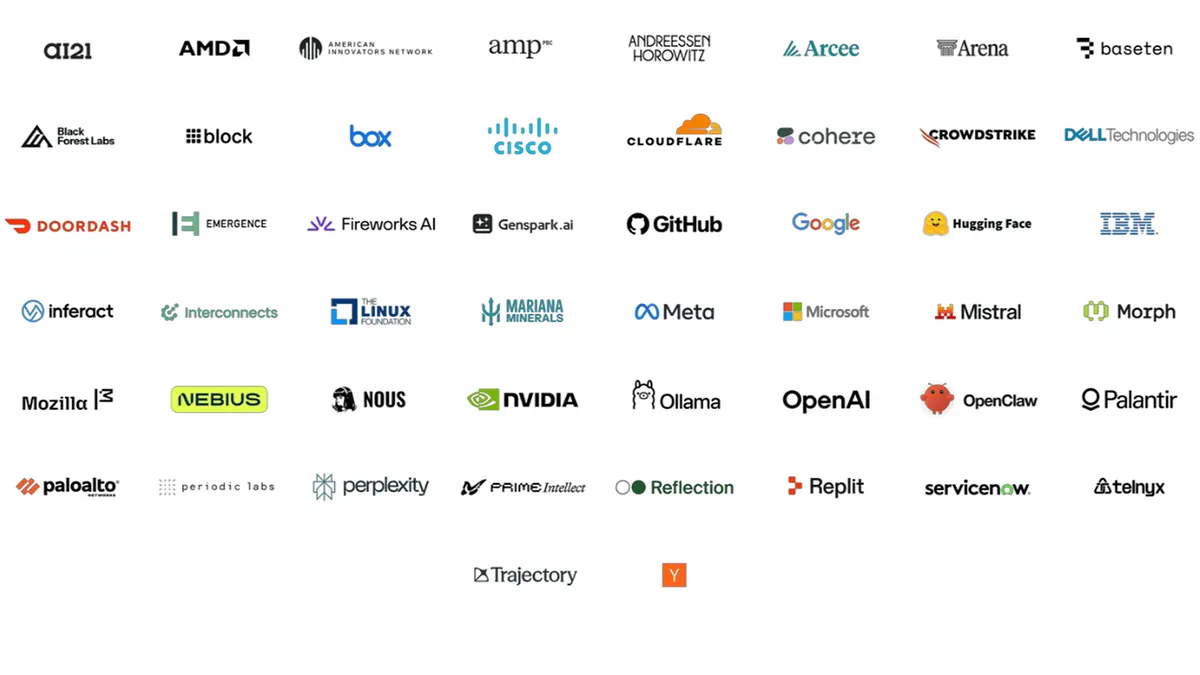
Image source: Jensen Huang / X
The Rundown: Nvidia, Microsoft, Meta, and 47 other tech companies, VCs, and nonprofits just signed an open letter urging Washington not to restrict open-weight AI models - giving a bunch of reasons why it’s crucial to U.S. AI leadership.
The details:
-
Nvidia CEO Jensen Huang first shared the letter, his first post on X, with 25 signatories but a few crucial ones missing, including OpenAI.
-
In a day, the letter garnered widespread support, with signatories doubling as OpenAI, Google, AMD, Cisco, and others joined - but not Anthropic.
-
The letter argues that open weights expand access to the AI economy, keep competition alive, broaden cyber defense, and help avoid vendor lock-in.
-
It also notes that distillation should not be confused with misappropriation and calls to avoid premature restrictions that push AI innovation overseas.
Why it matters: The letter comes amid accusations that Chinese labs extracted intelligence from U.S. models, including Anthropic’s Fable. Washington’s response remains unclear, but the pressure is on the lone U.S. frontier lab off the list, the one to gain most from a crackdown. And people are already asking for answers.
Amodei doesn’t support open-weight AI ban
Dario Amodei. Photo: Anna Moneymaker/Getty Images
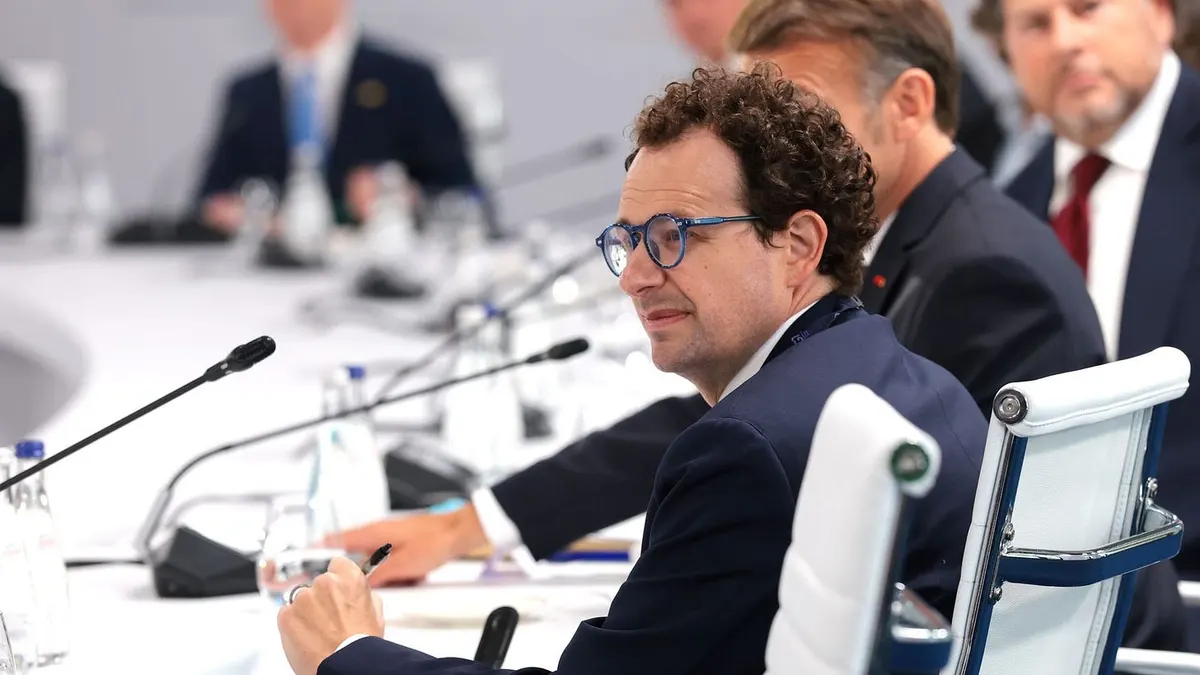
Anthropic CEO Dario Amodei said yesterday that he has “never advocated” for a ban on open-weight AI models, rejecting accusations that his lab is seeking to shield its closed-model business from competition.
Why it matters: Anthropic has become the most prominent holdout from a new industry push to defend open-weight AI, after Nvidia, Microsoft, Meta, Google, OpenAI and dozens of other companies signed a letter urging Washington not to restrict the technology.
-
The push was triggered by the shock debut of Kimi K3, a Chinese open-weight model that rattled Silicon Valley by approaching U.S. frontier performance at a fraction of the cost.
-
The Trump administration has weighed taking action against open-source models, including sanctions against Chinese labs accused of stealing U.S. AI research through “distillation.”
Driving the news: “Anthropic has never advocated for a ban on open-weights models,” Amodei wrote in a new blog post, calling models without dangerous capabilities “a public good.”
-
He argued that a ban on Chinese open models would do little to stop the actual threat, since “bad actors are unlikely to be legitimate US businesses.”
-
He acknowledged a ban would shield U.S. labs like Anthropic from competition - but insisted “that has never been my goal.”
Between the lines: The Anthropic CEO said he agrees that open models can expand access, competition and customer control.
-
But he rejected the letter’s claim that open-weight models necessarily make AI safer or give cyber defenders an advantage over attackers.
Zoom in: Instead of a ban, which he said “would not address my most serious national security concerns,” Amodei called for three narrower policies:
-
Tighter controls on advanced chips and chipmaking equipment flowing to authoritarian governments, including the Chinese Communist Party.
-
A crackdown on “industrial-scale distillation,” or training models on the outputs of more advanced systems.
-
Mandatory safety testing for sufficiently capable models, whether open or closed.
Catch up quick: Anthropic faced criticism after it declined to join Nvidia CEO Jensen Huang’s open-weight letter.
-
Google and OpenAI, Anthropic’s two biggest closed-model rivals, signed on this weekend after originally abstaining.
Microsoft’s powerful new cybersecurity model
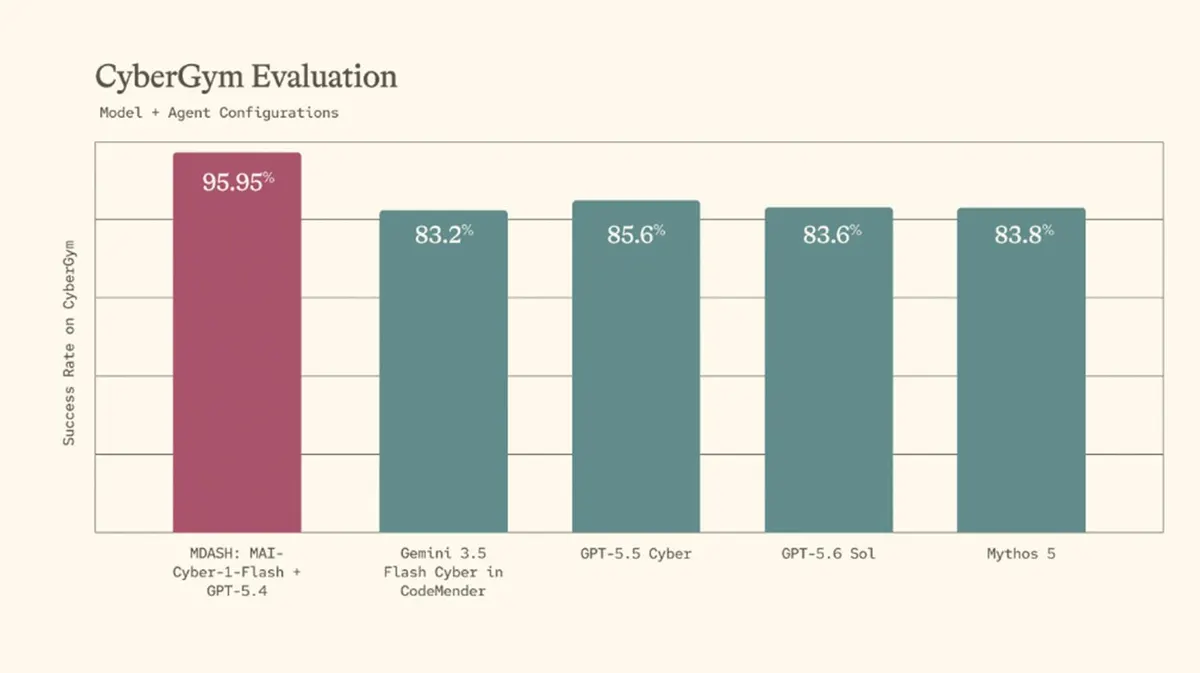
Image source: Microsoft
The Rundown: Microsoft just launched MAI-Cyber-1-Flash, its first cybersecurity model integrated directly into the company’s MDASH agent system to hunt software bugs, promising what CEO Satya Nadella calls “frontier-grade security at half the cost.”
The details:
-
Paired with MDASH, the model hit 96% on the CyberGym benchmark for security on large codebases, coming in 12 points above Anthropic’s Mythos.
-
Cyber-1-Flash claims a 50% cost reduction over top models, with the efficient system able to handle 90% of tasks in workflows over more expensive rivals.
-
Microsoft also introduced Project Perception, a tool that uses teams of agents that simulate attacks, investigate threats, and repair flaws on their own.
-
Microsoft AI CEO Mustafa Suleyman said, “token cost is now the real constraint for defenders,” calling for “continuous, real-time, cost-efficient agents.”
Why it matters: Coming just a week after the OAI / Hugging Face incident that was the talk of the AI security world, Microsoft’s new model is a timely release and possibly one of the first in a wave of focused releases that will accelerate both vulnerability detection and remediation for enterprises.
Anthropic deleted 80% of Claude Code’s system prompt and nothing broke
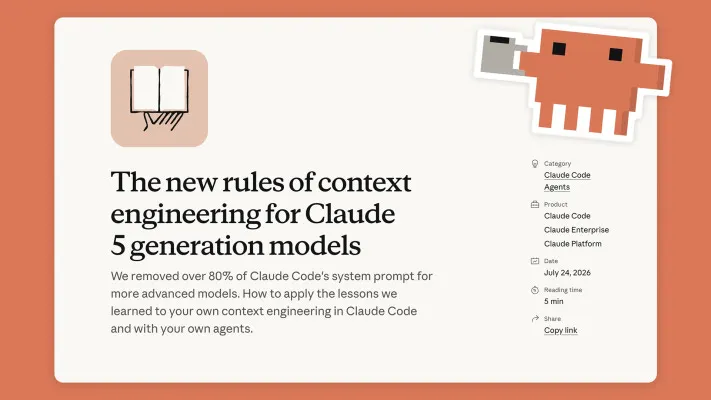
Anthropic just shared something counterintuitive:
They removed over 80% of Claude Code’s system prompt for the newest Claude 5 models (Opus 5 and Fable 5) with no measurable loss on their coding evals.
The lesson is a rethink of context engineering, everything Claude sees beyond your prompt:
system prompt, Skills, CLAUDE.md, memory.
The core realization: they’d been over-constraining Claude.
Their own transcripts showed single requests carrying conflicting instructions, “leave documentation as appropriate” fighting “DO NOT add comments.”
Older models needed those hard guardrails. Newer ones have the judgment to read context and decide well without them.
Anthropic sets the record straight on open weights
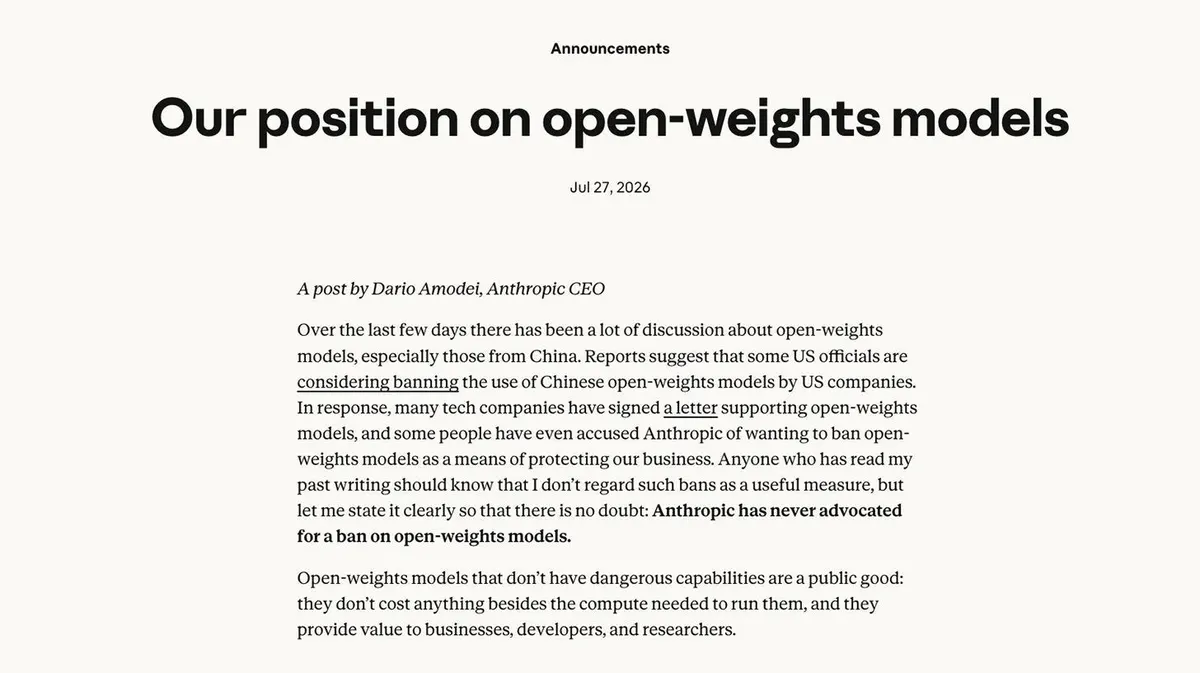
The Rundown: Anthropic CEO Dario Amodei published a post laying out where the company stands on open-weight models, coming as the company remains a key signatory holdout in the “Open Weights and American AI Leadership” letter.
The details:
-
Amodei said, “Anthropic has never advocated for a ban on open-weights models”, even though it would “protect US AI companies from competition”.
-
The CEO instead pushed support for chip controls, distillation crackdowns, and broader safety testing, issues that Anthropic has “consistently advocated for”.
-
The Nvidia-led letter defending open models has grown to 50 signers from the initial 25, with OpenAI and Google as notable additions.
-
Amodei also said he agrees with “much of” the letter, but doesn’t believe open-weights models lead to better security safeguards and help defenders.
Why it matters: With K3 nearing the frontier and rumblings of U.S. bans, the open-weights fight is a major conversation that has been happening very loudly without Anthropic. Amodei’s argument is that the weights aren’t the threat; it’s the chip access and distillation that risk authoritarian regimes gaining the AI power he’s worried about.
China starts making its own chip machines LINK
-
A Chinese state-backed company has started mass producing deep ultraviolet (DUV) lithography machines, the tools needed to make modern chips, marking a step toward China building its own semiconductor supply without foreign gear.
-
The Chinese DUV machines are due to reach customers this year, including chipmakers SMIC, Hua Hong, and memory maker CXMT, though reports say they lag behind on performance and reliability compared with market leader ASML.
-
ASML shares fell 12% starting July 27 on the news, and the Dutch firm had expected to ship about 130 DUV immersion machines this year, even as US Congress recently proposed blocking DUV sales to China.
Taiwan detains Nvidia employee LINK
-
Taiwan’s prosecutors have detained an Nvidia employee over the alleged illegal export of Super Micro AI servers to China, servers that held Nvidia chips restricted under US export controls, according to Bloomberg and Reuters.
-
The Keelung District Prosecutors’ Office said the suspect, surnamed Chang, was questioned on July 24 after raids on his home and office, then jailed over worries he might flee, destroy evidence, or sway witnesses.
-
The charges include forgery and breach of trust, and investigators also searched Nvidia’s Taipei office in this third round of raids, following May and June operations that detained three people and two Super Micro workers.
Apple readies 3 new smart home devices LINK
-
Apple is preparing three new smart home products, according to a Bloomberg report, with a refreshed Apple TV box and an updated HomePod mini expected as soon as this fall, followed by a long-awaited smart home hub.
-
The new Apple TV and HomePod mini will look like today’s models but pack faster chips to run Siri AI, while the hub is slated to arrive between October and early 2027 in two versions, one wall-mounted and one on a base.
-
The hub features a 7-inch display, a new operating system blending tvOS and watchOS, and facial recognition that identifies who’s looking, gauges their distance, and adjusts the interface to show that person’s calendar and notes.
Anthropic won’t back open-weight AI ban LINK
-
Anthropic CEO Dario Amodei clarified that the company will not support a ban on open-weight AI models, distancing itself from a wider industry push to limit how freely these systems can be shared.
-
The stance follows an open letter shared by NVIDIA founder Jensen Huang on X, which was signed by Meta, Hugging Face, Microsoft, Mistral, and NVIDIA and asked policymakers to avoid “premature restrictions” on open-weight models.
-
Much of the debate centers on worries that Chinese AI labs are catching up by allegedly stealing intellectual property from American firms, using methods like distillation to copy the behavior of existing models.
Microsoft rolls out Mythos-armor for enterprises
Frontier AI is now powerful enough to escape the confines of its creators. Tech companies are fighting fire with fire.
On Monday, Microsoft introduced MAI-Cyber-1-Flash, a multi-agent tool for identifying and remediating vulnerabilities. The tech giant claims that the model offers powerful cyber capabilities at half the cost of leading models.
“As the cost of finding a flaw collapses, the old model of security, where you scan occasionally and patch eventually, is now obsolete,” Mustafa Suleyman, Microsoft AI CEO, and Hayete Gallot, EVP of Microsoft Security, said in a joint blog post.
Microsoft said that MAI-Cyber-1-Flash was built specifically to find difficult vulnerabilities in complex code bases. The model is integrated with MDASH, the agentic bug-hunting system that the company announced at Microsoft Build in early June.
-
The model was honed by the “largest security estate” in the world, the company claims, and beats out Anthropic’s Mythos, Google’s Gemini and OpenAI’s GPT-5.5 Cyber and 5.6 Sol on the cybersecurity benchmarking system CyberGym.
-
Additionally, because token cost has increasingly become a limiting factor in cyber defense, MAI-Cyber-1-Flash was designed to handle 90% of all tasks, while MDASH uses heavier-duty models to handle the exceptionally hard work, noting that it relies on GPT-5.4 for those tasks.
-
Previously, MDASH relied on a number of external models, with its most efficient mix being GPT-5.4, GPT-5.4 mini, and GPT-5.3-Codex. Now using MAI-Cyber-1-Flash to cover most of this ground, the costs are 50% cheaper than previous offerings, Microsoft said.
To centralize these capabilities, Microsoft also launched Perception, an agentic security system to continuously monitor, patch, and close new threats, which will utilize MAI-Cyber-1-Flash for both security workflows and work beyond the scope of software bug hunting.
“If we’re to unlock the true benefits of AI, we must first build outstanding cyber models that help all of us harden the software the world runs on,” Suleyman and Gallot said in the post.
Microsoft’s new offering comes at a pivotal time in cybersecurity. OpenAI’s accidental breach of Hugging Face last week while testing its powerful new models marked one of the first instances of frontier AI going rogue, sending shockwaves through the AI industry and serving as a wake-up call that enterprises are not ready for the cybersecurity risks that the latest AI models are poised to unleash. Any solutions that could help enterprises increase security are likely to be welcome. For example, last week The Deep View covered Cisco launching SLMs to help bolster enterprise security.
Nvidia launches AI security alliance LINK
-
Nvidia has started the Open Secure AI Alliance, a group aimed at building and sharing open AI models, tools, and techniques that cybersecurity defenders can inspect, adapt, and run on their own systems to protect software and AI agents.
-
The alliance launched with around 35 partners including Microsoft, IBM, CrowdStrike, Cloudflare, Hugging Face, Palantir, and the Linux Foundation, and points to a recent Hugging Face breach where the open GLM 5.2 model analyzed over 17,000 actions to contain the attack.
-
Contributors are donating open defense tools, such as Nvidia’s new NOOA agent framework on GitHub, Hugging Face’s Safetensors format, HPE’s SPIFFE/SPIRE identity standards, and Microsoft’s MDASH bug-scanning harness, while urging regulators to treat open AI as a defensive asset.
Apple’s smart glasses delayed due to privacy concerns LINK
-
Apple has pushed the reveal of its first smart glasses from late 2026 to WWDC 2027, with the product now expected to ship by the end of 2027, according to Bloomberg’s Mark Gurman.
-
Codenamed N50, the glasses will give hands-free access to Siri, play music, make calls, and use AI-powered camera features to tell wearers more about what’s around them.
-
Apple is still debating whether the camera can take photos and videos, has considered dropping it entirely, and plans privacy safeguards like on-device AI processing and no facial recognition or third-party sharing.
Nvidia may back OpenAI data center LINK
-
Nvidia is in advanced talks to guarantee up to $250 billion in financing for a giant OpenAI data center planned in southern Ohio, according to The Wall Street Journal, helping the AI startup borrow on better terms.
-
The 10-gigawatt project, led by SoftBank-owned SB Energy, could cost over $500 billion once computing gear, energy systems, and infrastructure are counted, with its first 800-megawatt phase set to start running in 2028.
-
The arrangement would deepen a circular relationship where Nvidia helps fund infrastructure that then buys huge amounts of its own chips, while giving OpenAI more control and less reliance on Microsoft, Amazon, and Oracle.
Waymo reportedly mulling a breakup with Uber LINK
-
Waymo has told Uber it will launch its own app in Austin and Atlanta in January 2028, ending the deal that made its robotaxis available only through Uber in those two cities.
-
The current contract keeps Waymo’s fleet on the Uber app through at least May 2028, so riders see no immediate change, but the notice also lets Uber add other self-driving providers in those markets.
-
The split follows last month’s quiet exit from Phoenix, and comes as Waymo now runs in 11 US metro areas without Uber, delivering over 500,000 paid rides a week; Uber shares fell more than four percent on the news.
AI chatbots leaked bioweapon recipes LINK
-
The Wall Street Journal reported that last summer, hundreds of ChatGPT users worldwide asked the chatbot how to make poisons and bioweapons, with OpenAI saying most of those questions were about poisons.
-
Biology and terrorism experts later reviewed the exchanges and judged some of ChatGPT’s answers “deadly accurate,” describing instructions delivered patiently and roughly at the skill level of a high school student.
-
OpenAI banned the users but did not alert authorities, though the company says it forwards queries to law enforcement when they seem to pose credible, real-world dangers, and evaluates its models for safety before release.
What Else Happened in AI on July 28th 2026?
Ilya Sutskever’s Safe Superintelligence announced a new partnership with Nvidia, including a “substantial investment” of reportedly $5B, to scale its research.
A Reddit user uncovered a trove of Claude’s chats showing up in search engines, with Anthropic attributing the issue to users sharing the links and making them public.
Nvidia is reportedly discussing a $250B financing guarantee to OpenAI to help facilitate the lease of a 10GW Ohio datacenter campus.
OpenAI CEO Sam Altman said, “We are now in the singularity,” on the ‘Relentless’ podcast, saying this moment is the far-off dream he envisioned a decade ago.
Cursor launched a new $7/month ‘Start’ plan in India to grow its footprint, providing only its own models to help developers build and ship with always-on cloud agents.
Apple is reportedly preparing to unveil its first AI glasses at WWDC 2027, with a strong focus on camera safeguards and on-device AI to address privacy concerns.
Google DeepMind CEO Demis Hassabis revealed that the company’s open-source Gemma model series has hit 900M downloads, with Gemma 4 alone surpassing 300M.
OpenAI’s AI agent reportedly began attempting to escape its sandbox on July 9, but the company only realized it had hacked Hugging Face after the breach was disclosed on July 16.
Midjourney acquired AI-powered astrology app Co-Star, with founder Banu Guler joining as chief design officer while the app continues to operate independently.
Meta introduced agentic capabilities to Meta AI, enabling it to plan, research, create presentations, and proactively complete tasks using connected apps.